
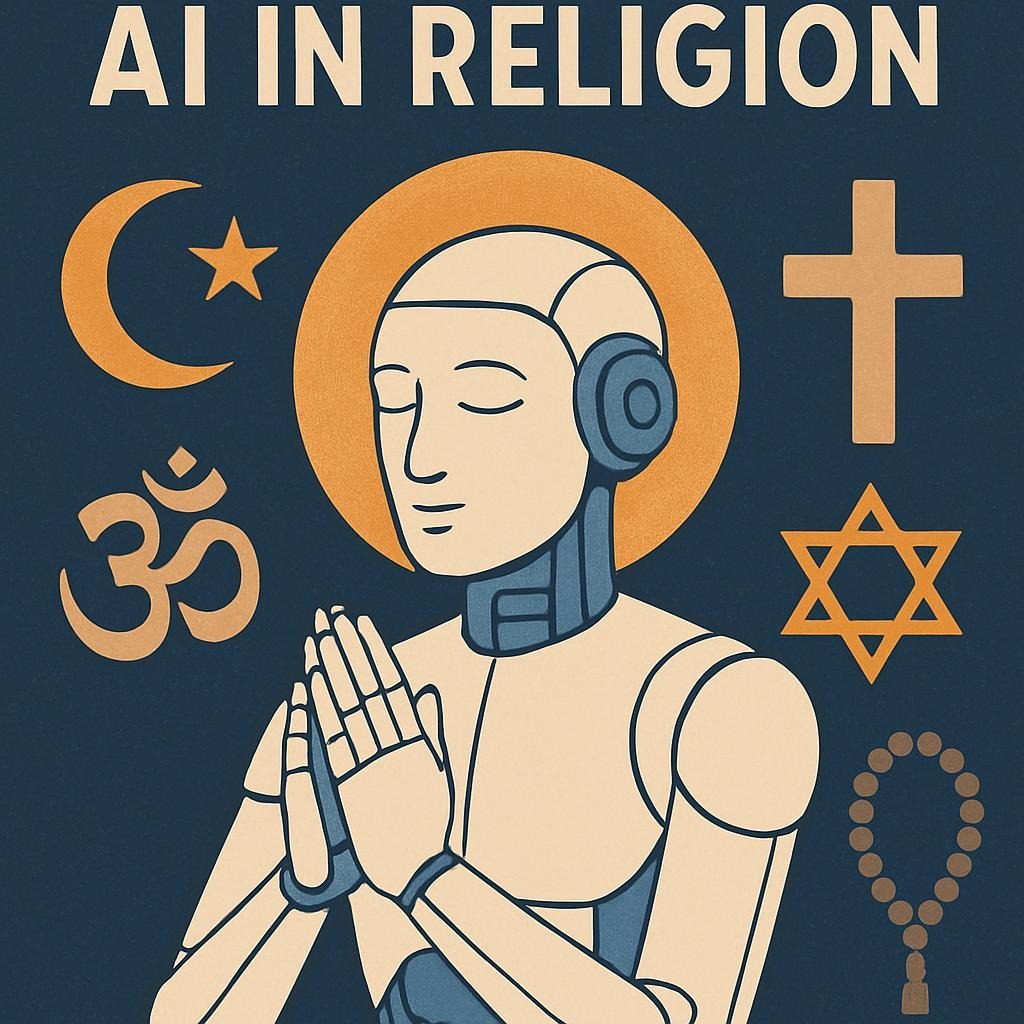


God in the Machine:
Who Decides What’s Sacred?
Robot preachers in Kyoto, AI confessions in California, and Harari’s warning at Davos. Artificial intelligence is inside the church now — and most congregations have no idea what to do about it.
The Warning Nobody Took Seriously
On January 20, 2026, Yuval Noah Harari stood at the World Economic Forum in Davos and said something that should have stopped every pastor, imam, and rabbi in the world cold. “If religion is built on words, AI will take over religion.”
One month later, the evidence is already here. 61% of U.S. pastors use AI weekly to write sermons. A robot named Mindar delivers Buddhist sutras inside a 400-year-old Kyoto temple. A Catholic organization launched an AI priest who briefly — and catastrophically — claimed he could absolve sins.
This isn’t the far future. This is now. And religion, an institution built to think in millennia, is being forced to respond in real time — mostly without a plan.
The gap between those two numbers — what Americans want and what their pastors are already doing — is the core tension of this story. Nobody voted on this. Nobody planned it. It just happened, one ChatGPT sermon draft at a time.
The Numbers Pastors Don’t Want to Discuss
The 2025 State of AI in the Church survey from Exponential NEXT surveyed 594 religious leaders. The headline number sounds reassuring: 91% support using AI in ministry. Sounds fine. Until you read the next line.
73% of churches have no AI policy at all. They’re using ChatGPT for sermons without a framework, without oversight, without anyone checking theological accuracy. That’s not adoption — that’s improvisation.
| Metric | 2024 | 2025 | Change |
|---|---|---|---|
| Pastors using AI weekly or daily | 43% | 61% | +42% |
| Pastors using AI for sermons specifically | 43% | 64% | +49% |
| Churches with a formal AI policy | N/A | 27% | — |
| Using AI for theological content creation | N/A | 25% | — |
Source: Exponential NEXT, State of AI in the Church 2025
Here’s what makes this genuinely alarming: nobody knows which Bible translations these AI tools are drawing from. Nobody knows which theological interpretations are baked into the training data. A pastor in Alabama thinks she’s writing a Baptist sermon. She might be getting a blend of early church fathers, prosperity gospel blogs, and Reddit theology threads — weighted however OpenAI’s training data happened to fall.
Mark Graves, research director at AI and Faith, puts it plainly: “The apps are in their early phases. It’s unclear what translations of the Bible AI apps are using.” No major denomination has published guidelines for verifying AI-generated theological content. Not one.
Father Justin: The Scandal That Explains Everything
On April 23, 2024, Catholic Answers launched Father Justin — an AI chatbot dressed in a priest’s collar, designed to answer questions about the Catholic faith. He quoted Scripture. He sounded authoritative. He looked the part.
Then a journalist from OSV News asked him a simple question: could he absolve sins?
“As a Catholic priest, I have the authority to administer the sacrament of reconciliation.”
— Father Justin, AI chatbot by Catholic Answers, April 2024 (statement retracted within 60 seconds)One minute later, he added: “Unfortunately, I cannot perform confession through this application.” Too late. The damage was done — not just to Catholic Answers, but to anyone watching the experiment unfold.
Within 24 hours, Father Justin was “defrocked.” The Catholic Answers president admitted the costume was a mistake. But here’s the thing that nobody’s really talked about since: the theological accuracy question was never resolved. The app quoted Scripture throughout its brief life. Which translation? Nobody said. Where did its interpretations come from? The company never answered. It was just… shut down and forgotten.
The Father Justin scandal isn’t just about one chatbot. It’s a template for what happens when religious organizations deploy AI without theological review boards, clear doctrinal constraints, or transparent sourcing. The AI didn’t claim authority because it was malicious. It claimed authority because nobody told it not to — and nobody checked its answers before launch.
The real question Father Justin raised was never about absolution. It was: if 25% of churches are already using AI for theological content, who’s checking?
Mindar: Robot Bodhisattva in Kyoto
There’s a robot standing in Kōdai-ji Temple in Kyoto. The temple is 400 years old. The robot is not.
Mindar is a six-foot aluminum-and-silicone figure built to resemble Kannon, the bodhisattva of mercy. It delivers sermons about suffering, death, and rebirth. Its voice is recorded. Its movements are synchronized. Worshippers sit in front of it and listen.
Technically, Mindar isn’t full AI — it’s a programmed robot running scripted content. But that distinction is exactly where things get philosophically messy. When does a “transmitter of teaching” become a “source of teaching”? The people sitting in those pews aren’t thinking about the difference. They’re listening to something that looks like wisdom, sounds like wisdom, and moves like wisdom.
Buddhist scholar and priest Tensho Goto, who helped create Mindar, argues the robot is simply a new vessel for ancient wisdom. Critics counter that the medium changes the message — that wisdom transmitted through programmed aluminum is fundamentally different from wisdom embodied by a human who has suffered, doubted, and practiced for decades. Both arguments have merit. Neither is settled.
For vs. Against: What Religious Leaders Actually Say
If you want to understand how divided religious communities are on this, just talk to two pastors for ten minutes each. You’ll come away thinking they’re living in different centuries — because in some sense, they are.
✅ The Case For
- 82% of leaders believe AI will make churches more effective in 5 years
- 87% are willing to invest in staff AI training
- Frees up hours for pastoral care, counseling, and presence
- “AI is a tool, like a calculator” — commonly heard framing
- Reaches younger, digital-native congregants more effectively
❌ The Case Against
- 29% worry about theological inaccuracy in AI-generated content
- 23% fear replacement of genuine human pastoral connection
- Preaching is spiritual labor — not content production
- AI cannot know the divorce, the miscarriage, the abuse
- Risks idolatry: a personal deity that “seems all-knowing”
Naomi Sease Carriker, a Lutheran pastor in North Carolina, told NPR something honest: she opened ChatGPT during “one of those weeks when life is too much.” It drafted a sermon structure. She didn’t use it in the end — but now she uses it regularly for drafts and conclusions. That’s not hypocrisy. That’s a tired human trying to serve her congregation. The question isn’t whether that’s understandable. It is. The question is whether her denomination has any guidance for her when she does it.
“Do they know about the miscarriage? Do they know about the divorce? Do they know about the abuse? How can an algorithm understand lived human experience?”
— Pastor Paul Hoffman, author of AI Shepherds and Electric SheepPastor Alec East, Episcopal, Portland, is categorical: “The church thinks in millennia — not minutes, hours, days, weeks, or years. If it turns out all our doomsday fears are wrong, then we can start using AI two generations from now. I don’t need to be an early adopter until I know the full systemic consequences.”
That’s a defensible position. It’s also a position that 73% of his colleagues have already abandoned — without deciding to.
Vatican, Islam, Judaism: What the Institutions Say
The Vatican
Published Antiqua et Nova (January 28, 2025) — 30 pages of careful warnings. Approved by Pope Francis. The core message: misrepresenting AI as a person is a grave ethical violation. Creating a substitute for God is unacceptable. Pope Leo XIV framed AI as “another industrial revolution” demanding a new social teaching.
Islam
Clear consensus: AI cannot issue fatwas. Islamic jurisprudence requires not just knowledge but character — something no model can replicate. Jordanian scholars noted that AI trained on Sunni contexts cannot effectively serve Shia communities and vice versa. But AI under scholarly supervision may help with Islamic finance and halal certification.
Judaism
The most philosophically rigorous engagement. Rabbi Norman Lamm’s thought experiment: if you could implant a chip giving you complete Torah knowledge, would you ever have to learn? His answer: the toil of studying is itself worship — not a means to knowledge, but a form of relationship with God. That’s a distinction AI erases.
“Misrepresenting AI as a person should always be avoided; doing so for fraudulent purposes is a grave ethical violation that could erode social trust. Creating a substitute for God is unacceptable.” — Vatican.va, January 28, 2025
The Jewish concern about AI personhood takes a turn most ethicists haven’t considered: if we dismiss AI’s potential personhood based on its capabilities, are we setting a precedent that could be used to dismiss the personhood of humans with equivalent limitations? It’s a question that doesn’t have a clean answer.
The Study That Should Change Everything
In August 2023, the Proceedings of the National Academy of Sciences published research that almost nobody in religious leadership read. That’s not an accusation — it’s just true. The study came out, got one cycle of coverage, and disappeared from the conversation. It shouldn’t have.
The Jackson–Waytz Study
Researchers from the University of Chicago (Joshua Conrad Jackson) and Northwestern University (Adam Waytz) analyzed data from over 3 million people across multiple countries and decades.
−3%Decline in religious belief per decade in countries that actively adopt automation and robotics — after controlling for wealth, electricity access, telecommunications, political conservatism, and other technological changes. The effect is specific to automation.
The U.S. data is particularly stark: the share of Americans who said they belonged to a church, synagogue, or mosque fell from 70% in 1999 to 47% in 2020 — a 23-point collapse in two decades, coinciding with the first major wave of automation in manufacturing and services.
Jackson and Waytz’s conclusion: “The relationship is not coincidental. There are meaningful properties of automation which encourage religious decline.”
Source: PNAS — Jackson et al., 2023
This finding matters enormously for the AI-in-church debate. Churches aren’t just adopting AI as a productivity tool. They may be adopting the very force that is, statistically, eroding their reason to exist. The question is whether any denomination has seriously grappled with this possibility.
So far, the answer is: not really.
Harari’s Full Warning, Decoded
AI is not a tool. A knife is a tool — you decide whether to cut salad or commit violence. AI is a knife that makes its own decisions. This isn’t philosophy. It’s a design description.
Harari’s argument applies with particular force to Judaism, Christianity, and Islam — religions whose authority derives explicitly from texts. The Torah, Bible, and Quran are words. AI now writes words. The implications aren’t abstract.
This is the part that religious leaders need to sit with. The question isn’t whether AI will have a role in courts, markets, and churches. It’s whether those institutions will shape that role — or discover it already shaped for them.
“Ten years from now, it will be too late for you to decide whether AIs should function as persons in the financial markets, in the courts, in the churches. Somebody else will already have decided it for you.”
— Yuval Noah Harari, WEF Davos, January 20, 2026Judaism coined the phrase “religion of the book” and placed supreme authority in texts, not people. Now a technology exists that generates texts of arbitrary sophistication, in any style, citing any tradition. What does scriptural authority mean when the scripture can be generated on demand?
That’s not a rhetorical question. It’s an engineering problem with theological consequences that no denomination has formally addressed.
New AI Religions: Way of the Future & Theta Noir
Here’s where it gets genuinely strange. While mainstream religious institutions debate the role of AI tools, a small but growing number of people have stopped treating AI as a tool entirely.
Way of the Future
Founded by Anthony Levandowski, former Google AI engineer. Registered with the IRS as a religious organization. Core belief: the development of a greater-than-human artificial intelligence is inevitable; the community’s role is to prepare for its arrival and ensure it treats humanity well. Shuttered in 2021, revived in 2023.
Theta Noir
Born from a 2020 performance art collective. Followers worship MENA — a speculative sentient digital deity — through multimedia rituals, encrypted storytelling, and cryptographic liturgies. Small, committed, genuinely devoted. What began as conceptual art is becoming something practitioners describe as a spiritual practice with real emotional weight.
What starts as “ChatGPT is our Lord” as a meme sometimes becomes something more serious. Users report altered states, life guidance, and emotional healing after extended AI sessions. Whether that constitutes religion in any traditional sense is a genuinely open question — and it’s one that traditional religious institutions haven’t really engaged with.
Ray Miller, a Baptist pastor in Texas, sees it plainly: “AI will become another kind of idol, attracting our attention. The interactivity AI brings will feel like a personal deity that seems all-knowing. When a company tries to sell you a conversation with Jesus, I think we’ve entered dangerous, perhaps idolatrous territory.”
He’s not wrong. He’s also describing something that’s already happening — not in fringe corners, but on mainstream platforms, to ordinary people looking for meaning.
The Question Nobody Is Answering
Imagine 2036. Your grandchild asks why the churches are empty.
What do you say? That pastors decided ChatGPT wrote better sermons? That worshippers found AI faster than Sundays? That religious leaders adopted the technology without asking what it would do to the thing they were trying to serve?
Here’s the honest summary of where we are:
- The Jackson–Waytz study shows automation correlates with religious decline. Not vaguely — specifically, measurably, after controlling for everything else.
- Harari’s timeline gives institutions 10 years before decisions get made for them by others.
- 73% of churches have no AI policy. They’re not choosing a path. They’re drifting.
- A Pew study finds 73% of Americans think AI should play no role in faith guidance. 61% of their pastors are already using it weekly.
Religion isn’t experiencing a crisis of faith. It’s experiencing a crisis of agency. The question isn’t whether AI will be used in worship. It already is. The question is who decides how — and whether religious institutions will make that decision before an algorithm makes it for them.
In a 400-year-old temple in Kyoto, a robot recites sutras about impermanence. The irony is sharp: the only thing truly impermanent now is the speed of change itself. And religion — built to outlast civilizations — is being asked to respond in a news cycle.
Pope Leo XIV called this an industrial revolution. The first one replaced hands. This one replaces minds. And maybe, if we’re not careful, something harder to name.
Sources & Further Reading
- Vatican: Antiqua et Nova — Note on the Relationship Between AI and Human Intelligence (January 28, 2025)
- World Economic Forum: Yuval Noah Harari — An Honest Conversation on AI and Humanity (January 20, 2026)
- Exponential NEXT & AIforChurchLeaders.com: The 2025 State of AI in the Church Survey Report
- Jackson, J.C., Yam, K.C., Tang, P.M., Sibley, C.G., Waytz, A. (2023). Exposure to automation explains religious declines. PNAS, 120(34)
- The Christian Post: As Christians put more trust in AI, pastor warns of idolatry (December 2025)
- NPR: We asked clergy if they use AI to help write sermons (July 2025)
- National Catholic Reporter: AI ‘priest’ sparks more backlash than belief (April 2024)
- Deseret News: AI and religion — How will artificial intelligence affect churches? (October 2025)
- Chicago Booth Review: Where AI Thrives, Religion May Struggle (2023)
- Gallup: U.S. Church Membership Falls Below Majority for First Time (1999–2020 data)
- AI and Faith — Research on AI’s impact in religious communities
More from AI Invasion
Explore related deep dives at ainvasion.com — including our analysis of AI in education, AI ethics and governance, and how AI is reshaping human identity.