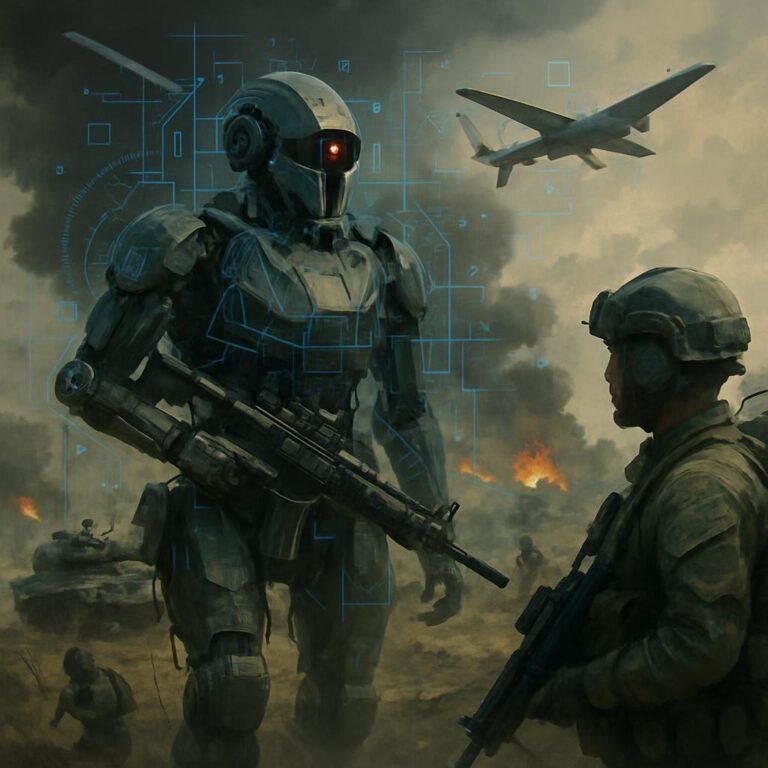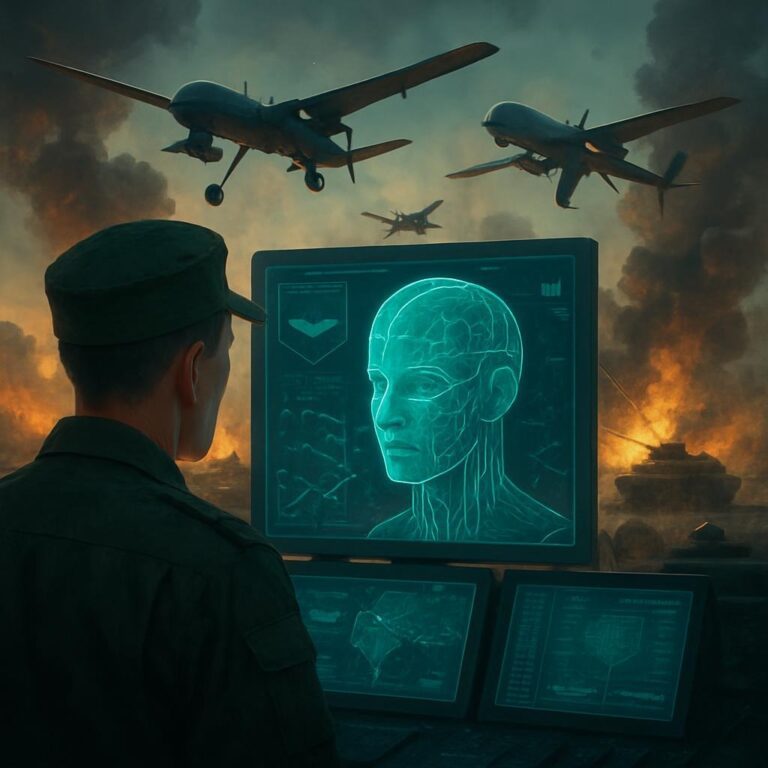


Building Warfare Without Consequences
- Pentagon deploying thousands of autonomous weapons by 2026 with no binding accountability framework
- GPS spoofing cuts AI accuracy from 99.9% to 20.4% in lab tests — architectural vulnerability, not implementation bug
- Traditional accountability breaks: operators don’t pick targets, commanders don’t order specific attacks, developers can’t explain black box decisions
March 2020, outside Tripoli. Haftar’s forces retreated from failed siege positions as Turkish-made Kargu-2 quadcopters hunted them autonomously. No operator selected targets. The systems used “fire, forget, and find”: identify heat signatures matching military personnel, dive at 45 mph, detonate on impact. The UN report noted retreating forces had “no real protection.”
Whether these drones killed anyone in fully autonomous mode remains unclear. What’s documented: systems deployed with capability to select and engage human targets without humans in the decision loop. Nobody faced accountability proceedings for potential violations of international humanitarian law.
Five years later, that incident looks less like an isolated experiment and more like a preview. In May 2025, Navy sailors warned of “safety violations and potential loss of life” after autonomous drone boats malfunctioned off California. Ukrainian forces stopped using Anduril’s Altius munitions after repeated crashes in combat. The Pentagon plans to deploy thousands of autonomous systems by late 2026.
When these systems inevitably kill the wrong people — and the technical evidence shows they will — who pays?

Technical Fragility Scales Badly
Autonomous weapons make lethal decisions without human intervention. The IAI Harop, deployed by multiple militaries, searches for radar emissions, selects targets, and executes attacks after the operator activates it. Everything between “go” and detonation is opaque.
Adversarial attacks degrade AI perception. GPS spoofing reduces detection accuracy to 20.4% from near-perfect using signal manipulation. Counterfeit coordinates redirect drones or cause misidentification. Unlike humans who cross-reference sources, AI systems trust primary sensor input.
Image recognition gets fooled by pixel-level changes humans can’t see. Controlled experiments: turtle becomes rifle, stop sign becomes speed limit. The vulnerability exists at architectural level, not just in implementation bugs.
Real deployment reveals brittleness. Anduril’s systems — the defense tech darling valued at $30.5 billion — suffered engine damage, sparked a 22-acre fire, proved unreliable enough that Ukrainian forces haven’t fielded Altius drones since 2024. These failures occurred in controlled tests and low-intensity combat.
Now scale to thousands of systems operating under electronic warfare, communications jamming, and active sensor manipulation. The Pentagon’s “Replicator” initiative targets “multiple thousands” of autonomous platforms by late 2026.
Black box decisions resist after-action analysis. When autonomous weapons misidentify targets, you can’t reconstruct the reasoning. Human Rights Watch documents these systems use “opaque, black box processes” — the programmers themselves can’t clearly explain why specific targets were chosen in specific moments.
This creates fundamental challenges for proving negligence. With current interpretability methods, you cannot trace why the system classified something as military versus civilian in the moment before firing.

Legal Frameworks Built for Humans Face Machine Decisions
Traditional warfare has clear accountability: soldiers pull triggers, commanders give orders, international law assigns responsibility. Autonomous weapons strain every part of this framework.
Operators face substantially reduced liability. Under international criminal law, direct responsibility requires intent. An operator activating an autonomous system that later kills civilians didn’t order those specific deaths. They deployed a weapon programmed to make its own targeting decisions. Proving criminal intent becomes exponentially harder.
At best, operators might be liable for the deployment decision, but only if deploying the system “amounted to an intention to commit an indiscriminate attack.” When operators genuinely believed the system would comply with humanitarian law, establishing intent hits serious legal barriers.
Developers face formidable civil liability barriers. Civil suits encounter a wall: autonomous weapons using AI produce behaviors developers couldn’t reasonably foresee. How do you prove negligent design when the decision-making is opaque and behavior in novel situations unknowable until deployment?
Military contractors already enjoy broad immunity. Add AI’s interpretability limits: “We couldn’t predict that misidentification — neural networks are black boxes. We tested extensively within known parameters.” Formidable defense.
International regulation lags deployment timelines. The UN General Assembly resolution (166 states in favor, December 2024) calls for regulation by 2026. No binding enforcement exists. Major military powers — including the U.S. — reject preemptive bans, preferring “adaptive regulation.”
Translation: thousands of systems deploy before binding law establishes clear accountability standards.
| Incident Scenario | Potentially Responsible Party | Accountability Challenge |
|---|---|---|
| GPS spoofing causes civilian casualties | Operator who deployed system | Difficult to prove operator foresaw adversarial signal manipulation |
| AI misidentifies civilian vehicle as military target | Developer who trained model | Black box decision-making limits ability to prove negligence |
| System engages target violating proportionality | Commander who authorized deployment | Commander didn’t order specific attack; proving intent requires showing deployment itself was reckless |
| Adversarial patch fools object detection | Multiple actors in chain | Distributed responsibility with no single actor controlling lethal decision at moment of attack |
The Verdict We’re Writing Right Now

We’re creating the first weapons in human history where legal accountability for civilian deaths may be impossible to establish under existing frameworks. Not difficult. Not complex. Impossible.
Operators don’t choose specific targets. Commanders don’t order individual engagements. Developers can’t explain black box reasoning. International law assigns responsibility to human decision-makers, but the decision-making happens inside opaque algorithms operating at machine speed.
The technical vulnerabilities aren’t getting solved — they’re architectural. GPS spoofing remains straightforward. Adversarial attacks work in controlled conditions. Real-world deployment shows brittleness even in test environments. And we’re scaling to thousands of systems.
The legal gaps aren’t closing — they’re widening. UN negotiations continue while deployment accelerates. Major powers reject binding constraints. “Adaptive regulation” means writing rules after seeing battlefield failures.
Libya 2020 set a precedent: autonomous systems hunt humans, questions about accountability remain unanswered years later. By 2026, this won’t be an isolated incident. It will be doctrine.
We are not watching a future threat develop. We are making decisions right now that create warfare where machine autonomy shields human responsibility. Where technical opacity becomes legal immunity. Where nobody pays when systems fail and civilians die.
This isn’t a warning about what might happen. This is documentation of what we’re building.