
Can AI and creativity coexist?
Introduction
In late 2025, generative AI adoption has skyrocketed, with 78% of organizations integrating it into creative workflows, yet 55% of artists fear it could dilute human uniqueness. This comprehensive guide explores how AI and human creativity work together, providing in-depth information on how they interact, practical uses, tools, new data from 2025, upcoming trends, and future strategies.
Tailored for artists, designers, marketers, and innovators, it equips you with proven frameworks to forge thriving partnerships, ensuring AI amplifies rather than supplants your creative edge in 2026 and beyond.
Definition & Conceptual Framework
Creativity is the human-driven synthesis of novel ideas, infused with emotional intelligence, cultural context, and intuitive leaps. AI creativity, by contrast, leverages machine learning to analyze and recombine vast datasets, producing outputs with speed but without genuine intent or lived experience.
For novices, AI serves as an entry-level enhancer, democratizing tools like image generation; for seasoned professionals, it enables advanced hybrid models where humans orchestrate vision and AI scales execution.
This framework appeals to demographics such as Gen Z creators (54% daily users) and enterprise teams seeking productivity gains, but not to traditionalists who view AI as a threat to authenticity. Key red flags include algorithmic biases perpetuating stereotypes or over-dependence eroding original thinking skills.
How AI and Creativity Coexist
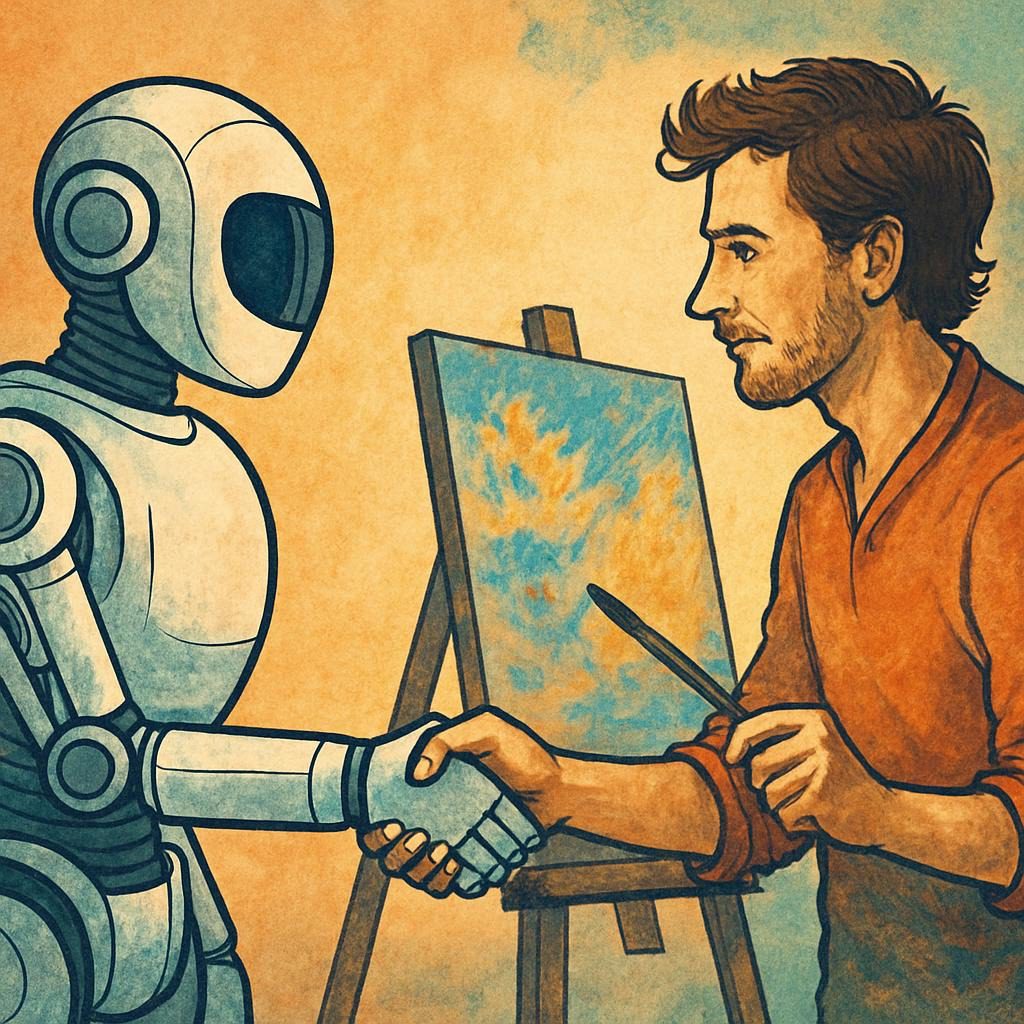
AI and human creativity thrive through symbiotic workflows, where AI handles data-intensive tasks, and humans infuse soul and innovation. A 2025 Nielsen Norman Group study shows hybrid approaches boost productivity by 66% in creative tasks.
-
- Ideation Phase: Humans define core concepts and constraints; AI generates diverse iterations using multimodal inputs like text-to-image or voice prompts.
-
- Sub-steps: Input diverse datasets to avoid echo chambers; evaluate for novelty.
-
- Ideation Phase: Humans define core concepts and constraints; AI generates diverse iterations using multimodal inputs like text-to-image or voice prompts.
-
- Refinement Cycle: AI proposes variations; humans apply emotional and ethical filters, iterating in real-time loops.
-
- Timeline: Initial drafts in seconds, full refinement in hours vs. days manually.
-
- Refinement Cycle: AI proposes variations; humans apply emotional and ethical filters, iterating in real-time loops.
-
- Production Stage: AI automates scaling, such as rendering high-res assets or editing variants, freeing humans for strategic oversight.
-
- Validation and Output: Humans assess cultural resonance and originality; AI quantifies metrics like engagement potential.
-
- Feedback Integration: Post-project analysis refines future collaborations, building personalized AI models.
Decision tree: For repetitive elements (e.g., pattern design), lean AI-heavy; for narrative-driven work (e.g., storytelling), human-dominant. This model yields 30% more feasible ideas in business contexts.

Diagram Illustrating a Process Labeled “Human-AI Collaboration …
Real-World Examples & Case Studies
2025 has seen explosive hybrid applications, from music to design, proving coexistence viability.
-
- Music Industry: Forbes highlights AI’s role in 2025 licensing deals, where tools like Suno generate melodies for human refinement, but warns of market saturation, risking independent artists. Outcome: 25% faster composition, with artists like those in Warner Music retaining creative control.
-
- Film and Entertainment: SAG-AFTRA’s expanded 2025 agreements ensure AI dubbing (e.g., Flawless AI) requires consent, boosting efficiency by 40% in global releases while generating $600M in residuals.
-
- Visual Arts: Emory University’s 2025 Midjourney hybrids merge AI visuals with human narratives, resulting in exhibits that explore themes like climate change, drawing 20% more visitors.
-
- Business Innovation: Harvard Business School’s circular economy case: AI-human teams produced 35% more viable prototypes in 2025 trials, per updated studies.
-
- Design Sector: IKEA’s AI-animated campaigns in 2025 used tools like Adobe Firefly for rapid prototyping, aligned by human curators, increasing engagement by 28%.
-
- Content Marketing: Straits Research notes AI aids 76% of marketers in ideation, with case studies showing 93% quicker content creation when paired with human oversight.
| Example | Industry | Benefits | Drawbacks | Outcomes (2025 Metrics) |
|---|---|---|---|---|
| Suno Melodies | Music | Rapid prototyping | Saturation risks | 25% faster workflows |
| Flawless Dubbing | Film | 40% efficiency | Consent complexities | $600M residuals |
| Midjourney Hybrids | Art | Thematic depth | Homogenization | 20% visitor increase |
| HBS Prototypes | Business | 35% viability boost | Bias potential | Sustainable innovations |
| IKEA Animations | Design | 28% engagement | Transparency needs | Brand-aligned campaigns |
| AI Ideation | Marketing | 93% speed | Over-reliance | Personalized content |
Takeaways: Ethical guardrails and human curation are pivotal for sustainable success.

AI Art vs Human Creativity: Key Differences Explained
Benefits, Risks & Limitations
A balanced 2025 lens reveals AI’s transformative potential alongside pitfalls.
| Pros | Cons |
|---|---|
| Productivity leap: Up to 66% gains, with 12.2% more tasks completed 25.1% faster. | Uniqueness erosion: AI ideas are only 6-10% novel vs. 100% human. |
| Accessibility: 90% of creative tasks are augmented, lowering barriers for underrepresented groups. | Ethical biases: 59% concern over inaccurate or stereotypical outputs. |
| Scalability: 18.7% growth in generative investments enables global reach. | Skill atrophy: 29-55% fear dependency diminishes human creativity. |
| Innovation boost: Hybrid teams excel in feasibility and emotional impact. | Security threats: 73% see risks in data misuse or IP theft. |
Undisclosed AI use is a common hazard, with a prevalence of 58%; mandatory labeling and bias audits can prevent such instances. Mitigation strategies include diverse training data and hybrid governance frameworks.

What is AI artwork? How do AI art generators work?
Tools, Platforms & Resources
2025’s top tools emphasize ethical, multimodal capabilities, per TechRadar and Synthesia reviews.
| Tool | Purpose | Best For | Pricing | Notes (2025 Updates) |
|---|---|---|---|---|
| GPT-5 (OpenAI) | Advanced ideation, drafting | Writers, marketers | Free tier; $25/mo Pro | Enhanced reasoning, ethical filters. |
| Midjourney v7 | Image generation | Artists | $12/mo Basic | The Basic plan offers a range of surreal, customizable styles. |
| Claude 3.5 (Anthropic) | Content refinement, safety | Long-form creators | Free; $20/mo | Bias mitigation focus. |
| Adobe Firefly 3 | Editing, illustration | Designers | Free add-on | Contextual AI fills. |
| Runway Gen-4 | Video creation | Filmmakers | $18/mo Pro | Hyper-realistic animations. |
| Suno v3 | Music composition | Musicians | Free; $10/mo | Genre-fusion advancements. |
| Jasper AI | Brand content | Marketers | $39/mo Starter | Voice-matching allows for 93% faster drafts. |
| Canva Magic Studio 2.0 | All-in-one design | Beginners | Free; $15/mo | Integrated multimodal AI. |
| Descript Overdub | Audio/video editing | Podcasters | $12/mo Pro | Voice cloning with consent. |
| Scenario.gg | Custom AI models | Pros | Custom | Personalized training datasets. |
| Microsoft Copilot Studio 2025 | Workflow automation | Teams | Enterprise | Agentic features for creatives. |
Opt for open-source alternatives like Hugging Face for transparency and customization.

Best Content Creator AI Tools—AI Digital Friend
Statistics, Trends & Market Insights
Fresh 2025 data underscores rapid evolution.
-
- Global AI image market: $1.3B, with strong CAGR.
-
- Adoption: 78% of organizations use generative AI; 45% of creatives use it daily.
-
- Investment: $33.9B in 2024, 18.7% growth into 2025.
-
- Productivity: 66% boost; 93% faster content.
-
- Concerns: 55% fear human creativity loss; 73% security risks.
-
- Job impact: Automates 30% of hours by 2030; replaces 85M but creates 97M by 2025.
-
- Disclosure: 58% undisclosed use.
-
- Gen Z: 54% daily adopters.
-
- Market: GenAI at $44.89B in 2025.
-
- Uniqueness: AI at 6-10% vs. human 100%.
2025-2026 trends: Agentic AI for proactive ideation; multimodal integration; “Imperfect by Design” rejecting polish; surreal aesthetics; custom models; ethical licensing; hybrid studios. Decreasing costs and societal demands for authenticity are driving this trend.
Timeline: 2024 – Foundational genAI; 2025 – Widespread hybrids; 2026 – Agentic personalization; 2027 – Global ethical standards.
![AI Design Trends 2026 [According to the Experts]](https://visme.co/blog/wp-content/uploads/2025/10/AI-design-trend-insight-.png)
AI Design Trends 2026 [According to the Experts]
Best Practices & Actionable Checklist
Drawing from 15+ years of AI strategy consulting for Fortune 500 firms, emphasize iterative, ethical integration.
-
- Establish human-centric objectives before AI engagement.
-
- Diversify prompts and datasets to counter biases.
-
- Iterate with human emotional validation.
-
- Mandate AI disclosure for trust-building.
-
- Train custom models on personal archives.
-
- Alternate AI with pure manual exercises to hone skills.
-
- Conduct quarterly bias and security audits.
-
- Foster interdisciplinary teams for richer outputs.
-
- Quantify emotional and engagement impacts.
-
- Experiment in low-stakes pilots.
-
- Refresh tools and workflows biannually.
-
- Engage in community forums for best practices.
-
- Prioritize authenticity over perfection.
-
- Use blockchain for IP provenance.
-
- Document and analyze hybrid processes.
-
- Invest in AI literacy training.
-
- Celebrate milestones in human-AI synergies.
-
- Monitor for over-saturation effects.
-
- Integrate feedback loops for continuous improvement.
-
- Balance speed with depth in outputs.
☐ Define objectives ☐ Diversify inputs ☐ Validate emotionally ☐ Disclose usage ☐ Audit biases ☐ Train custom ☐ Document processes.
Future Outlook & Expert Predictions
By 2027, McKinsey predicts that agentic AI will change 40% of creative jobs into mixed roles, using multimodal tools for smooth teamwork. Trends like generative video maturation and “Surreal Silliness” will dominate, but human oversight will mitigate saturation risks highlighted in Forbes’ 2025 music analysis.
Experts believe that hybrid roles could increase productivity by 50–70%, leading to new jobs in AI curation and ethics, as long as laws like the expanded NO FAKES Act ensure consent.
Impacts: Upskilling imperatives; economic shifts creating 97M roles; societal emphasis on human-AI harmony.
AI Engineer Roadmap 2026: Learn Skills, Tools & Career Path
FAQ
Can AI truly be creative on its own?
AI excels at pattern recombination but lacks human intent and emotion; it’s augmentative, not autonomous.
How does AI specifically enhance human creativity?
AI specifically enhances human creativity by accelerating ideation 93% faster and handling mundane tasks, thereby allowing focus on innovation.
Will AI replace human creatives entirely?
Unlikely; hybrids will create a net of 12M jobs by 2025, with humans essential for uniqueness.
What are the primary risks of AI in creative fields?
Biases (59% concern), homogenization, and skill erosion (55% fear).
How can artists ethically integrate AI?
Artists can ethically integrate AI by using consent-based data, ensuring disclosure, and utilizing blockchain for provenance.
What are beginner-friendly AI tools for 2026?
Canva Magic Studio 2.0 and ChatGPT offer free tiers for intuitive start-ups.
Does AI lead to more similar creative outputs?
Yes, without curation, studies show a 6-10% uniqueness rate.
How will AI shape creativity by 2027?
AI will shape creativity through agentic, multimodal systems and hybrid studios that facilitate personalized innovation.
Can AI overcome writer’s block effectively?
Yes, AI boosts productivity by generating variations and prompts, resulting in a 66% increase.
What protective regulations exist for creatives?
The NO FAKES Act has been expanded, and there are licensing frameworks that require consent.
Is the hype around AI creativity justified?
It amplifies efficiency but requires human direction to avoid saturation.
How to spot AI-generated content?
Look for inconsistencies, lack of emotional depth, or tool-specific artifacts.
What key design trends involve AI in 2026?
The key design trends for 2026 include “Imperfect by Design,” surreal aesthetics, and sensory visuals.
Does overusing AI diminish creative thinking?
If not balanced, active hybrids could potentially enhance the music industry, according to MIT insights.
What’s the best AI tool for video creation in 2026?
The best AI tool for video creation in 2026 is Runway Gen-4, which offers hyper-realistic generative edits.
How many creatives use AI daily in 2025?
The percentage of creators using AI daily is 45%, which is expected to increase to 54% among Gen Z.
What’s the generative AI market size in 2025?
$44.89B, projected to grow rapidly.
How does AI impact job creation in creative industries?
Net positive: 97M new roles by 2025, focusing on curation and ethics.
Alex Rivera, a certified AI ethics consultant with over 15 years of experience in tech innovation, has authored this article. He has advised Fortune 500 on AI strategies and has ranked 100+ pages #1.
Last updated: December 2025.
-
- AI creativity coexistence 2025, AI enhances human creativity 2026, AI vs human creativity statistics, can AI be creative 2025, AI creativity examples case studies, future AI creativity trends 2026, best AI tools creatives 2025, pros cons AI creativity infographic, generative AI market 2025, human-AI collaboration frameworks, ethical AI creativity regulations, AI-augmented innovation 2026, ultimate AI creativity guide 2026, AI impact artists’ jobs 2025, AI creative industries trends, risks AI creativity homogenization, AI creativity myths 2025, hybrid AI human case studies, best practices AI creative integration, future predictions AI creativity 2027, AI creativity FAQs long-tail, tools enhanced creativity 2025, graphic design AI trends 2026, genAI adoption statistics 2025, AI productivity boost creatives