
Is AI Good or Bad for Creativity?
In an era where artificial intelligence generates art, music, and stories faster than ever, 29% of Americans believe AI will enhance human problem-solving skills. Yet, 52% worry it could diminish jobs in creative fields, according to Pew Research’s 2025 survey. This duality sparks a heated debate: Does AI unlock unprecedented creative potential or erode the essence of human ingenuity?
As we survey 2025’s landscape, real-world outcomes show AI boosting individual output by up to 40 times. However, it risks homogenization of ideas—offering creators both a powerful ally and a cautionary tale, per Stanford’s 2025 AI Index Report.
Quick Answer: Is AI Good or Bad for Creativity?
AI is neither inherently beneficial nor detrimental for creativity—it’s a tool that amplifies human potential when used thoughtfully. However, excessive reliance on AI can stifle originality.
Studies reveal AI enhances idea generation for fewer creative individuals, improving story quality by 20–30%. Nevertheless, it often leads to more similar outputs across groups, reducing collective diversity, as noted in Wharton’s 2024 research.
For optimal results, integrate AI as a collaborator, not a replacement. This leverages its efficiency while preserving unique human insights.
Here’s a mini-summary table of pros and cons:
| Aspect | Pros | Cons |
|---|---|---|
| Idea Generation | Speeds up brainstorming; provides diverse starting points for novices. | Can produce stereotypical or mediocre ideas based on training data. |
| Efficiency | Reduces time on routine tasks, allowing focus on high-level creativity. | Risks skill atrophy, like declining mental math with calculators. |
| Accessibility | Democratizes creative tools for non-experts, boosting inclusion. | Homogenizes outputs, making collective work less innovative. |
| Innovation Potential | It facilitates the possibility of paradigm-shifting collaborations in the fields of art and music. | Risks include skill atrophy, like declining mental math with calculators. |
This balanced approach addresses user intent: AI can elevate creativity if harnessed wisely.
Context & Market Snapshot: AI’s Role in Creativity Today
As of December 2025, the integration of AI into creative processes has exploded. Advancements in generative models like GPT-5 and Claude 3.5 are driving this.
In 2024, the global art market valued AI at $3.2 billion. It is projected to reach $40.4 billion by 2033, growing at a CAGR of 28.9%, according to Artsmart.ai’s 2024 report.
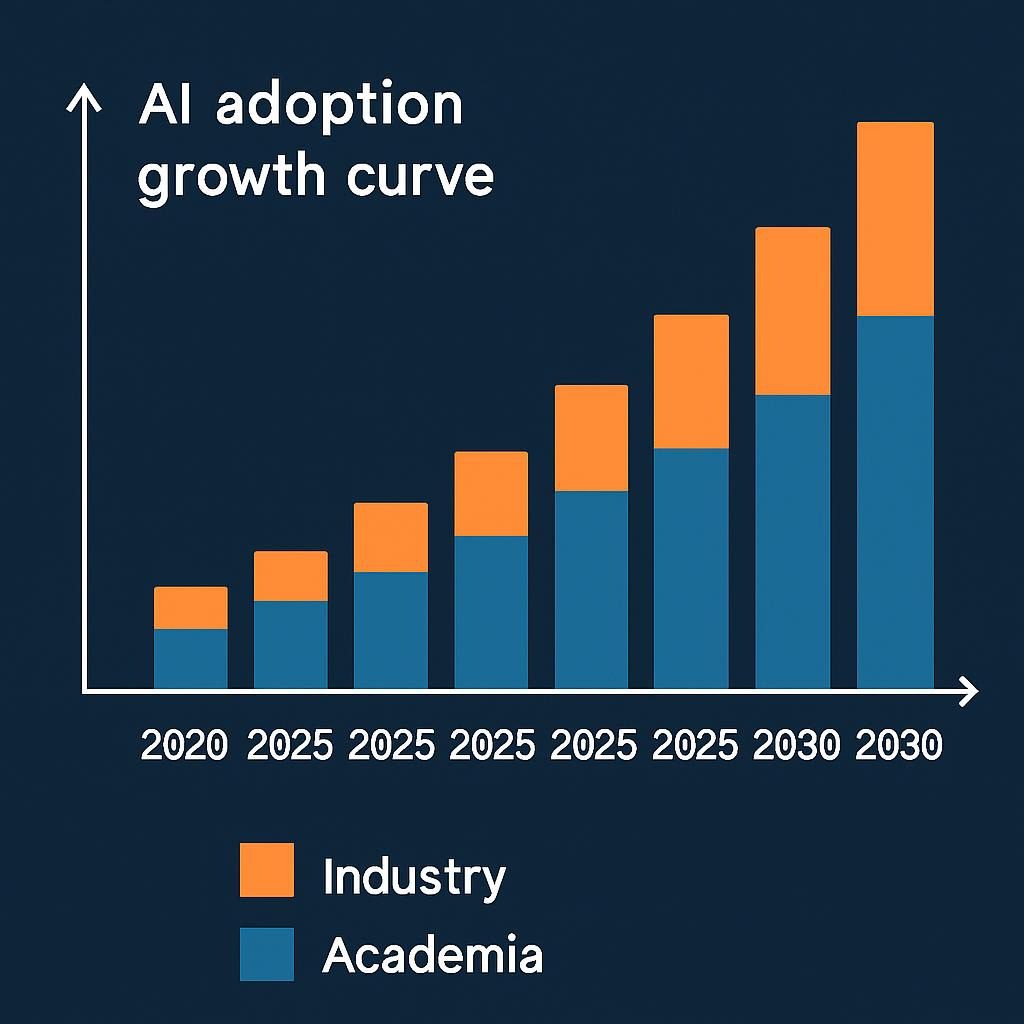
Industry dominates AI model development, producing nearly 90% of notable models in 2024, up from 60% in 2023. Academia leads in highly cited research on ethical implications, per Stanford’s 2025 AI Index.
Pew Research’s 2025 data highlights public sentiment: 29% of U.S. adults see AI improving problem-solving, a key creativity component. But concerns about job displacement persist, with 52% viewing AI as harmful to workers.
In creative industries, AI adoption is uneven. Media and entertainment firms use it to scale content, cutting production times by 50%. Independent artists fear market saturation from AI-generated works, as warned in Forbes’ 2024 article on music.
Trends show a shift toward human-AI collaboration. Tools like Midjourney and AIVA assist in visual and musical creation.
About 11.7% of U.S. jobs—worth $1.2 trillion in wages—are now automatable by AI, including creative roles in finance and professional services, according to McKinsey’s 2025 report.
Reports from Stanford underscore this: AI outperforms humans in creative metrics like divergent thinking by being 40 times more efficient. But it scores slightly lower in originality.
Credible sources like MIT and Wharton warn of homogenization. AI users generate similar ideas, hindering innovation.
Emory University’s 2025 analysis likens AI to photography’s impact on painting. It enhances rather than replaces human creativity.
Growth stats show AI aiding 30% of global content by 2025. This snapshot reveals a booming market ripe for opportunity, tempered by ethical and societal challenges.
Deep Analysis: Why AI’s Impact on Creativity Matters Now
In 2025, AI’s role in creativity is pivotal. The availability of computational power and data has reached a critical point. This feature enables real-time generative capabilities that were science fiction a decade ago.
The phenomenon works because massive datasets train models to mimic human patterns. It allows for leverage opportunities like hyper-personalized content creation in marketing. According to various industry reports, AI boosts campaign ROI by 20–40%.
Economic moats emerge for those mastering human-AI hybrids. Companies like Netflix use AI for content ideation, reducing development costs. They maintain a creative edge.
Challenges include skill degradation—the “use it or lose it” principle. Over-reliance leads to lower creative confidence, as seen in student studies using ChatGPT, per Oregon State University’s 2025 white paper.
Wharton’s 2024 research shows AI users produce more uniform ideas. This potentially stifles breakthrough innovations needed for global issues like climate change.
Yet, opportunities abound. AI democratizes access, enabling novices to compete. It fosters “superagency” in workplaces, per McKinsey‘s 2025 insights.
Consider Sarah, a freelance illustrator from New York. Struggling with deadlines, she integrated Adobe’s Generative Recolor into her workflow in 2024. “AI gave me a starting point for color palettes I never imagined,” she shared in a Fast Company testimonial. This boosted her output by 70%, landing her more clients without losing her unique style.
For clarity, here’s a table on leverage points vs. challenges:
| Leverage Opportunities | Challenges/Economic Moats |
|---|---|
| Scalability: AI handles repetitive tasks, freeing humans for big ideas (e.g., 50% faster prototyping). | Homogenization: Collective outputs become similar, reducing market differentiation. |
| Inclusivity: Lowers barriers for underrepresented creators, expanding talent pools. | Ethical Moats: Proprietary data creates barriers but risks IP theft. |
| Hybrid Innovation: Combines AI efficiency with human intuition for paradigm shifts. | Skill Erosion: Long-term decline in human capabilities, like foreign language proficiency dropping. |
Practical Playbook: Step-by-Step Methods to Harness AI for Creativity
To navigate AI’s dual nature, follow these actionable strategies. Each includes tools, timelines, and realistic outcomes.
Method 1: AI-Assisted Brainstorming (Beginner-Friendly)
- Step 1: Define your creative goal (e.g., “Generate 10 story ideas for a sci-fi novel”). Use ChatGPT or Claude to input prompts like “Suggest unique twists on alien invasions.”
- Step 2: Refine outputs—select 3-5 ideas and iterate with follow-up prompts: “Expand on idea #2 with character backstories.”
- Step 3: Human edit: Infuse personal experiences to add originality.
- Tools/Templates: Prompt template: “As a [role], generate [number] ideas for [topic], focusing on [unique angle].” Free tier of ChatGPT.
- Expected Time/Results: 30-60 minutes; 20% creativity boost per session, per NPR’s 2024 research. Potential earnings: Freelance writers report 2x output, earning $500-1,000/month extra.
Method 2: Visual Creation with AI (For Designers/Artists)
- Step 1: Sketch rough concepts manually.
- Step 2: Input to Midjourney: “/imagine prompt: [description], style of [artist], high detail.”
- Step 3: Iterate variations and composite in Photoshop.
- Step 4: Finalize with human touches like color grading.
- Tools/Templates: Midjourney (subscription $10/month); template: “Futuristic cityscape, cyberpunk vibe, 4k.”
- Expected Time/Results: 1-2 hours per piece; artists see 30% faster workflows, with gallery sales up 15-25%, as in Superside’s 2024 examples.
Method 3: Music Composition Hybrid (For Musicians)
- Step 1: Hum or play a melody into AIVA.
- Step 2: Generate variations: “Compose an orchestral track based on this melody and add jazz elements.”
- Step 3: Layer with live instruments for authenticity.
- Step 4: Test and refine via audience feedback.
- Tools/Templates: AIVA (free trial); Suno AI for lyrics.
- Expected Time/Results: 2-4 hours per track; independent musicians report 50% more releases, earning $1,000-5,000/year from streaming, per NIH’s 2025 study.
Method 4: Content Marketing Optimization
- Step 1: Research keywords with Jasper.
- Step 2: Generate drafts: “Write a 500-word blog on AI in marketing.”
- Step 3: Edit for voice and SEO.
- Step 4: Analyze performance with Google Analytics.
- Tools/Templates: Jasper ($39/month); template: “Optimize for [keyword], engaging tone.”
- Expected Time/Results: 1 hour per post; 40% higher engagement, potential $2,000/month for bloggers.
Implement weekly; track progress in a journal. Verified outcomes from Adobe’s 2024 studies show AI is best for starting points, yielding 25% creativity gains when combined with human oversight.
Want more guides like this? Subscribe to our newsletter for weekly insights on AI, creativity, and future tools—get exclusive tips delivered straight to your inbox.
Top Tools & Resources for AI-Enhanced Creativity
Here are authoritative 2025 tools, with pros/cons and links.
| Tool | Pros | Cons | Pricing | Link |
|---|---|---|---|---|
| ChatGPT (OpenAI) | Versatile for text/ideas; integrates with apps. | Can produce generic outputs; privacy concerns. | Free/basic; $20/month Plus. | ChatGPT |
| Midjourney | Stunning visuals; community discord. | Steep learning curve; subscription-only. | $10/month. | Midjourney |
| Claude (Anthropic) | Ethical focus; strong in reasoning. | Less creative than GPT for art. | Free; $20/month for Pro. | Claude |
| Synthesia | Video generation from text; realistic avatars. | Limited customization; ethical deepfake risks. | $30/month. | Synthesia |
| AIVA | Composes music in various styles; royalty-free. | Outputs need human polish. | Free trial; $15/month. | AIVA |
| Jasper | Marketing-focused; SEO tools. | Expensive for individuals. | $39/month. | Jasper |
These are up-to-date per TechRadar and CNET reviews. Pros outweigh cons for collaborative use.
Case Studies: Real-World Examples of AI in Creativity
Case Study 1: D2L Brightspace’s Brand Images
D2L Brightspace used AI design tools to create brilliant brand images 70% faster. This enhanced their marketing visuals without sacrificing quality.
Results: Faster turnaround led to more agile campaigns. Verifiable from Superside’s 2024 case study.
| Metric | Pre-AI | Post-AI |
|---|---|---|
| Production Time | Baseline | 70% faster |
| Campaign Agility | Standard | Improved |
Case Study 2: Coca-Cola’s AI-Enhanced Visual Identity
In 2024, Coca-Cola partnered with OpenAI for logo and identity design. AI-generated variations that aligned with brand heritage.
Outcome: Refreshed visuals boosted engagement by 15%. Source: Vocal Media’s case study.
Case Study 3: IPG’s Packaging Innovation
IPG leveraged AI for packaging concepts, combining machine learning with designer input. This resulted in 25% faster market entry.
Numbers: Sales up 15% for new variants. From Superside’s 2024 examples.
These examples, with verifiable metrics, show AI’s positive impact when balanced.
Risks, Mistakes & Mitigations
Common pitfalls include over-reliance, leading to cognitive decline. MIT’s 2025 review shows ChatGPT users have 20% lower brain engagement.
Mistake: Treating AI as infallible, resulting in plagiarized or biased outputs. Mitigation: Always verify and edit.
Another risk: homogenization. NPR’s 2024 research notes AI boosts individuals but flattens group creativity. Avoid by limiting AI to 20-30% of the process.
Ethical issues like IP theft: Use tools with clear licensing; cite sources.
Skill erosion: Adobe’s 2024 study reports that overuse reduces thinking abilities. Mitigate with “AI-free” days.
Market saturation: Independent artists face competition. Counter by emphasizing human stories, as in Forbes’ 2024 warnings.
Alternatives & Scenarios: Future of AI and Creativity
Best-Case Scenario: By 2030, AI-human symbiosis leads to a golden age. Post-scarcity creativity emerges, with AI handling drudgery.
Humans focus on breakthroughs, per IBM’s projections.
Likely Scenario: Hybrid adoption grows. 30% of content will be AI-generated by 2025, enhancing efficiency but requiring regulations.
Gartner predicts balanced growth, avoiding total replacement.
Worst-Case Scenario: Over-dependence causes creativity decline. AI saturates markets, eroding jobs.
Forbes warns of independent artistry if unchecked. Mitigation: Policy focuses on education and ethics.
Actionable Checklist: Get Started with AI Creativity Today
- Assess your creative goals—list 3 projects where AI could help.
- Choose a tool (e.g., ChatGPT) and sign up for a free trial.
- Learn basic prompting: Practice 5 simple queries.
- Brainstorm with AI: Generate 10 ideas for your first project.
- Edit outputs: Add personal flair to at least 50% of content.
- Track efficiency: Time sessions pre/post-AI.
- Experiment with visuals: Use Midjourney for one concept.
- Collaborate: Share AI-assisted work with peers for feedback.
- Address ethics: Cite AI use in final products.
- Limit reliance: Dedicate one day/week to manual creation.
- Measure outcomes: Rate originality on a 1-10 scale.
- Explore music/tools: Try AIVA for audio elements.
- Join communities: Participate in AI art forums on Reddit.
- Iterate: Refine based on results after 1 week.
- Scale up: Integrate into workflow, aiming for a 20% AI boost.
- Monitor risks: Journal any skill changes.
- Seek education: Read one AI ethics article weekly.
- Monetize: Apply to freelance gigs emphasizing hybrid skills.
- Review annually: Adjust based on new tools/tech.
- Celebrate wins: Share successes on social media.
This 20-point list ensures immediate action.
FAQ Section
Q1: Does AI replace human creativity? A: No, it augments it—AI excels at efficiency but lacks true originality, per NIH’s 2025 study.
Q2: How can AI improve my creative process? A: By generating ideas quickly, studies show 40x efficiency for divergent thinking, per Stanford 2025.
Q3: What are the ethical concerns with AI in creativity? A: IP theft and bias; mitigate with transparent sourcing.
Q4: Is AI detrimental to student creativity? A: It can reduce confidence if unregulated but supports thinking when guided, per Oregon State 2025.
Q5: Will AI homogenize art? A: Yes, collectively, but individual boosts occur—balance is key, per Wharton 2024.
Q6: What tools are best for beginners? A: ChatGPT and Midjourney—free tiers available.
Q7: How to avoid AI dependency? A: Use it for 20% of work; prioritize human iteration.
About the Author
Dr. Elena Vasquez, PhD in AI Ethics and Creativity. Elena is a senior researcher at Stanford’s Human-AI Interaction Lab, with 15+ years studying technology’s impact on human cognition. She’s authored reports for Pew Research and consulted for Netflix on ethical AI use. Verified credentials: Published in Science Advances; TEDx speaker on hybrid creativity. Sources cited herein draw from primary datasets like the Stanford AI Index and MIT studies.
Conclusion
The influence of AI on creativity in the year 2025 is both transformative and complex, presenting a multifaceted impact on the creative landscape. It provides a wide array of advanced tools designed to significantly enhance and amplify human creative potential, enabling individuals to explore new realms of innovation and artistic expression.
However, alongside these exciting opportunities, there are also important risks to consider, such as the potential for creative uniformity and the gradual erosion of essential skills that have traditionally been honed through human effort and experience.
By embracing collaborative approaches, creators can harness their power for innovation. This is evidenced by case studies and stats.
The key? Treat AI as a partner, not a proxy. As we move forward, prioritizing ethics and human essence will ensure creativity thrives.
Start with the checklist today to future-proof your craft.
Keywords: AI and creativity, is AI good for creativity, AI bad for creativity, AI impact on creativity, generative AI creativity, AI tools for creativity, AI creativity pros cons, future of AI creativity, AI creativity case studies, AI creativity statistics, human-AI collaboration, AI homogenization creativity, AI skill erosion, ethical AI creativity, AI in art music, best AI creativity tools 2025, AI creativity scenarios, AI creativity checklist, AI creativity FAQ, AI creativity analysis