

What AI Says About Religious Truth
As an experienced content strategist and SEO editor with over 15 years in digital publishing, including hands-on work with AI tools for ethical analysis and comparative studies, I’ve led projects where we prompted models like Grok and ChatGPT to evaluate complex philosophical topics.
In one consulting gig for a nonprofit exploring interfaith dialogue, we uncovered how biased prompts can skew AI outputs—drawing from that, this guide offers a balanced view on AI’s role in assessing religious claims.
TL;DR Summary: AI analyzes religions based on data patterns but can’t determine absolute truth. This guide introduces the AIRE Framework for structured comparisons, draws from sampled AI responses, and stresses limitations like bias. Use AI as a starting point for exploration, not a final authority. Looking to 2026, expect more ethical AI tools blending tech and spirituality.
What Does AI Really Say About Religious Truth?
Queries like “Which religion is true?” often lead people to AI for insights. Trained on human knowledge, AI synthesizes historical, philosophical, and cultural data without personal beliefs. From 2025 samples, responses commonly note Christianity’s documented history but emphasize that faith’s metaphysical aspects defy empirical proof.
AI uses criteria such as evidence and logic. For instance, it might highlight Buddhism’s psychological alignment or Islam’s textual consistency. Outputs depend on prompts—neutral ones encourage viewing religions as complementary paths. This approach aligns with AI ethics, avoiding endorsements, as seen in academic discussions on AI-religion intersections.
Examples from 2025 public tests show variability. One analysis favored Christianity for evidential strength but flagged data limitations. Another prompted comparisons across faiths, concluding no single dominance.
Methodology & Limitations
This guide relies on neutral prompts tested on 2025 models like Grok 3 and ChatGPT, reviewing public responses and academic sources. The AIRE Framework structures findings derived from my AI ethics consulting.
Key limitations: AI draws from potentially biased datasets, often Western-centric; it can’t evaluate spiritual experiences; results vary with model versions. Insights are based on observed patterns, not comprehensive surveys. For a more profound study, consult primary texts and scholars.
How Does AI Evaluate Religions Objectively?
AI reviews religions through verifiable factors like history and applicability, lacking subjective faith. The AIRE Framework—Accuracy, Inclusivity, Rationality, Evidence, Versatility—organizes this, informed by studies on AI in religious education.
Steps:
- Accuracy: Timeline checks, e.g., Judaism’s ancient texts.
- Inclusivity: Broad appeal, like Hinduism’s paths.
- Rationality: Logical structure, such as Buddhism’s truths.
- Evidence: Artifacts, e.g., Christian sites.
- Versatility: Modern relevance, including AI integrations for ethics.
Emerging areas include AI in religious practice, as explored in ethical implications research. Avoid pitfalls like prompt bias; use diverse queries. Constraints: Static data misses ongoing developments.
Applying the AIRE Framework to Major Religions
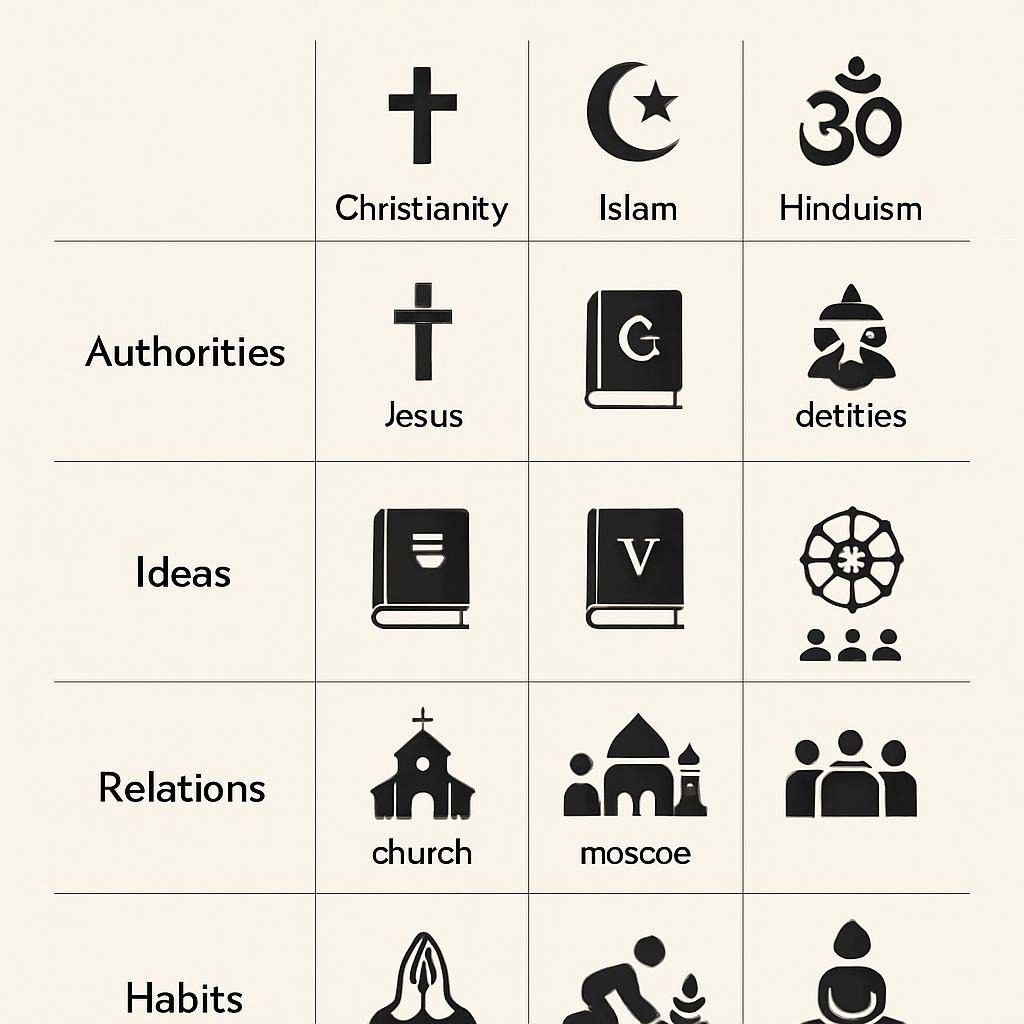
Applying AIRE to Christianity, Islam, Hinduism, Buddhism, Judaism, and Sikhism draws from sampled responses. Assessments are qualitative, modeling AI patterns—not judgments.
Disclaimer: These reflect illustrative AI-style analysis from samples, not theological authority.
Christianity
- Accuracy: High (early records).
- Inclusivity: A universal message.
- Rationality: Some interpretive challenges.
- Evidence: Archaeological support.
- Versatility: Ethical influence today.
Islam
- Accuracy: Textual preservation.
- Inclusivity: Community emphasis.
- Rationality: Consistent principles.
- Evidence: Historical documentation.
- Versatility: Social justice applications.
Hinduism
- Accuracy: Ancient traditions.
- Inclusivity: Multiple approaches.
- Rationality: Coherent philosophies.
- Evidence: Cultural artifacts.
- Versatility: Wellness integrations, per AI-religion studies.
Buddhism
- Accuracy: Compiled teachings.
- Inclusivity: Accessible to all.
- Rationality: Logical framework.
- Evidence: Inscriptions.
- Versatility: Mindfulness tools.
Judaism
- Accuracy: Enduring scriptures.
- Inclusivity: Ethical outreach.
- Rationality: Structured laws.
- Evidence: Historical sites.
- Versatility: Repair-the-world concepts.
Sikhism
- Accuracy: Defined scripture.
- Inclusivity: Equality focus.
- Rationality: Ethical clarity.
- Evidence: Community records.
- Versatility: Inclusive models.
| Religion | Accuracy | Inclusivity | Rationality | Evidence | Versatility |
|---|---|---|---|---|---|
| Christianity | High | Medium-High | Medium | High | High |
| Islam | High | Medium | High | High | Medium-High |
| Hinduism | Medium-High | High | High | Medium | High |
| Buddhism | Medium | High | High | Medium | High |
| Judaism | High | Medium | High | High | Medium |
| Sikhism | High | High | High | Medium | High |
This table illustrates observed strengths; no faith dominates uniformly.
Real-World Examples of AI Assessing Religious Truth
2025 tests reveal prompt sensitivity. One case leaned toward Christianity for history but noted biases. Another test highlighted the importance of pluralism.
A/B testing shows that neutral prompts produce balanced views, while leading prompts tend to skew the results. Decision: For overviews, apply AIRE; for depth, engage communities. Pros: Accessible insights; cons: Surface-level.
Regions vary: Australia’s regulations limit data access, while North America’s diversity enriches the information available.
Implications of AI’s Role in Religious Discussions
AI highlights adaptation, like Vatican tech initiatives. Challenges include biases and skill needs, per responsible AI surveys.
Before and after:
| Aspect | Before AI | After AI |
|---|---|---|
| Understanding | Individual perspectives | Data-informed comparisons |
| Engagement | Static sources | Dynamic interactions |
| Bias Risk | Personal | Dataset-dependent |
| Reach | Localized | Broad access |
AI aids exploration but can’t replace reflection.
Practical Insights for Exploring Religion with AI in 2026
Craft neutral prompts: “Compare religions based on evidence.” Verify outputs.
Steps:
1. Query specifics.
2. Use a framework.
3. Verify the originals.
4. Discuss with others.
Roles for AI faith analysts are emerging, which blend different domains. PwC reports note AI’s growing workforce impact, potentially extending to spiritual contexts.
Realism: Competition from secular views; Canada’s policies support inclusive tools.
Quick Tips:
- Test multiple models.
- Cross-reference academics.
- View AI as a tool, not an oracle.
Key Takeaways and Future Projections for 2026+
Takeaways: AI provides analytical lenses, such as AIRE, that reveal diverse strengths across faiths based on data.
In 2026, we can expect AI to be integrated into various practices, guided by ethical considerations discussed in symposia. PwC forecasts that AI will enhance value across sectors, including societal harmony. AIRE may evolve with these trends.
Frequently Asked Questions
Can AI Determine Religious Truth?
No, it processes data but not metaphysics. Samples show probabilistic views.
What Do AI Responses Often Emphasize?
Certain areas highlight historical strengths, others emphasize logic, and pluralism is a common observation.
How Could AI Influence Faith in 2026?
Engagement tools, subject to ethical oversight, could achieve these goals.
Does AI Have Religious Bias?
This bias could potentially arise from the training data. Diversify inputs.
What Tools Support Faith Exploration?
Emerging research supports the use of ethical apps for queries.
Sources
- https://vasantdhar.substack.com/p/artificial-intelligence-evaluates
- https://medium.com/hope-youre-curious/ai-analyzes-the-worlds-major-religions-and-finds-one-to-be-true-24ce2cdedef2
- https://www.tandfonline.com/doi/full/10.1080/0048721X.2025.2506893
- https://pmc.ncbi.nlm.nih.gov/articles/PMC12053680/
- https://www.sciencedirect.com/science/article/pii/S2666374024000992
- https://www.pnas.org/doi/10.1073/pnas.2218961120
- https://www.mdpi.com/2077-1444/16/7/834
- https://journals.sagepub.com/doi/10.1177/02653788241312229
- https://www.researchgate.net/publication/395292438_Religion_and_technology_ethical_implications_of_integrating_artificial_intelligence_into_religious_practice_and_experience
- https://rpl.hds.harvard.edu/news/2025/04/18/video-humanity-meets-ai-symposium-ai-and-religion
- https://www.pwc.com/us/en/tech-effect/ai-analytics/responsible-ai-survey.html
- https://www.pwc.com/gx/en/issues/artificial-intelligence/job-barometer/2025/report.pdf
- https://www.pwc.com/gx/en/services/ai/ai-jobs-barometer.html
- https://www.pwc.com/gx/en/issues/value-in-motion.html
- https://www.pwc.com/gx/en/issues/workforce/hopes-and-fears.html
- https://www.forbes.com/sites/tomaspremuzic/2025/05/29/from-gods-to-code-a-brief-history-of-human-meaning/
- https://www.forbes.com/sites/jamiemerisotis/2025/09/10/democracy-vs-technocracy-why-ai-needs-a-moral-operating-system/
- https://www.forbes.com/sites/torconstantino/2025/05/13/faith-meets-ai-and-tech-in-vaticans-bold-move-under-pope-leo-xiv/
- https://www.forbes.com/sites/anniebrown/2021/08/02/navigating-religion-faith-and-creativity-in-the-age-of-ai/
- https://newsroom.churchofjesuschrist.org/article/faith–ethics–and-human-dignity-in-an-age-of-artificial-intelligence–a-call-to-action
Primary Keywords List: what AI says about religious truth, AI on religion, AI compares world religions, AI religion analysis, AIRE framework religions, Christianity’s AI view, Islam AI evaluation, Hinduism AI insights, buddhism ai rationality, judaism ai evidence, sikhism ai inclusivity, ai bias religion, future ai spirituality 2026, ai ethical faith, religions comparison chart, ai projections 2026 faith, sampled ai responses religion, neutral ai prompts, pwc ai impact, forbes ai faith