
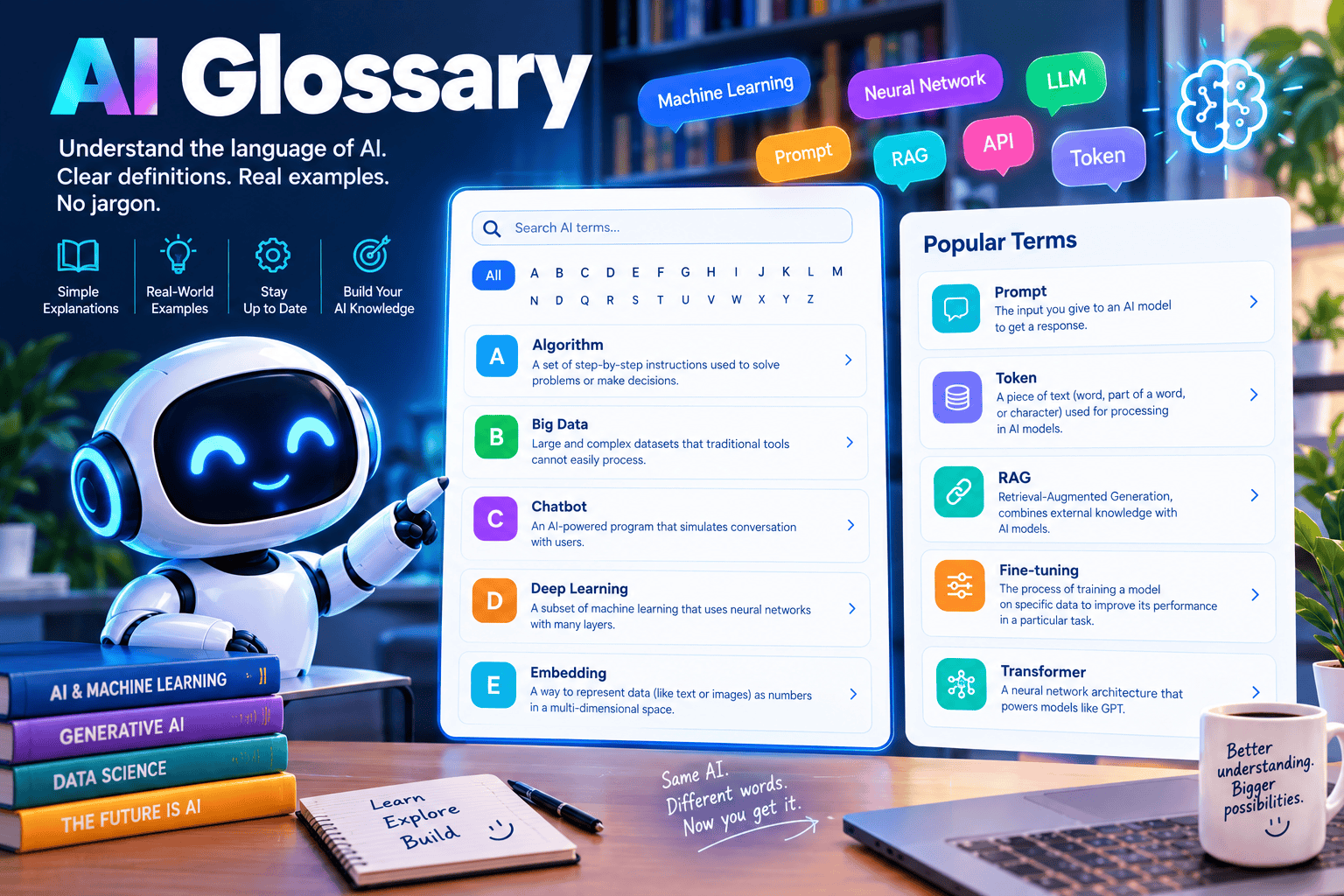
AI Glossary
70+ AI and LLM terms, defined in plain English — searchable, alphabetized, and linkable. No jargon left unexplained.
72 terms
A
- Agent (AI agent)
- Software that uses a model to decide its own next steps — calling tools, reading results, and deciding what to do next — rather than following a fixed script. The defining trait is that the loop between “decide” and “act” repeats without a human approving each step. See also: Agentic AI, Agentic loop, Tool use / function calling
- Agentic AI
- A style of AI system built around agents rather than single-turn chat — the model plans a sequence of actions, executes them (often using tools), checks the outcome, and adjusts, with limited human oversight per step.
- Agentic loop
- The repeating cycle an agent runs through: observe the current state, decide on an action, execute it (often a tool call), observe the result, and decide again. Most of what makes an agent feel autonomous is just this loop running many times in a row.
- AGI (Artificial General Intelligence)
- A hypothetical AI system that matches or exceeds human ability across essentially every cognitive task, rather than performing well only in narrow, trained-for domains. No consensus definition or agreed benchmark exists for when this threshold is crossed — treat any specific date claim skeptically.
- AI washing
- Marketing a product as “AI-powered” when the actual functionality is minimal, cosmetic, or unrelated to machine learning — the AI equivalent of greenwashing. Regulators in several jurisdictions have begun treating overstated AI claims as a consumer-protection issue, not just a branding one.
- Alignment
- The work of making a model’s behavior match what its developers and users actually intend — helpful, honest, and safe — rather than just technically satisfying its training objective. Alignment is an ongoing engineering and research problem, not a switch that gets flipped once.
- API (Application Programming Interface)
- The programmatic interface developers use to send requests to a model and get responses back in code, instead of typing into a chat window. Most AI products — chatbots, coding assistants, browser extensions — are built on top of a provider’s API.
- Attention mechanism
- The core component of the Transformer architecture that lets a model weigh how relevant every other token is to the one it’s currently processing, regardless of distance between them in the text. It’s what allows a model to connect “it” on page three to a name introduced on page one.
B
- Benchmark
- A standardized test used to compare models against each other on a specific capability — coding (SWE-bench), general knowledge (MMLU), math, or agentic tool use. Benchmark scores are a useful signal, not a guarantee of real-world performance on your specific task.
- Bias (AI bias)
- Systematic skew in a model’s outputs that reflects imbalances or patterns in its training data, rather than a neutral or representative view. Bias can show up in subtle ways — which examples a model reaches for first, whose writing style it mimics by default — not just in obviously offensive output.
C
- Chain-of-thought (CoT)
- A prompting or model-design technique where the model works through intermediate reasoning steps before giving a final answer, instead of jumping straight to a conclusion. This tends to improve accuracy on multi-step problems, though the written-out steps aren’t always a fully faithful account of how the model actually arrived at the answer.
- Chatbot
- Any conversational interface to a model — the simplest form of AI product, built around a single back-and-forth text exchange rather than autonomous multi-step action.
- Computer use
- A model capability that lets an agent control a computer directly — moving a cursor, clicking, typing, reading a screen — instead of only calling defined APIs. It trades reliability for reach: it can operate any app with no custom integration, but is generally slower and more error-prone than a purpose-built tool.
- Context compaction
- Summarizing or trimming an agent’s accumulated conversation and tool output so it fits back within the context window, instead of hitting a hard length limit mid-task. It preserves the gist of what’s happened so far at the cost of some detail.
- Context engineering
- Deliberately curating everything a model sees at the moment it answers — which files, documents, prior turns, and tool results are included, excluded, or compressed — rather than relying on one clever prompt. It’s become the practical successor to plain prompt engineering for agentic and coding work, where getting the right information in front of the model matters more than how the instruction is phrased. See also: Prompt engineering, Context window
- Context window
- The maximum amount of text — measured in tokens — a model can hold in “working memory” at once, including the prompt, conversation history, and any documents or tool output fed in. Content beyond that limit either gets truncated or has to be summarized down first. See also: Token
D
- Data poisoning
- Deliberately inserting misleading, malicious, or low-quality examples into a model’s training data to corrupt its behavior — for instance, seeding text that makes the model more likely to produce a specific wrong answer or hidden trigger response.
- Diffusion model
- A generative model architecture, most commonly used for images, that starts from random noise and repeatedly refines it into a coherent output, guided by a text prompt. It’s the technique behind most mainstream AI image generators.
E
- Embedding
- A numerical representation of text (or an image, or audio) as a list of numbers — a vector — positioned so that similar meanings end up close together in that numerical space. Embeddings are what let a search system find “cheap flights” as relevant to a query for “budget airfare” even though the words don’t match. See also: Vector database, RAG
F
- Few-shot learning
- Giving a model a handful of example input-output pairs directly in the prompt so it can infer the pattern you want, without any retraining. Contrast with zero-shot, where no examples are given at all.
- Fine-tuning
- Continuing to train an already-trained model on a smaller, task-specific dataset to shift its behavior, tone, or knowledge toward a particular use case. It changes the model’s actual weights, unlike prompting, which only changes what you show it at request time. See also: LoRA
- Foundation model
- A large model trained on broad, general-purpose data that serves as the base for many downstream applications, whether used directly or adapted through fine-tuning. Most commercial LLMs and image generators are foundation models.
- Function calling (tool use)
- A model’s ability to recognize when a task needs an external action — running a calculation, searching the web, querying a database — and output a structured request to trigger it, rather than trying to answer from memory alone. This is the mechanism that turns a plain chatbot into an agent.
G
- Generative AI
- Any AI system that creates new content — text, images, audio, video, code — rather than just classifying, scoring, or retrieving existing content. LLMs and image diffusion models both fall under this umbrella.
- GPU / accelerator
- Specialized processing hardware — GPUs, or purpose-built chips like TPUs — that can run the huge number of parallel matrix calculations a model needs, far faster than a general-purpose CPU. Access to enough of this hardware is one of the main bottlenecks in training and running large models.
- Grounding
- Connecting a model’s output to a verifiable external source — search results, a document, a database — so its answer is anchored to something checkable rather than generated purely from what it learned during training. See also: RAG, Hallucination
- Guardrails
- Rules, filters, or checks layered around a model to keep its behavior within acceptable bounds — blocking certain outputs, validating tool calls before they execute, or catching obviously wrong answers — distinct from the model’s own training-time alignment.
H
- Hallucination
- When a model states something false, fabricated, or unsupported with the same confident tone it uses for accurate information — a made-up citation, a nonexistent function, a plausible-sounding but wrong fact. It happens because a model is predicting likely-sounding text, not looking up truth in a database. See also: Grounding, RAG
I
- Inference
- The process of actually running a trained model to produce an output — as opposed to training, which is building the model in the first place. Every reply a chatbot gives you is one inference pass.
- In-context learning
- A model adapting its behavior within a single conversation based on examples, instructions, or corrections you give it — without any of its underlying weights changing. Once the conversation ends, that “learning” is gone.
J
- Jailbreak
- A prompt or sequence of prompts specifically designed to get a model to bypass its safety training and produce content or actions it would normally refuse. See also: Prompt injection, Guardrails
K
- Knowledge cutoff
- The date after which a model has no built-in knowledge of events, because its training data was collected before that point. A model with a live search tool can still discuss recent events — it’s just retrieving them, not recalling them from training.
L
- Large Language Model (LLM)
- A neural network, almost always built on the Transformer architecture, trained on huge amounts of text to predict what comes next — a capability that turns out to generalize to conversation, writing, reasoning, and code. Claude, GPT, and Gemini are all LLMs. See also: Transformer, Foundation model
- Latency
- The delay between sending a request to a model and getting a response back — both the time to the first token and the total time to finish. Larger, more capable models are generally slower per token than smaller ones.
- LoRA (Low-Rank Adaptation)
- A fine-tuning technique that trains a small set of additional parameters instead of updating the entire model, making customization dramatically cheaper and faster while keeping most of the original model frozen.
M
- Model Context Protocol (MCP)
- An open protocol, introduced by Anthropic, that standardizes how AI applications connect to external tools, data sources, and services — so a single integration can work across different AI clients instead of every app needing its own custom connector to every tool.
- Model card
- A published document describing a model’s intended use, known limitations, training data at a high level, and evaluation results — the AI-industry equivalent of a nutrition label.
- Model routing
- Automatically sending each request to the cheapest or fastest model capable of handling it, and escalating only the harder requests to a more expensive, more capable model — a common cost-control pattern for production AI applications.
- Model weights
- The billions of numerical values, learned during training, that actually encode what a model “knows” — how strongly each connection between neurons should fire. Downloading a model’s weights is downloading the model itself.
- Multimodal AI
- A model that can take in, and sometimes produce, more than one type of content — text, images, audio, video — within the same system, rather than requiring separate models bolted together for each format.
O
- Open-weight model
- A model whose trained weights are published for anyone to download and run, as opposed to a closed model only accessible through a provider’s hosted API. “Open-weight” is more precise than “open source,” since the training data and code often aren’t released alongside the weights.
- Orchestration
- Coordinating multiple models, agents, or tool calls to complete a larger task — deciding what runs in what order, passing results between steps, and handling failures — rather than relying on a single model call to do everything at once.
- Overfitting
- When a model learns its training data too specifically — including its noise and quirks — and performs worse on new, unseen data as a result. The model has effectively memorized examples instead of learning the underlying pattern.
P
- Parameter
- One individual adjustable value inside a model’s weights. Parameter count is often used as a rough proxy for model size and capability, though it’s an increasingly unreliable one on its own — training data quality and architecture matter just as much.
- Prompt
- The text (or image, or audio) input you give a model to get a response — anything from a one-line question to a multi-page document with instructions attached.
- Prompt engineering
- Deliberately structuring how you phrase an instruction — the wording, examples, format requests, and structure — to reliably get better output from a model. As tasks have shifted toward multi-step agent work, this has partly given way to context engineering: curating what the model sees, not just how the request is worded. See also: Context engineering
- Prompt injection
- An attack where malicious instructions are hidden inside content a model processes — a webpage, a document, an email — so that when an agent reads that content, it follows the hidden instructions instead of (or in addition to) the user’s actual request.
Q
- Quantization
- Reducing the numerical precision used to store a model’s weights — for example, from 16-bit to 4-bit numbers — to shrink its memory footprint and speed up inference, usually at a small, controllable cost to output quality.
R
- RAG (Retrieval-Augmented Generation)
- A technique where a model retrieves relevant chunks from an external knowledge base before generating its answer, then writes its response grounded in that retrieved material — instead of answering purely from what it memorized during training. It’s the standard way to make a model accurate about private documents or fast-changing information. See also: Embedding, Vector database, Grounding
- Reasoning model
- A model specifically trained to spend extra computation working through a problem step by step before answering, trading response speed for accuracy on harder tasks like math, coding, and multi-step logic. See also: Test-time compute, Chain-of-thought
- Red teaming
- Deliberately probing a model for weaknesses, unsafe outputs, or exploitable behavior before release, by simulating how a motivated bad actor would try to misuse it.
- RLHF (Reinforcement Learning from Human Feedback)
- A training technique where human raters compare and rank different model outputs, and that feedback is used to train the model toward responses people actually prefer — a core part of turning a raw text predictor into a helpful, well-behaved assistant.
S
- Sandboxing
- Running an agent’s actions — especially code execution or file changes — inside an isolated environment that can’t affect the real system, so a mistake or a successful attack stays contained.
- Shadow AI
- Employees using AI tools at work without IT or security approval — personal ChatGPT accounts for work tasks, unsanctioned browser extensions — creating data-handling and compliance risk the organization doesn’t know about.
- Skill (agent skill)
- A packaged, reusable set of instructions, and sometimes scripts or reference files, that an agent can load to handle a specific type of task well — the agent equivalent of handing a new hire a written playbook for one part of the job.
- Structured output
- Constraining a model’s response to a specific format — usually JSON matching a defined schema — so the output can be parsed reliably by other software instead of extracted from free-form text.
- Subagent
- A secondary agent that a primary agent delegates a specific piece of work to — for example, a coding agent spinning off a subagent just to write tests — then incorporates the result back into its own task.
- Synthetic data
- Training data generated by a model rather than collected from real-world sources — increasingly used to fill gaps or scale up training, with the risk that errors or quirks in the generating model get baked into the next one.
- System prompt
- Instructions set by the developer of an AI application, rather than the end user, that shape a model’s behavior for the whole conversation — its persona, rules, and constraints — and normally sit “above” whatever the user types.
T
- Temperature
- A setting that controls how random or predictable a model’s output is. Low temperature makes the model pick its most likely next word almost every time (consistent, sometimes repetitive); high temperature lets it take more varied, creative risks (more surprising, sometimes less coherent).
- Test-time compute
- Extra computation spent at the moment of answering — generating and evaluating more intermediate reasoning before committing to a final response — rather than only investing more compute during training. Reasoning models are built specifically to make good use of this.
- Token
- The basic unit a model reads and generates text in — often a word, part of a word, or a punctuation mark, depending on the tokenizer. Both usage limits and API pricing are measured in tokens, not words or characters. See also: Context window, Tokenizer
- Tokenizer
- The component that splits raw text into tokens before a model processes it, using a fixed vocabulary learned during training. Every model family uses its own tokenizer, which is why the same sentence produces a different token count on different models.
- Training data
- The text, images, code, or other content a model learns from during training. What’s included — and what’s left out — shapes everything about what the model knows and how it writes.
- Transformer
- The neural network architecture, introduced in 2017, built around the attention mechanism, that underlies essentially every modern large language model. It replaced earlier architectures largely because it processes text in parallel rather than one word at a time, making it far more efficient to train at scale. See also: Attention mechanism
V
- Vector database
- A database built to store embeddings and quickly find the ones most similar to a given query — the retrieval half of a RAG pipeline. See also: Embedding, RAG
- Vibe coding
- Building software mainly by describing what you want in natural language and letting an AI coding tool generate and iterate on the code, rather than writing most of it by hand. The term was coined by Andrej Karpathy in early 2025; by 2026 it’s widely understood to work best paired with real engineering discipline — specs, tests, review — not as a replacement for them.
Z
- Zero-shot learning
- Asking a model to perform a task with no examples given at all — just an instruction — and relying entirely on what it generalized from training. Contrast with few-shot, where a handful of examples are provided in the prompt.
No terms match that search. Try a shorter word — searches match both the term and its definition.
How this glossary is kept accurate
Terminology in this field moves fast, and a couple of these entries — context engineering, vibe coding, Model Context Protocol — describe practices that didn’t have settled names a year or two ago. Where a term’s meaning is still shifting or contested, the definition above says so rather than presenting one narrow usage as the only one. Foundational terms (transformer, token, fine-tuning) are stable and unlikely to need revision; the newer, faster-moving ones get rechecked more often.