
The short answer
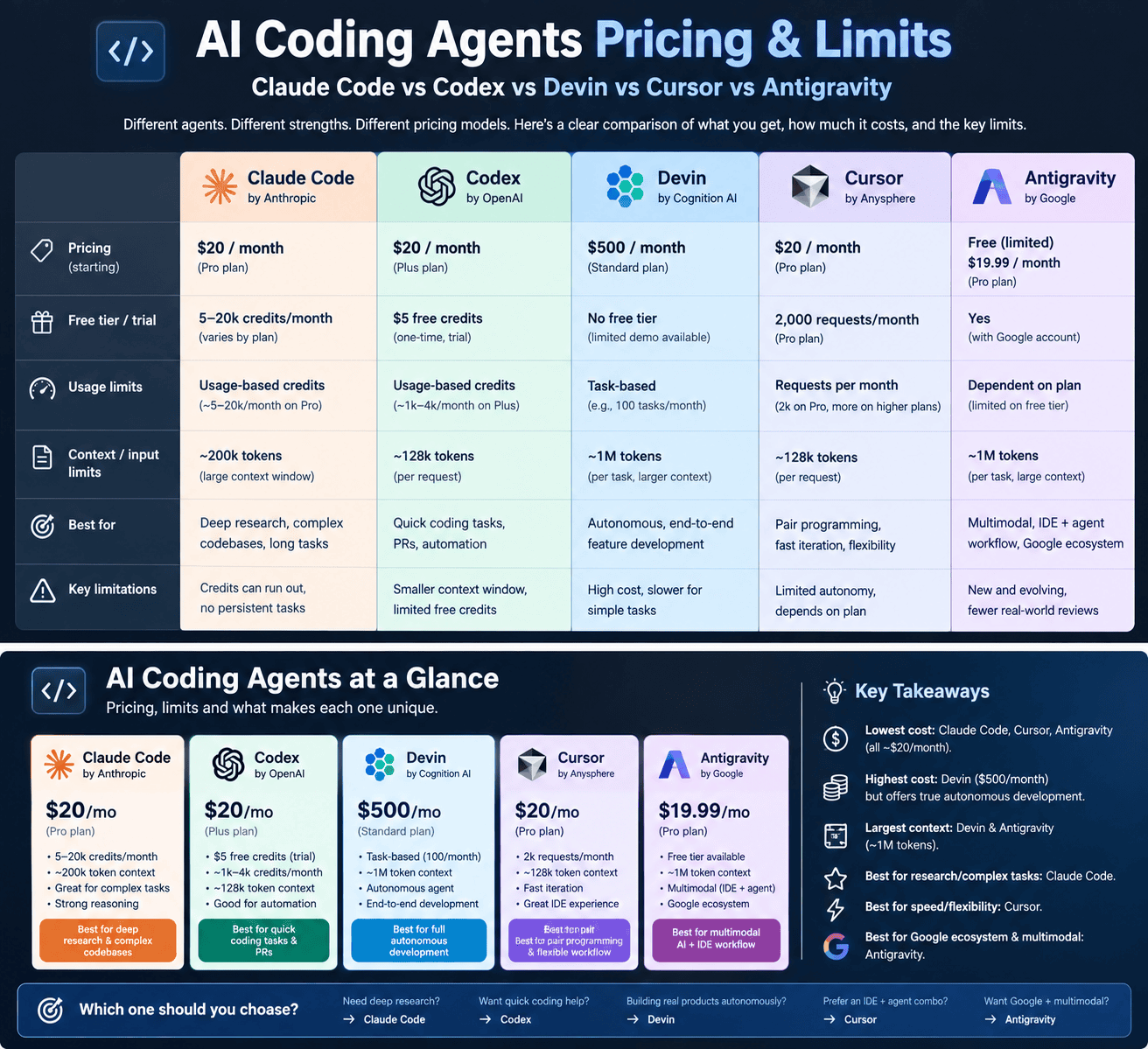
Four of these five tools now sell at the same three price points: roughly $20, $100 and $200 a month. Devin joined them this year with $20 and $200 tiers of its own. Price tells you very little, because each vendor measures usage differently, hides the real quota differently, and has changed the rules more than once in 2026.
Practical takeaways:
- Start on a $20 plan and pick by workflow, not price.
- If you hit limits every week, go straight to a $200 tier. Inside most vendors it costs about half as much per unit of capacity as the $100 tier.
- Don’t prepay annually above $100 a month. Every vendor here changed its limits in 2026.
- Treat every published multiplier as a relative claim against that vendor’s own baseline, not a cross-vendor comparison.
How the five tools meter usage
| Tool | Entry | Mid | Top | How usage is metered |
|---|---|---|---|---|
| Claude Code | Pro $20 ($17 annual) | Max 5x $100 | Max 20x $200 | Rolling 5-hour session window + weekly caps |
| Codex | Plus $20 | Pro $100 (5x) | Pro $200 (now ~10x for new); $500 tier | Credits; 5-hour windows and weekly limits on Plus; Pro currently has no 5-hour limit |
| Cursor | Pro $20 | Pro+ $60 (3x) | Ultra $200 (20x) | Monthly included model-usage pools, then on-demand billing |
| Antigravity | Free; AI Pro $19.99 | Ultra 5x $99.99 | Ultra 20x $199.99 | 5-hour refresh up to a weekly limit, plus optional credits |
| Devin | Free; Pro $20 | none | Max $200 | Daily and weekly quota, then on-demand credits |
Tool by tool
Claude Code
Claude Code is not on the free plan. Every paid plan’s limits reset on a rolling five-hour window, and paid plans add weekly limits on top. Pro is $17 a month with the annual discount or $20 billed monthly. Max 5x is $100 and Max 20x is $200. Team Standard seats cost $25 a month, or $20 on annual billing. Official pricing is at claude.com/pricing and the Max plan details are in Anthropic’s help center.
Three recent changes matter for budgeting:
- Weekly limits. From May 13 through September 13, 2026, Anthropic ran weekly limits 50% above the published standard on Pro, Max, Team and seat-based Enterprise. That promotion ended and was replaced by a permanent 25% raise over the pre-promotion baseline (roughly a 17% drop from the boosted level). See the Claude Code usage limits documentation for the current structure.
- The newest model. Anthropic increased the five-hour limits when Claude Opus 5.5 launched on September 22, 2026. Pro reaches Fable only through usage credits; Max includes it within roughly half of its weekly limits.
- Scripted use. Since June 15, 2026, claude -p and the Claude Agent SDK draw on a separate monthly credit on eligible paid plans. If you run Claude Code in CI or scripts, this matters more than the sticker price.
Anthropic describes Max only in multiples: Max 5x is five times Pro’s usage per five-hour session and Max 20x is twenty times. Both tiers are clearly listed on official pricing and help pages at $100 and $200.
OpenAI Codex
Codex has no price of its own. It is included in every ChatGPT plan: Free at $0, Go at $8, Plus at $20, Pro from $100, and Business at $20 per user per month on annual billing ($25 monthly). Eligible users can buy extra credits once included usage runs out. Official details are at developers.openai.com/codex/pricing.
Codex had the most turbulent year of the five:
- On July 12, OpenAI temporarily removed the five-hour window for Plus, Business and Pro. It restored it for Plus on August 25; Pro has stayed exempt.
- Since September 10, OpenAI paused new sign-ups and upgrades to Pro $200.
- On September 29 it reopened Pro $200 with roughly half the previous usage value for new subscribers (now marketed as ~10x Plus instead of the old 20x) and added a $500 tier. Existing Pro $200 subscribers kept their old allowance through late October 2026, after which they receive a transitional credit grant.
- GPT-5.5 leaves Codex on every plan on October 14, 2026.
Third-party guides still use different model names for the current Codex lineup. Quote OpenAI’s own page for any specific limit figure.
Cursor
Cursor is an editor with an agent, and it meters like one. It measures agent and chat usage against monthly included model-usage pools; once those are exhausted, on-demand usage is billed at API rates. Pro is $20, Pro+ is $60 (3×), and Ultra is $200 (20×). Teams seats are $40 or $120. Current plans are listed at cursor.com/pricing.
Official pages mostly speak in multiples of Pro and “generous included usage.” Some documentation lists explicit dollar amounts for the third-party (“Other Models”) pool — roughly $20 on Pro, $70 on Pro+, $400 on Ultra — while the Cursor-owned models pool remains less precisely quantified. This is still the only tool in the set that gives buyers anything close to an absolute number.
Pro+ is the interesting rung. It often costs less than staying on Pro and paying overage once your average monthly overage exceeds ~$40. That is exactly why the tier exists.
Google Antigravity
There is no Antigravity-only subscription. Paid quota rides on Google AI plans at $19.99 (Pro), $99.99 (Ultra 5x) and $199.99 (Ultra 20x). The 5x tier was added on May 19, 2026, and the 20x tier was cut from $249.99 the same day (see the official announcement). AI credits arrived earlier in 2026 as a pure overage currency. Current plans are at antigravity.google/pricing.
The free tier is a moving target. Its quota has been tightened repeatedly since launch. Google’s own pages are inconsistent: Antigravity documentation lists a $0 Individual tier, while some Google One pages imply access is only for Pro and Ultra subscribers. Treat free-tier reports of quota lockouts as anecdotal, not a measurement.
Devin
This is the section most 2026 roundups still get wrong. The old Core plan, the $500 Team plan and the per-ACU pricing that went with them are no longer the self-serve model. Devin’s self-serve plans are Free ($0), Pro ($20/month), Max ($200/month), and Teams ($80/month minimum + $40/month per full developer seat; flex seats are free and draw from the shared credit pool). Official pricing is at devin.ai/pricing and self-serve billing details are in the Cognition docs. The plan restructure was announced in April 2026.
Cognition’s billing documentation now splits Devin in two: self-serve accounts spend an included quota and then prepaid on-demand credits; Enterprise contracts are still billed in Agent Compute Units at whatever rate the order form sets. Any “Devin costs $9 an hour” claim you see is out of date.
Two other things changed. Windsurf is now Devin Desktop, and Devin CLI competes with Claude Code in the terminal. That makes Devin a tool you can run locally and in the cloud, not only an autonomous cloud engineer. Sources disagree on exact announcement dates, so check Cognition’s page before relying on any single timeline.
The multiplier problem
Every vendor sells its upper tiers as multiples of its own entry plan. Those multiples are not comparable across vendors, and they are not stable.
They are not comparable because each vendor picks its own baseline and publishes no absolute quota. A “20x” from one vendor says nothing about how it compares with another’s.
They are not stable because the baseline moves while the price stays put. Anthropic’s 50% weekly promotion became a permanent 25% raise over the old baseline. OpenAI reopened its $200 tier with roughly half the previous usage value for new subscribers. In both cases the marketing multiplier stayed the same (or was quietly adjusted) while the capacity behind it changed.
With that caveat, here is what each tier costs against its own entry plan:
| Vendor | Rung | Price | Stated multiplier | Price per own-baseline unit |
|---|---|---|---|---|
| Claude | Max 5x / 20x | $100 / $200 | 5x / 20x | $20 / $10 |
| Codex | Pro 5x / 20x→~10x | $100 / $200 | 5x / ~10x (new) | $20 / ~$20 |
| Antigravity | Ultra 5x / 20x | $99.99 / $199.99 | ~5x / ~20x | ~$20 / ~$10 |
| Cursor | Pro+ / Ultra | $60 / $200 | 3x / 20x | $20 / $10 |
Cursor’s 3x sits on a different scale from the 5x rows, so read it only against Cursor’s own Pro. The pattern holds inside each vendor: the middle tier is roughly price-neutral, and the $200 tier is half price per unit (except for new Codex $200 subscribers). Devin is absent because its Pro and Max tiers do not publish a multiplier.
What I’d buy
These are opinions based on public pricing and changelogs. I have not benchmarked the tools against each other on code quality or speed.
- Just starting out. Try Antigravity’s free tier, then pick whichever $20 plan fits how you work: Cursor Pro for an editor-first workflow, Claude Code Pro for a terminal-first one. At this price the tools are close enough that workflow fit should decide it.
- Hitting limits every week. Skip the $100 tier and go to $200 on the tool you already prefer. The exception is new Codex $200 subscribers, who now get a smaller relative allowance than the previous cohort.
- Cursor users. Move to Pro+ once your average monthly overage approaches ~$40. That is usually cheaper than staying on Pro and paying the overage.
- Devin. It no longer has an ACU meter to budget against on self-serve. Run it on a real project for a month and look at what you actually spend.
- Annual billing. Stay monthly above $100 a month until the limits settle. Only some vendors offer an annual discount in the first place. Cursor’s is 20% on every paid plan.
- Already on Codex Pro $200. Note the grandfathering window that ends in late October 2026; after that the transitional credit grant applies.
What a team of ten pays
This is simple arithmetic from published seat prices using monthly billing. Real spend is almost always higher once overages and credits are included.
| Tool | Plan | Ten developers (seat cost only) |
|---|---|---|
| Claude Code | Team Standard, $25/seat | ~$250 |
| Codex | Business, $25/seat | ~$250 |
| Cursor | Teams, $40/seat | ~$400 |
| Devin | Teams, $80 minimum + $40/full seat | ~$480 (10 full seats) |
| Antigravity | Organization route via Google Cloud | Consumption-based, not comparable |
For heavy users, premium seats exist: a Claude Team Premium seat gives 5× a Standard seat’s usage, and Cursor’s Teams Premium is $120 per user. Expect meaningful overage or credit spend on top of these numbers for any team that actually runs agents hard.
Before you rely on any number here
- Confirm live. Vendors have changed these plans several times this year. Check each vendor’s pricing page on the day you buy or republish: Claude, Codex, Cursor, Antigravity, Devin.
- Third-party quota estimates. Figures like “prompts per window” for Claude come from outside testing, not from Anthropic.
- Codex model names. Guides disagree on the current lineup. Use OpenAI’s page for model-specific limits.
- Multipliers are relative. A “20x” only means twenty times that vendor’s own entry plan. It is not a cross-vendor unit of work.
FAQ
Which AI coding agent is cheapest?
At the entry level they cluster around $20. Antigravity and Devin both have free tiers, and Devin’s Pro is $20. The cheapest tool in practice is whichever one you can use without hitting its limits. Since no vendor publishes absolute quotas, you only find out by using it for a week.
Does the $200 plan give twice the value of the $100 plan?
It gives four times the stated multiplier for twice the price, so about half the cost per unit — if you would actually use the extra capacity, and if the multipliers themselves have not changed. New Codex $200 subscribers are the current exception.
Is Devin still priced per ACU?
Not on self-serve plans. Per-ACU billing remains for Enterprise contracts, at the rate written into the order form. See devin.ai/pricing and the self-serve billing docs.
Can I use these tools in scripts or CI?
It depends on the vendor. On Claude, scripted use draws on a separate monthly credit. On Cursor, Codex and Antigravity, extra usage is billed through credits or on-demand charges once you pass your plan’s included amount.
All prices and structural claims above were cross-checked against the vendors’ official pricing and documentation pages on October 7, 2026. Always re-verify before purchasing.