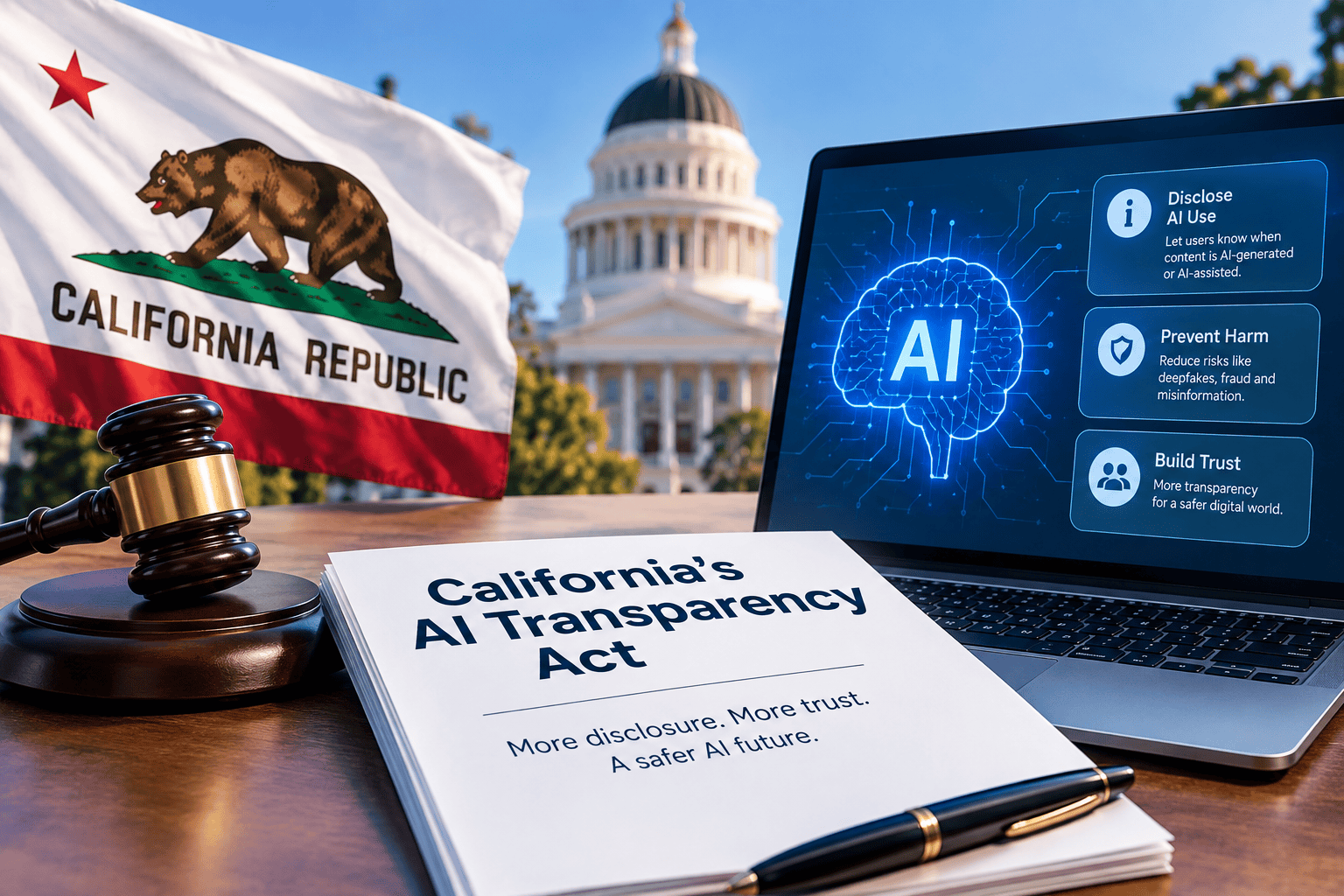
Short answer: Almost anyone who builds a generative AI system that people in California can reach. On September 30, 2026, Governor Newsom signed SB 1000, which deletes the old “more than 1,000,000 monthly users” test from the definition of a covered provider. The law took effect immediately. A startup with 2,000 users now sits under the same statute as a lab with 200 million.
If you make, fine-tune into a product, or host a gen-AI tool that produces images, video or audio, read on.
TL;DR
| Question | Answer |
|---|---|
| What changed? | SB 1000 amends the California AI Transparency Act (CATA), originally SB 942 (2024) and amended by AB 853 (2025) |
| Who is a “covered provider” now? | Any person that creates, codes or otherwise produces a gen-AI system that is publicly accessible in California. No user threshold |
| When did it start? | Immediately. SB 1000 is an urgency statute, signed September 30, 2026 |
| What content is in scope? | Image, video and audio (text is not covered) |
| Biggest compliance shifts | Visible “manifest” disclosure option removed; latent disclosure expanded; “AI detection tool” becomes “disclosure verification tool”; new licensee process |
| Penalty | Reported as $5,000 per violation, each day counted separately (one tracker lists $5,500; see note below) |
| Next hard dates | Jan 1, 2027 (large platforms, GenAI hosting platforms), Jan 1, 2028 (capture devices), Jan 1, 2029 (assistive-tech exemption ends) |
How we got here: a two-year timeline
- September 19, 2024: SB 942 (Becker) is signed, creating the original AI Transparency Act. It covered only providers above one million monthly visitors or users.
- October 13, 2025: AB 853 (Wicks) is signed. It pushed the operative date to August 2, 2026, which lines up with the EU AI Act’s Article 50 transparency duties, and it added new duties for large online platforms, GenAI hosting platforms, and capture-device makers.
- August 2, 2026: The core act becomes operative.
- Late August 2026: The Legislature passes SB 1000 only weeks after the act began operating.
- September 30, 2026: Newsom signs SB 1000 and AB 2713, plus two related AI bills (SB 1111 on digital replicas and SB 1159 on AI systems and government processes).
That speed matters. Providers had barely finished their first compliance sprint when the target moved.
Who is covered now
1. The new definition of “covered provider”
Before SB 1000, you were covered if you produced a gen-AI system that was publicly accessible in California and had over one million monthly visitors or users. SB 1000 removes the second condition. What remains is simple: you create, code, or otherwise produce a generative AI system, and people in California can access it.
Law firm analysis from Morrison Foerster and commentary from Eversheds Sutherland both read this as a real expansion, not a clean-up. Kelley Drye’s session wrap-up says the same.
2. The entertainment carve-out shrank
The old law exempted products that were exclusively non-user-generated video games, television, streaming, movies, or interactive experiences. SB 1000 narrows that to non-user-generated video games only. A streaming or film-adjacent product with gen-AI features can no longer lean on that exemption.
3. A practical who’s-in, who’s-out guide
These are my reading of the statute’s structure, not legal conclusions. Edge cases depend on facts.
| Scenario | Likely covered? | Why |
|---|---|---|
| Solo developer ships an AI image generator, open to California users | Yes (new) | Publicly accessible; threshold gone |
| SaaS company embeds a gen-AI video feature it built itself | Yes (new) | It produces the system |
| Company that only uses a licensed model internally, with no public access | Probably no | Not “publicly accessible” |
| Company that licenses a model from a provider and offers it publicly | Depends | Provider has licensee duties; the licensee must keep the system compliant |
| Text-only chatbot | No (for CATA’s core duties) | Scope is image, video, audio |
| Studio’s non-user-generated game with no gen-AI user features | Exempt | Narrow video game exemption |
| Gen-AI tool designed primarily as assistive technology | Temporarily exempt | Until Jan 1, 2029 |
The “publicly accessible within California” hook is broad. Geo-blocking California is the only clean way out, and that carries its own business cost. Whether a US-wide launch counts as “accessible in California” is the kind of question counsel should answer for you.
What covered providers must do now
Latent disclosures (kept and strengthened)
Covered providers must embed a machine-readable disclosure in image, video and audio content their system creates or alters, to the extent technically feasible. Minor modifications such as cropping, resizing, or color changes are excluded.
The disclosure still has to carry the provider’s name, the system name and version, the date and time, and a unique identifier. SB 1000 adds:
- A statement of whether the GenAI system created or altered the content
- From January 1, 2029, a flag showing whether the system is designed primarily as assistive technology
- A requirement that it be permanent or extraordinarily difficult to remove or tamper with
- Compatibility with the provider’s own verification tool
- Compliance or interoperability with widely recognized industry standards
“Provenance data” is also redefined as origin-and-edit-history information in a format that meets widely adopted specifications from an established standards body. In practice, that points toward C2PA-style approaches, though the statute is written around standards generally, not one named spec.
Manifest (visible) disclosure: no longer required
AB 853’s version required providers to offer users the option to add a visible label. SB 1000 deletes that. If you built a toggle for it, the legal mandate is gone, though you may keep it for product or trust reasons.
“AI detection tool” becomes “disclosure verification tool”
Providers still owe users a free tool that lets them check whether content was created or altered by the provider’s system. It must still accept uploads or URLs, output detected provenance data, support use without visiting the provider’s website, and collect user feedback on how well it works.
What changed:
- Minor edits are excluded from the “created or altered” assessment.
- Providers may meet the duty with a qualifying third-party verification tool.
- Providers may set reasonable access limits to stop malicious misuse.
- The tool generally may not output personal information found in content unless the person concerned consents after proper notice.
- Providers may not collect, use, keep, sell, or share personal information from tool users or processed content beyond what compliance strictly requires.
- Providers may not make access to the gen-AI system or the tool depend on handing over personal information beyond what is strictly necessary.
Third-party licensees: a new notice-and-report process
The old revocation-style framework is replaced. Per Morrison Foerster’s summary:
- When licensing a system, the provider must tell the licensee about its CATA obligations.
- If the provider knows an identifiable licensee modified the system into non-compliance, it has 72 hours to either terminate that licensee’s authorization or send notice of the noncompliance and reporting duties.
- The licensee then has 96 hours to fix the system or stop using or making it available (including copies), and to report what it did.
- If the licensee does not report, or reports it did neither, the provider must report the licensee to the California Attorney General.
The statute also says providers need not monitor or investigate licensees. The trigger is knowledge, not a duty to go looking. Note the hours: some summaries describe the change as a reduction from 96 hours; I relied on Morrison Foerster’s step-by-step reading above and recommend checking the enrolled text for your contracts.
Temporary assistive-technology exemption
Gen-AI systems designed primarily as assistive technology are exempt until January 1, 2029. A provider that falsely claims the exemption faces a $50,000 civil penalty per violation, with each day a separate violation. That special penalty also sunsets January 1, 2029.
The companion law: AB 2713 and the platform layer
Signed the same day (Chapter 856, Statutes of 2026), AB 2713 reworks the duties of large online platforms: public-facing social media, file-sharing or mass messaging platforms, or standalone search engines with more than 2,000,000 unique monthly users (DataGuidance). From January 1, 2027, they must:
- Detect standards-based provenance data in content they distribute
- Show in the interface whether it marks content as AI-generated or captured by a recording device
- Let users inspect that data
- Not knowingly strip provenance data or digital signatures (AB 2713 extends this to user-downloaded content), where technically feasible
AB 853’s other dates stand: January 1, 2027 for GenAI hosting platforms, January 1, 2028 for capture-device manufacturers. If you run a platform or host other people’s models, SB 1000 and AB 2713 together define your 2027 roadmap.
Enforcement and penalties
Enforcement belongs to the Attorney General, city attorneys, and county counsel. Most sources report the general penalty at $5,000 per violation, with every day of continuing violation counted as a separate violation. One bill tracker (Regulon) describes AB 2713 as raising it to $5,500; I could not confirm that against the primary text, so treat $5,000 as the working figure until you check the chaptered statute.
One more detail: per Morrison Foerster, a civil action filed before SB 1000’s effective date cannot go forward if the alleged conduct would not violate CATA as amended.
Daily accrual is what makes this expensive. A small provider that ignores the law for a quarter is not looking at one violation.
Why this matters beyond California
- The patchwork effect. California rules tend to become national defaults because companies rarely build separate stacks per state.
- EU alignment. AB 853 deliberately set the operative date alongside the EU’s Article 50 transparency duties, so provenance work can serve both regimes (EDRM).
- A quieter shift in philosophy. Dropping the visible-label requirement while strengthening invisible, tamper-resistant provenance signals that lawmakers trust machine-readable standards more than user-toggled badges. Critics will note that this puts the burden on verification tools and platforms, and that a latent mark is only useful if platforms actually read it.
- Open questions. “Technically feasible” and “extraordinarily difficult to remove” are soft standards. Open-weight models, which anyone can modify and run locally, are the hardest case, and the statute’s licensee mechanism does not fully resolve it.
A 30-day action plan
- Scope check. Document whether you produce a gen-AI system that outputs image, video or audio and is reachable from California. Record your reasoning.
- Gap audit. Compare your current watermarking or provenance method with the new latent disclosure fields and tamper-resistance requirement.
- Verification tool. Decide whether to build or point users to a qualifying third-party tool, and review privacy handling around it.
- Retire what is no longer required. If you built manifest-label options only for compliance, decide whether to keep them as a product choice.
- Contracts. Update licensing terms to include CATA notice language and the 72-hour / 96-hour workflow.
- Assistive-tech claim. If you plan to rely on the exemption, get it reviewed. A false claim is costly.
- Platform and hosting teams. Start the 2027 provenance detection and display work now.
- Get legal advice. This guide is informational, not legal advice.
FAQ
Does SB 1000 apply to text-generating AI? The act’s disclosure and verification duties are framed around image, video, and audio content. Pure text tools are not the target of these duties.
Is there still a user-count test anywhere? Not for covered providers. Large online platforms still have a 2,000,000-user test under AB 2713.
Do I still need a visible AI label on my outputs? Not under CATA after SB 1000. Other laws, platform rules or your own policy may still call for one.
What if I only license my model to others? You still carry provider duties, plus the licensee notice and reporting process described above.
Is the law in force today? Yes. SB 1000 took effect on signing, September 30, 2026.
Sources and verification notes
Verified October 6, 2026.
- Morrison Foerster, “California Revamps AI Transparency Requirements” (Oct 1, 2026): https://www.mofo.com/resources/insights/261001-california-revamps-ai-transparency-requirements
- Kelley Drye, “California’s 2026 Legislative Session Wraps”: https://www.kelleydrye.com/viewpoints/blogs/ad-law-access/californias-2026-legislative-session-wraps-a-wave-of-privacy-and-ai-bills-reaches-the-governor-with-key-child-safety-and-ai-measures-signed-into-law
- DataGuidance, “California: Governor signs bills on AI content provenance”: https://www.dataguidance.com/news/california-governor-signs-bills-ai-content-provenance
- Eversheds Sutherland, “California modifies AI transparency law weeks after it took effect”: https://www.eversheds-sutherland.com/en/finland/insights/california-modifies-ai-transparency-law-weeks-after-it-took-effect-what-sb-1000-changes
- EDRM, “California’s AI Transparency Act arrives alongside Europe’s Article 50”: https://edrm.net/2026/08/californias-ai-transparency-act-arrives-alongside-europes-article-50/
- Assembly Privacy Committee analysis of SB 1000 (June 2026): https://apcp.assembly.ca.gov/system/files/2026-06/sb-1000-becker-apcp-analysis.pdf
- Bill text, SB 1000: https://leginfo.legislature.ca.gov/faces/billTextClient.xhtml?bill_id=202520260SB1000