A sourced research review, October 2026 · By Tom Morgan is responsible for editorial decisions. · Last verified: October 7, 2026 · Reading time: 4 min for the guide, 15 with appendices
What this is. A sourced review of five agents, organized by job, with a test you can run in an afternoon.
What it is not. A hands-on bake-off. We did not run the same tasks through all five, so no product is declared the winner on output quality.
Disclosure. This article was drafted with Claude, made by Anthropic, and Claude is one of the products reviewed. To limit bias, every Claude claim is tied to a third-party source or Anthropic’s own statements, Claude’s risks come first in its card, and every card uses the same template and length.Contents
- The short answer
- The agent you were told to buy may be gone
- Decision guide
- The six cards
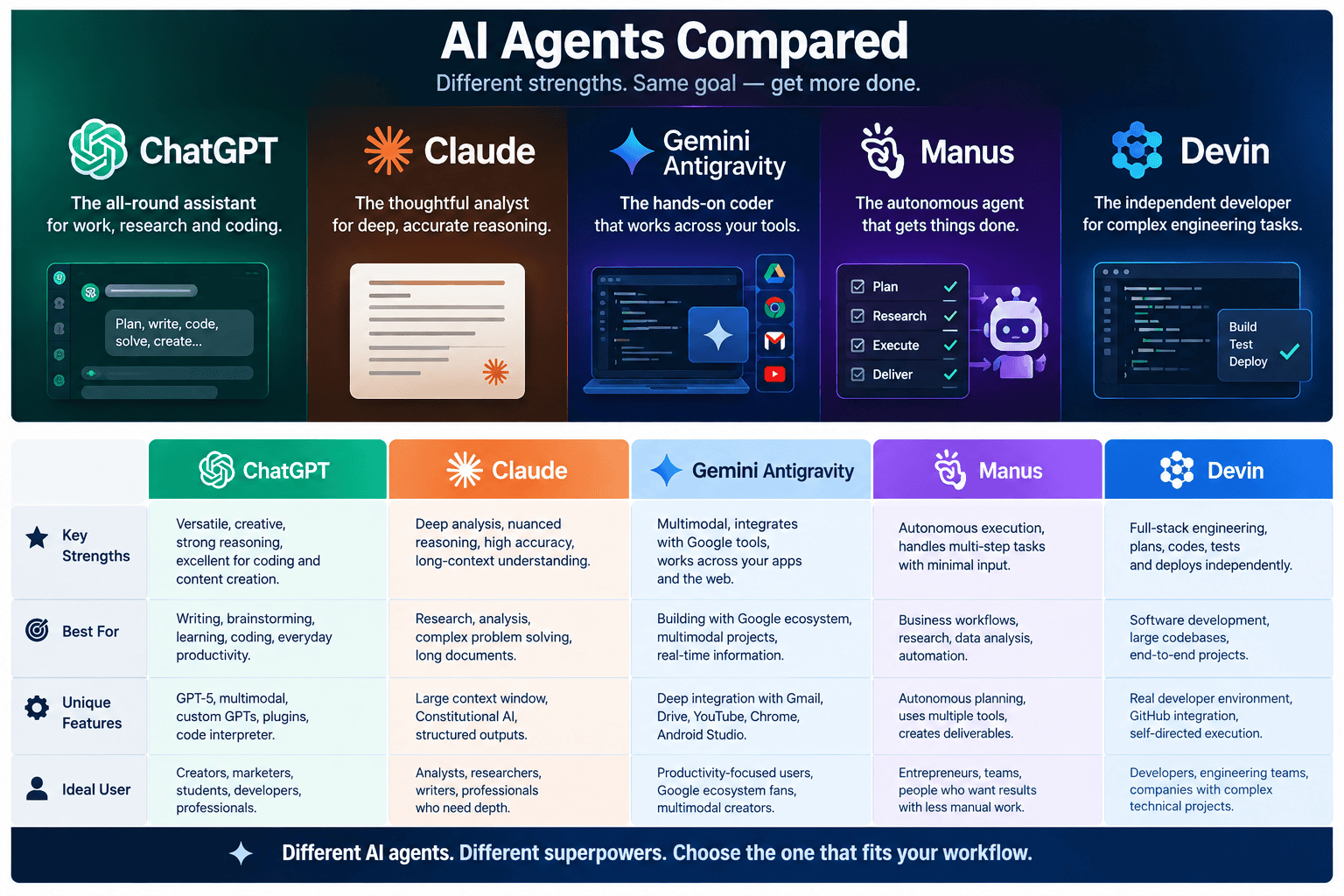
- Side-by-side
- Run the test yourself
- What benchmarks can and can’t tell you
- Security
- FAQ
- Appendices
The short answer
| If your job is… | Start with | Why | Main catch |
|---|---|---|---|
| Research, documents, spreadsheets, slides, recurring office work | ChatGPT Work | Built for multi-step deliverables, with scheduled and event-triggered runs | Allowance shared with Codex; varies by task |
| Hard coding in an existing codebase | Claude Code or Codex | Both lead independent coding leaderboards; order shifts by model version | Both burn plan allowances fast |
| File and desktop tasks, non-programmers | Claude Cowork | Works inside folders you grant; included in paid plans | Prompt-injection risk, flagged by Anthropic itself |
| Cheap experiments with coding agents | Google Antigravity | Reported free individual tier; multi-agent desktop app | Weekly quota; Google’s pages disagree on the free tier |
| Hands-off web research | Manus | Credit-based, free daily allowance | Ownership unsettled; credits don’t roll over |
| Backlog tickets that return pull requests | Devin | Takes a task, returns a PR | Cost scales with delegation; needs clear tasks |
The most useful finding is not a ranking. Several widely shared “best AI agent” lists still crown a product that, according to OpenAI, no longer exists.
How to read the tags
VENDOR company’s own page or announcement · INDEPENDENT third-party research or benchmark · PRESS named outlet, unconfirmed by the company · CONFLICTING sources disagree. Untagged statements are our own analysis.
The agent you were told to buy may be gone
At least two recently updated roundups still call ChatGPT Agent the best general-purpose agent of 2026. OpenAI’s help center now says it is no longer available and points users to ChatGPT Work for multi-step tasks and finished deliverables, plus a separate cloud browser feature VENDOR. Wikipedia’s entry on OpenAI’s Operator reports it was removed in early August 2026 without advance notice PRESS. This review therefore covers ChatGPT Work, with Codex for software.
This is the norm, not an exception:
| 2026 | What happened | Source |
|---|---|---|
| Apr 27 | China’s regulator blocked Meta’s roughly $2B acquisition of Manus | PRESS |
| May 6 | Anthropic doubled Claude Code’s five-hour caps; the weekly cap reportedly did not change | PRESS |
| May 19 | Google launched Antigravity 2.0 at I/O | PRESS |
| Jun 2 | Cognition rebranded Windsurf as Devin Desktop | PRESS |
| Jun 12 – Jul 1 | Anthropic suspended access to Claude Fable 5 and Mythos 5 to comply with U.S. export controls, then restored it | VENDOR |
| Jun 18 | Google stopped serving Gemini CLI to free and individual accounts; Antigravity CLI replaced it | PRESS |
| Early Aug | OpenAI retired ChatGPT agent | VENDOR |
What this means: don’t prepay annually on the strength of a ranking. Pick by job, run a monthly plan for 30 days, and measure.
What counts as an “AI agent”?
A chatbot answers. An agent takes a goal, plans steps, uses tools (browser, files, terminal, connected apps) and returns finished work. Interactive agents work in your files while you watch and approve (Claude Code, Codex, ChatGPT Work on desktop, Antigravity). Delegated cloud agents run elsewhere and come back with a result (Manus, Devin, Codex Cloud). One scorecard for both would mislead, so we compare by job.
Not covered: editor-first or suite-embedded assistants such as Cursor, GitHub Copilot and Microsoft 365 Copilot agents. We did not research them, so we make no claims. If you live in one of those ecosystems, add it as a sixth candidate in the test below.
Decision guide
- Reports, data analysis, recurring tasks: try ChatGPT Work first.
- Engineer on a real codebase: run Claude Code and Codex on your own repo for a week. Benchmarks say the order depends on model version.
- Learning agentic coding cheaply: start with Antigravity’s free tier; upgrade only if you hit the quota.
- Backlog of small, well-defined tickets: pilot Devin on a handful and track cost per merged PR.
- Messy research question: trial Manus on free credits and keep sensitive data out.
- Regulated or sensitive data: prefer a business or enterprise plan with admin controls, audit logging and a no-training default, and get your security team to review it first.
The six cards
Every card has the same five parts: job, risks first, what the evidence supports, price, and who should skip it. Claude Code and Cowork share one card because they share one plan and usage pool. Codex gets its own.
1. ChatGPT Work (OpenAI) · checked Oct 7, 2026
Job: research, analysis, documents, spreadsheets, presentations, recurring admin. Cloud on web and mobile; the desktop app can use local files and apps with your permission. Runs once, on a schedule, or on triggers such as a new Gmail message, Slack message or GitHub pull request activity VENDOR.
Risks first:
- Usage is hard to predict: Work follows Codex’s usage structure and varies by task VENDOR. Trackers describe rolling five-hour windows plus weekly limits PRESS.
- The predecessor was retired abruptly, forcing migration VENDOR. Newer models draw the allowance faster VENDOR.
- Prompt injection: OpenAI warned that logged-in agents face this risk and its safeguards don’t eliminate it VENDOR. Expect the same logic with connected apps.
Evidence supports: the broadest knowledge-work scope here, event-triggered tasks, and a clear permission model VENDOR. No neutral benchmark exists for office agents, so output quality is untested.
Price: Plus $20/month; Pro tiers at $100, $200 and $500; Business Premium seats include 5x Standard usage PRESS (verify on OpenAI’s pricing page).
Skip if: you need predictable, published usage numbers.
2. OpenAI Codex · checked Oct 7, 2026
Job: software work, as the coding-focused sibling of Work; available as a cloud agent (Codex Cloud) VENDOR.
Risks first:
- Shares its allowance with Work, so heavy use of one eats the other VENDOR.
- Newer models draw the allowance faster VENDOR.
- Its leaderboard position is a dated snapshot tied to a model version (see Benchmarks).
Evidence supports: a near tie with Claude Code on one September 22 Terminal-Bench 4.0 snapshot (Codex with GPT-6 Astra 58.2%, Claude Code with Fable 5.1 57.9%) INDEPENDENT. Source is an aggregator; check the primary leaderboard.
Price: bundled with OpenAI’s ChatGPT plans, from Plus at $20/month PRESS (verify).
Skip if: you want a cloud-only tool with fixed monthly cost per task.
3. Claude Code and Claude Cowork (Anthropic) · checked Oct 7, 2026
Made by the company behind the AI that drafted this article. Read with that in mind.
Job: Claude Code is a coding agent for terminal and editors; Cowork brings the approach to non-developers, working on files in folders you grant. Both are included in paid plans and share one pool with Claude chat VENDOR.
Risks first:
- Prompt injection is documented: PromptArmor reported in January 2026 that a file-exfiltration weakness first found in Claude Code also affected Cowork, where a hidden instruction in a document could upload a victim’s files to an attacker’s account INDEPENDENT. Anthropic says agent safety “is still an active area of development in the industry” VENDOR.
- Destructive actions are possible: Anthropic’s Cowork launch said Claude can take “potentially destructive actions,” including deleting local files VENDOR.
- Limits bite: Anthropic doubled five-hour caps on May 6; the weekly cap reportedly stayed put PRESS.
- Availability: top models were suspended roughly three weeks in June 2026 under U.S. export controls VENDOR (Anthropic’s statement).
Evidence supports: a near tie with Codex on the September 22 snapshot, and a lead on an October 6 snapshot (Claude Code with Opus 5.5 64.8% vs Codex 58.2%) INDEPENDENT. Different model versions and dates; aggregator source.
Price: Pro $20/month ($17 annual); Max $100 (5x Pro) or $200 (20x). Team Premium seats are listed at $125 and $150 in different sources CONFLICTING (verify at claude.com/pricing). No free Claude Code.
Skip if: you will point it at untrusted files or sites alongside sensitive data without supervision.
4. Google Antigravity (Google) · checked Oct 7, 2026
Job: low-cost coding-agent experiments; Google-centric teams. Antigravity 2.0 (May 19) is a desktop app for running multiple agents in parallel, plus a CLI (agy), an SDK and a managed-agents tier in the Gemini API. Third-party guides say it also supports selected Claude and open models PRESS. On August 21 it was bundled into Gemini Enterprise Standard and Plus at no extra cost PRESS.
Risks first:
- Google’s documentation lists a $0 individual tier while a Google One page still says AI Pro or Ultra is required CONFLICTING.
- Coding-only: we found no comparably documented general office agent from Google.
- Introductory API pricing for the default Flash model reportedly rises January 1, 2027 PRESS; free Gemini CLI access already ended June 18.
- Benchmark trap: a model scoring 89.4% on Terminal-Bench 2.1 scored 19.1% on 4.0 in one September comparison INDEPENDENT.
Evidence supports: the cheapest on-ramp: a reported $0 tier with weekly quota, a ~$20 AI Pro tier and Ultra tiers at $100 and ~$200 PRESS. Editor support includes VS Code and JetBrains (preview).
Price: $0 (weekly quota; CONFLICTING), ~$20, $100, ~$200 (verify).
Skip if: you need a mature, documented non-coding automation product.
5. Manus · checked Oct 7, 2026
Job: one-off research and “go do this” tasks where variability is acceptable. A general-purpose cloud agent launched March 2025, billed in credits. We could not retrieve a primary statement from Manus.
Risks first:
- Ownership is unsettled: Meta announced the deal in December 2025, China’s regulator blocked it April 27, and Bloomberg reported an operational split by June 11. Some September reports say Manus is independent again; other pages still say Meta owns it CONFLICTING.
- Credits don’t roll over, and refunds are reportedly discretionary PRESS.
- Much coverage comes from affiliate-style sites; verify prices on Manus’s own page.
Evidence supports: a Free plan with a reported 300 daily credits; spring 2026 pricing of $20 for 4,000 credits, $40 for 8,000, $200 for 40,000, restructured at least once PRESS.
Price: free tier, then about $20 to $200 PRESS (verify).
Skip if: you need stable ownership, SLAs or an audit trail.
6. Devin (Cognition) · checked Oct 7, 2026
Job: delegating well-defined engineering tickets and receiving pull requests. It works in a cloud environment with browser, terminal and editor. Cognition also owns the editor formerly called Windsurf, now Devin Desktop.
Risks first:
- Cost scales with delegation: the older ACU model (~$2.25 per ACU, ~15 minutes) put an hour near $9. Pricing appears restructured around June 2026, but trackers show both models CONFLICTING.
- It needs clear tasks: reviewers cite the need for clear requirements and human architectural review, plus loop risk on fuzzy tasks INDEPENDENT.
- Cognition says its engineers commit most code through Devin. That is a company claim, not independent measurement VENDOR.
Evidence supports: roundups describe it as best for handing off a scoped ticket and waiting for a PR. Cognition reportedly raised $1B in May 2026 at roughly $25 to $26B valuation PRESS (not audited).
Price: Free (limited), Pro $20, Max $200, Teams PRESS (verify).
Skip if: your tasks are exploratory or you want a tight interactive editor loop.
Side-by-side
| ChatGPT Work | Codex | Claude Code / Cowork | Antigravity | Manus | Devin | |
|---|---|---|---|---|---|---|
| Primary job | Knowledge work | Coding | Coding; file tasks | Coding, multi-agent | General cloud tasks | Delegated engineering |
| Runs | Cloud + desktop | Cloud | Local terminal/desktop | Desktop, CLI, API | Cloud | Cloud + desktop |
| Free tier | None documented | None documented | None for Claude Code | Yes, weekly (conflicting) | Yes, daily credits | Limited (reported) |
| Entry paid | $20 | $20 (via Plus) | $20 | ~$20 | $20 | $20 |
| Top individual | $500 | n/a | $200 | ~$200 | $200 | $200 |
| Usage model | Shared, 5-hour windows | Shared with Work | Shared pool, 5-hour + weekly | Weekly quota | Credits | Quota + credits |
| Biggest risk | Unpredictable usage | Shared allowance | Prompt injection | Inconsistent plan pages | Ownership | Cost at scale |
Prices as reported in September and October 2026. Verify before buying.
Run the test yourself: a 5-task bake-off (about 3 hours)
No article can run this for you: the right agent depends on your files, codebase and tolerance for editing. Use monthly plans and real work, not toy prompts.
The five tasks
- Research brief: “Compare three vendors for [your real purchase] and recommend one, with sources.”
- Spreadsheet: give it a messy CSV from your work; ask for a cleaned file plus a summary chart.
- Deck or document: “Turn these notes into a 6-slide update for [your real audience].”
- Code task: a small real bug or refactor with a test that must pass. Skip for non-coding agents.
- Recurring task: “Every Monday, summarize [source] and send me the changes.”
Score each result 0 to 2 on five criteria
| Criterion | 0 | 1 | 2 |
|---|---|---|---|
| Correctness | Wrong or invented facts | Minor errors | Verified correct |
| Completeness | Missing parts | Mostly done | Fully done |
| Edits needed | Redo it | Fix a few things | Send as is |
| Time to usable | Over an hour | 15 to 60 minutes | Under 15 minutes |
| Allowance used | Large share of limit | Moderate | Small |
Rules: same prompt for every agent, at most two re-prompts; have someone else check correctness; record plan, model and date beside every score; never test with sensitive data. Maximum is 10 per task and 50 per agent. Ignore gaps of a point or two; that is noise.
Our results: [PUBLISH YOUR OWN SCORES HERE once you have run the test, with plan, model and date for each. Until then, this section stays a protocol and the headline stays “a sourced review.”]
What benchmarks can and can’t tell you
- They are coding-centric. We found no neutral leaderboard for office agents like ChatGPT Work or Manus, which is why we don’t rank them against coding agents.
- Vendor-reported and standardized scores differ. One tracker notes Scale’s standardized SWE-bench Pro leaderboard runs far below self-reported numbers INDEPENDENT.
- Agent and model are different things. Leaderboards usually score an agent paired with a model; swap the model and the result changes.
- Versions matter. Terminal-Bench 2.1 vs 4.0 (89.4% vs 19.1% for one model) shows how. Treat any percentage as a dated snapshot.
Security: the weakness all of them share
Any agent that reads untrusted content and can act is exposed to prompt injection: hidden instructions in a page, document or email that the agent treats as commands. OpenAI and Anthropic both say their safeguards reduce the risk but don’t remove it VENDOR, and researchers have shown a working file-exfiltration attack against Claude Cowork INDEPENDENT.
- Give it one folder or project, not your whole drive.
- Turn off connectors you don’t need for the task.
- Don’t mix untrusted web content with sensitive logins in one session.
- Keep approval prompts on for sending, deleting, buying and sharing.
- Avoid vague mandates like “handle my inbox.”
- Review the output. An agent can be confidently wrong.
FAQ
What is the best AI agent in 2026?
There isn’t one. ChatGPT Work is the most direct match for knowledge work. For coding, Claude Code and Codex lead independent leaderboards, with order shifting by model version. Devin suits delegated tickets; Antigravity suits low-cost experiments. Is ChatGPT Agent still available?
No. OpenAI’s help center says it is no longer available and directs users to ChatGPT Work and a cloud browser feature. Is Claude Code free?
No. It needs a paid Claude plan (Pro at $20 a month or above) or a pay-per-token API key. Is Google Antigravity free?
Reports list a free individual tier with a weekly quota, but Google’s own pages are inconsistent. Confirm on your account. Who owns Manus?
Unsettled in public reporting. Meta announced a deal in December 2025, China blocked it in April 2026, and Meta reportedly split operations by June. Check Manus’s own announcements. Is it safe to give an agent my files and email?
It carries real prompt-injection risk, and vendors say so. Limit access, keep approvals on and keep sensitive data away from untrusted content. Do AI agents replace developers?
The evidence here shows agents completing defined tasks and returning work for human review, not replacing review. ChatGPT Work vs Claude: which should I choose?
They mostly target different jobs: Work for documents, analysis and recurring office tasks; Claude for coding (Claude Code) and file tasks (Cowork). If your work is mixed, run the test on both.
Appendices
A. Verify in 60 seconds
If a number here differs from the vendor page, trust the vendor page.
| Product | Check | Most likely stale |
|---|---|---|
| ChatGPT Work / Codex | OpenAI pricing | Tier names, usage multiples |
| Claude | claude.com/pricing | Team/Premium seat price |
| Antigravity | Google pricing and your plan page | Free-tier eligibility |
| Manus | Manus pricing | Credits, ownership |
| Devin | Cognition pricing | ACU vs tier model |
B. How this was researched
Used: vendor help centers and documentation, vendor announcements as reported by named outlets, independent security research, benchmark leaderboards and pricing pages. Not done: a hands-on same-task bake-off. Anyone claiming a clean winner across all of these without publishing that test is guessing. Where sources conflict, we say so and tag it.
C. Sources
Vendor: OpenAI Help Center: ChatGPT agent retirement · OpenAI Help Center: ChatGPT Work and Codex · OpenAI Help Center: Business release notes · Anthropic: Fable and Mythos access
Reporting and research: The Register: Claude Cowork · VentureBeat: Cowork launch · Security Boulevard: PromptArmor findings · Security Boulevard: Manus · Wikipedia: OpenAI Operator · Wikipedia: Cognition AI · Enterprise DNA: Antigravity · Startup Fortune: Antigravity API · Morph: leaderboards
Pricing trackers (secondary): CloudZero · Data Studios · CodeAgentSwarm · Agent Intellect · Spectrum AI Lab
Corrections: found something out of date? Tell us.