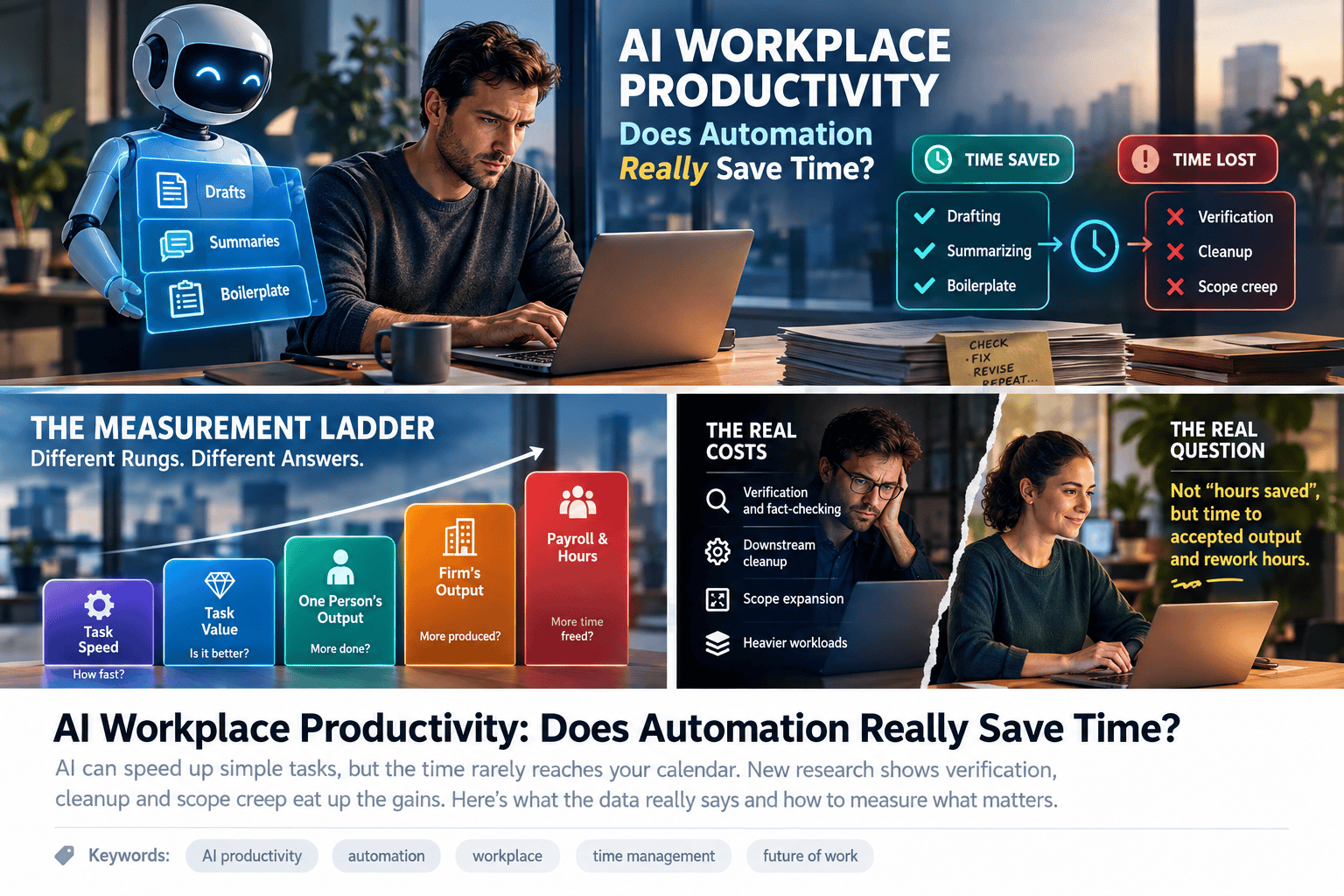
AI saves real time on individual tasks such as drafting, summarizing and boilerplate, but most of that saving never reaches anyone’s calendar: 2026 field data shows it leaking away through verification, downstream cleanup and heavier workloads. In Danish payroll records, chatbot adoption left earnings and recorded hours statistically unchanged, and workers’ own estimate of the saving averaged about 2.8% of their work hours. nberarxiv
TL;DR
- Task-level savings are real where output is easy to check (drafts, summaries, boilerplate). They shrink or reverse where checking is expensive (spreadsheet analysis, ambiguous judgment calls).
- The best-designed developer trial found a 19% slowdown in early 2025, while participants believed they were faster. The 2026 rerun was too compromised to give a current number.
- Three leaks separate “time saved” from “time released”: verification, downstream cleanup and scope expansion.
- About 89% of executives in a survey of nearly 6,000 firms report no labor-productivity effect from AI over the past three years. That is perception, not measurement. NBER
- Stop tracking “hours saved.” Track time to accepted output and rework hours.
The study that broke because people liked the tool too much
In February 2026, METR, a nonprofit that evaluates AI systems, said it was redesigning its developer productivity experiment. The reason was awkward. More developers were declining to participate because they didn’t want to work without AI, and 30% to 50% of them said they held back tasks they didn’t want to do without it. METR
That is a strange kind of evidence. Nobody demands to keep a tool that slows them down, so the refusals look like a signal that AI helps. But METR’s earlier trial showed how unreliable that signal can be. Its 16 experienced developers forecast a 24% speedup, reported feeling 20% faster afterward, and were measured at a 19% slowdown across 246 tasks. METR’s later survey work puts the average overestimate at more than 40 percentage points. arxivmetr
This matters now because licence budgets and staffing plans are being set on “hours saved” figures. Those figures come from at least six measurement methods, and their answers run from a 19% slowdown on a developer’s own repository to an 80% speedup on tasks sampled from real Claude conversations. Nothing is wrong with the arithmetic. The methods measure different things, and most of what follows is about which thing each one measures. anthropic
Why the numbers disagree: each one measures a different rung
Picture a ladder of measurements: the speed of a task, the value of a task, one person’s output, one firm’s output, and finally payroll and hours. Every rung up drops information. A tool can make a task faster without making the task more valuable, and a more valuable task does not guarantee a firm produces more.
Here is how the main sources rank, from strongest to weakest evidence for the question “does AI free up working time?”
| Source | Design | What it can actually show | Strength |
|---|---|---|---|
| Humlum & Vestergaard, NBER 33777 | Adoption surveys linked to Danish administrative records | Effects on earnings and recorded hours | Strong for pay and hours. Covers 2023–24 tools. |
| METR trials (2025, 2026) | Randomized tasks, experienced open-source developers | Task completion time | Strong design, small samples. 2026 round compromised. |
| Brynjolfsson et al., Dell’Acqua et al. | Field rollout at one firm; preregistered experiment with 758 consultants | Throughput and quality | Strong internally. One firm each. Dell’Acqua used GPT-4. |
| UK DBT Copilot evaluation | Diaries and usage data, no counterfactual | Self-reported time saved, task quality | Moderate to weak. 32% diary response. Oct–Dec 2024. |
| NBER “Firm Data on AI” | Executive surveys, four countries | Perceived firm-level effects | Moderate. Broad, but perceptions. |
| Workday and BetterUp/Stanford surveys | Self-reported surveys | Rework and “workslop” | Weak to moderate. Self-reported, from vendor-adjacent sources. |
| Anthropic productivity estimate | Claude estimates time saved on 100,000 conversations | Task-level speedup | Weak for net productivity. First-party, model-estimated. |
| METR survey | 349 technical workers, convenience sample | Self-reported value uplift | Weak. METR itself flags overstatement risk. |
Two notes on this ranking. Anthropic makes the Claude assistant, so its estimate is a first-party claim. And its authors say the estimate doesn’t include the time humans spend checking Claude’s work outside the conversation, which is exactly where the leaks below occur. anthropic
The strongest evidence comes from payroll data and randomized trials, and both are quiet. The loudest numbers come from the weakest designs.
What METR’s two rounds do and don’t tell you
The early-2025 result is the most-cited number in this debate and, by now, a stale one. The 2025 study found tasks took 19% longer with AI, with a confidence interval from +2% to +39%. That interval means the slowdown was probably real, but its size was uncertain. It covered tools from early 2025, in the hands of experienced developers working on repositories they knew well. METR
METR’s follow-up, started in August 2025, produced raw estimates that leaned toward speedup: about 18% faster for the ten returning developers (interval −38% to +9% on the time change) and about 4% faster for newly recruited developers (−15% to +9%). Both intervals include zero. More importantly, METR judged the data unreliable and likely biased against AI, because the developers who most value AI opted out, and the pay dropped from $150 to $50 an hour. METRMETR
My read, as an inference and not a finding: anyone still quoting “AI makes developers 19% slower” as a 2026 fact is wrong, and anyone quoting the 2026 round as proof of a big speedup is also wrong. What the evidence supports is narrower. On the tasks developers were willing to submit, AI looks roughly neutral to modestly helpful, and the tasks where it helps most are the ones being screened out.
METR’s own May 2026 survey adds a second warning. Its 349 respondents reported a median 1.4–2x gain in the value of their work and a median 3x change in speed. The gap matters. METR expects speed figures to overstate value, because people substitute toward tasks that AI makes cheap but that matter less, and in the cases where it could inspect public output behind 10x claims, it judged them overstated. Someone who builds a dashboard in an hour that would have taken thirty hours reports a giant speedup. The dashboard may still not be worth much. Measuring the Self-Reported Impact of Early-2026 AI on Technical Worker Productivity +2
The time ledger: where a saved hour goes
Frame the question as accounting. Gross savings are the top line. Three deductions come out before any time reaches the person who could spend it.
The diagram carries no invented percentages. Each leak is tagged with the source that documents it and the strength of that source. The three leaks run through different mechanisms, so I take them in turn.
Leak A: verification
Output that looks right and isn’t forces a check, and the check costs time. In a Workday survey of employees and leaders, 85% of respondents said AI saved them one to seven hours a week, but Workday estimated that roughly 37% of that time went to correcting, clarifying or rewriting AI output. Only 14% of employees said they consistently get clear net-positive outcomes. Workday sells AI-enabled HR and finance software and frames the problem as generic tools, so read the number as directional. It is self-reported and vendor-adjacent. QuartzNewsroom
Independent evidence points the same way in a specific place. The UK Department for Business and Trade gave 1,000 Microsoft 365 Copilot licences to staff from October to December 2024, and about 300 people consented to data analysis. The evaluation found extra time on some tasks, caused either by Copilot’s output not being good enough or by extra work that only existed because Copilot was there. It found no evidence that time savings translated into productivity. A secondary write-up reports Excel analysis was slower and less accurate with AI, while PowerPoint creation was seven minutes faster but of lower quality. UK government trial of M365 Copilot finds no clear productivity boost +2
Two limits apply. The trial predates today’s tools. And the report describes itself as an evaluation without a counterfactual, with a 32% diary response rate. It supports one narrow claim: routine writing tasks sped up while complex analysis did not. service
Leak B: the cost moves to the receiver
Verification is at least paid by the person who used AI. The worse leak is the one where cleanup lands on a colleague. BetterUp and Stanford’s Social Media Lab coined “workslop” for AI output that looks polished but lacks the substance to advance the task. Respondents reported spending an average of 1 hour and 56 minutes on each incident, which the researchers priced at about $186 a month per person. About 40% of 1,150 surveyed desk workers said they had received workslop in the previous month. Note that BetterUp’s own pages give both 1,150 and 1,004 as the sample size, and the prevalence appears as both 40% and 41%. I treat the figures as a range and as self-reported. Coverage of a June 2026 HBR article on “knowledge decay” notes that the concept itself hasn’t been tested in controlled studies. AI “workslop” is crushing workplace efficiency, study finds +2
This leak yields the most useful rule in the article, which I’ll call the break-even rule. A shortcut that saves the sender less time than the receiver’s cleanup costs is a net loss for the organization. With a reported average cleanup of 116 minutes, a sender who saves 20 minutes on a draft and triggers one such incident has cost the firm about an hour and a half. The sender’s timesheet shows a win and the organization’s shows a loss, which is why sender-side “hours saved” surveys can’t detect this problem.
Leak C: the saved hour becomes more work
In an eight-month study of a US technology company with about 200 employees, Berkeley researchers found AI didn’t reduce work; people worked faster, took on broader scope, and stretched work into more hours of the day. Workers juggled multiple active threads and revived long-deferred tasks because AI could handle them in the background. One firm and 200 people can’t be generalized to the economy, but the mechanism is easy to recognize, and it shows up at scale too. Benton Institute for Broadband & SocietySimon Willison
The Danish study finds that employers absorb AI through task reorganization, including new tasks in content generation, AI oversight, and AI integration, while earnings and hours stayed put. The work changed shape without shrinking. nber
A related question is who gets to spend a saved hour. Meta’s CTO Andrew Bosworth reportedly told staff in July that AI gains should go into building more, not into extra days off. He later said he had come down too hard on the employee. It is one company’s executive, relayed through press reports, and I wouldn’t generalize it. It does show the default outcome when nobody decides what saved time is for. The Next WebStartup Fortune
The net-time arithmetic
Calculation beats repetition, so here are the published figures run through simple math. Everything below is editorial arithmetic on other people’s numbers. It is not a new measurement, and it mixes studies with different populations. Treat it as a scale check.
| Step | Inputs | Source | Result |
|---|---|---|---|
| Average saving, Denmark | 2.8% × 40-hour week | Humlum & Vestergaard (2025 draft, self-reported) | ≈ 1.1 h (67 min) per week |
| Net of rework | 1–7 h saved × (1 − 0.37) | Workday | ≈ 0.6–4.4 h per week |
| One workslop incident | 116 min ÷ 67 min | BetterUp/Stanford vs. Denmark average | ≈ 1.7 weeks of average savings |
| Perception gap | Felt +20% vs. measured −19% | METR 2025 | ≈ 40-point spread |
The third row is the one I’d put in front of a budget committee. Under the average Danish savings, a single incident of downstream cleanup cancels almost two weeks of one worker’s gain. The rows use different populations and time periods, so this isn’t a forecast. It shows that leaks measured in hours are big enough to matter next to savings measured in minutes.
One caution on the Danish figure. I’ve taken 2.8% from the 2025 draft, as described in secondary sources, and couldn’t confirm it in the March 2026 revision. The precision bound also moved between versions. Press coverage of the first draft quoted a bound ruling out effects on earnings and hours above 1%, while the March 2026 revision rules out effects larger than 2%. The null result stands, but the range of effects it excludes is wider than early coverage suggested. Quartznber
Who gains: the verification asymmetry
The pattern across studies is consistent. AI helps most where the person lacks context and can cheaply check the result, and it helps least, or harms, where they have deep context, and checking is hard.
- In a customer-support rollout covering 5,179 agents, AI raised issues resolved per hour by 14% on average and 34% for novice and low-skilled workers, with minimal impact on experienced, highly skilled workers. nber
- In a preregistered experiment with 758 consultants, AI users on 18 tasks within AI’s capability completed 12.2% more tasks and finished 25.1% faster, but on a task outside its capability they were 19 percentage points less likely to reach the correct answer. The study was formally published in Organization Science in March 2026. mitit
- METR’s 2025 subjects were experts on their own repositories, and they were the ones measured slower.
My explanation, which is analysis and not something these studies test: production cost falls for everyone, but verification cost doesn’t. An expert’s own baseline is fast and their internal model is rich, so checking generated output against it is a large share of the job. A novice’s baseline is slow, and an acceptable draft is a big step up. The consultant result adds a further risk: users can produce more persuasive arguments even when the answer is wrong, per one practitioner’s summary of the paper, which I haven’t verified against the full text. linkedin
That gives a practical triage, which is my editorial classification and not a study result:
| Task | Cost to check | Cost of a miss | Reading |
|---|---|---|---|
| Meeting recap | Low | Low | Use it. |
| First draft of a routine email | Low | Low | Use it. |
| Spreadsheet analysis behind a decision | High | High | Use with a check step. UK trial results were weakest here. |
| Recommendation on an ambiguous problem | High | High | Treat AI as a sparring partner, not an author. |
The best case for the optimists
The optimist case has three parts, and each has evidence.
First, METR itself thinks current tools help more than its 2025 result showed. Its update says developers are likely more sped up in early 2026 than in early 2025, though its data is only very weak evidence for the size of the gain. The people best placed to know say the old number is out of date. METR
Second, “speed” undercounts value in some cases. If AI makes worthwhile tasks affordable that would never have been done, output rises even when no hours are released. Anthropic’s field estimate points this way, though it’s a first-party number built from model-estimated time. Claude speeds up individual tasks by about 80% in its sample and, extrapolated, would raise US labor productivity growth by 1.8% a year over a decade if adopted widely. Reporting on the study notes the method relies on Claude to estimate task times and leaves out checking time. The estimate is an upper bound on the task-level effect. It isn’t a forecast. anthropicTime
Third, accessibility. The UK evaluation found Copilot was particularly beneficial for neurodiverse colleagues, who were significantly more satisfied, and non-native English speakers reported gains in wellbeing and confidence. A tool that fails a productivity test can still be worth its licence for those groups. service
None of that rescues the claim that AI is already freeing up working time at scale. It does mean “no measured time saved” and “no value” are different conclusions.
Will it show up later?
This is the question the whole debate turns on, so here is a direct answer. Maybe, and the current data can’t say. The Solow-paradox story, where a general-purpose technology takes years to appear in statistics, is plausible. But it can’t be falsified with today’s data, which makes it a hope and not a finding.
Consider what the aggregate data offers. US nonfarm business labor productivity rose 2.2% year over year in Q2 2026, with output up 2.5% and hours up 0.2%. BLS puts its long-term productivity growth rate since 1987 at 2.1%. So the latest year sits close to the long-run average, and no statistic separates AI’s contribution from everything else. Bureau of Labor StatisticsBureau of Labor Statistics
Expectations are running ahead of results. Executives in the NBER survey predict AI will raise their firms’ productivity by an average of 1.4% over the next three years. The minority who reported past effects saw an average boost of just 0.29%, and US employees expected smaller gains (0.9%) than US executives did (2.3%). Executives’ own usage is thin: more than two-thirds use AI regularly, but average only 1.5 hours a week. That is a survey of beliefs held by people who don’t use the tool much. Firm Data on AI by Ivan Yotzov, Jose Maria Barrero, Nicholas Bloom, Philip Bunn, Steven Davis, Kevin Foster, Aaron Jalca, Brent Meyer, Paul Mizen, Michael A. Navarrete, Pawel Smietanka, Greg Thwaites, Ben Zhe Wang :: SSRN +2
My position: the 2026 net effect for the median office worker is a modest, uneven reduction in effort on routine writing and summarizing, absorbed mostly as extra output or extra checking. The large multiples in headlines are task-speed numbers on selected work. The small numbers in payroll data are what’s left after the ledger closes. That is inference, and three kinds of evidence would settle it:
- Quality-adjusted output per hour at firm level, matched adopters against non-adopters, over at least three years.
- Payroll-linked hours data extended beyond the Danish window.
- Fixed-task randomized trials with blind quality grading, the design METR says it is moving toward.
What to measure on Monday
If you’re deciding whether AI is saving your team time, drop “hours saved” and run this instead:
- Fix the task set. Pick 6–10 recurring task types before anyone starts. METR’s experience shows people quietly withhold tasks when the choice is theirs.
- Randomize by task. Assign each task to AI-allowed or AI-not-allowed for three to four weeks.
- Stop the clock at acceptance, when a second person signs off, not at first draft.
- Log receiver cleanup. Ask recipients how many minutes they spent fixing what they were sent.
- Blind-review a sample for quality, so speed gains don’t hide degraded output.
- Compute net time: gross saving minus verification minus receiver cleanup. Then record where any remainder went: new scope, more output, or actual free time.
If people refuse the no-AI arm, which METR ran into, randomize by week or by task type, or compare a team using the tool against a control team over the same period. If a trial is too heavy, use proxies: review time per document, rework tickets, and cycle time from draft to approval.
The trade-offs are real. Measurement has overhead. Blinding is hard on a small team, and small samples are noisy. Results are also tied to a tool version, so re-run quarterly.
AI doesn’t save your time until someone decides, on purpose, what the saved time is for. Until then, it mostly changes who does the checking.
Next step: pick one recurring task this week and run the accepted-output clock on it.