
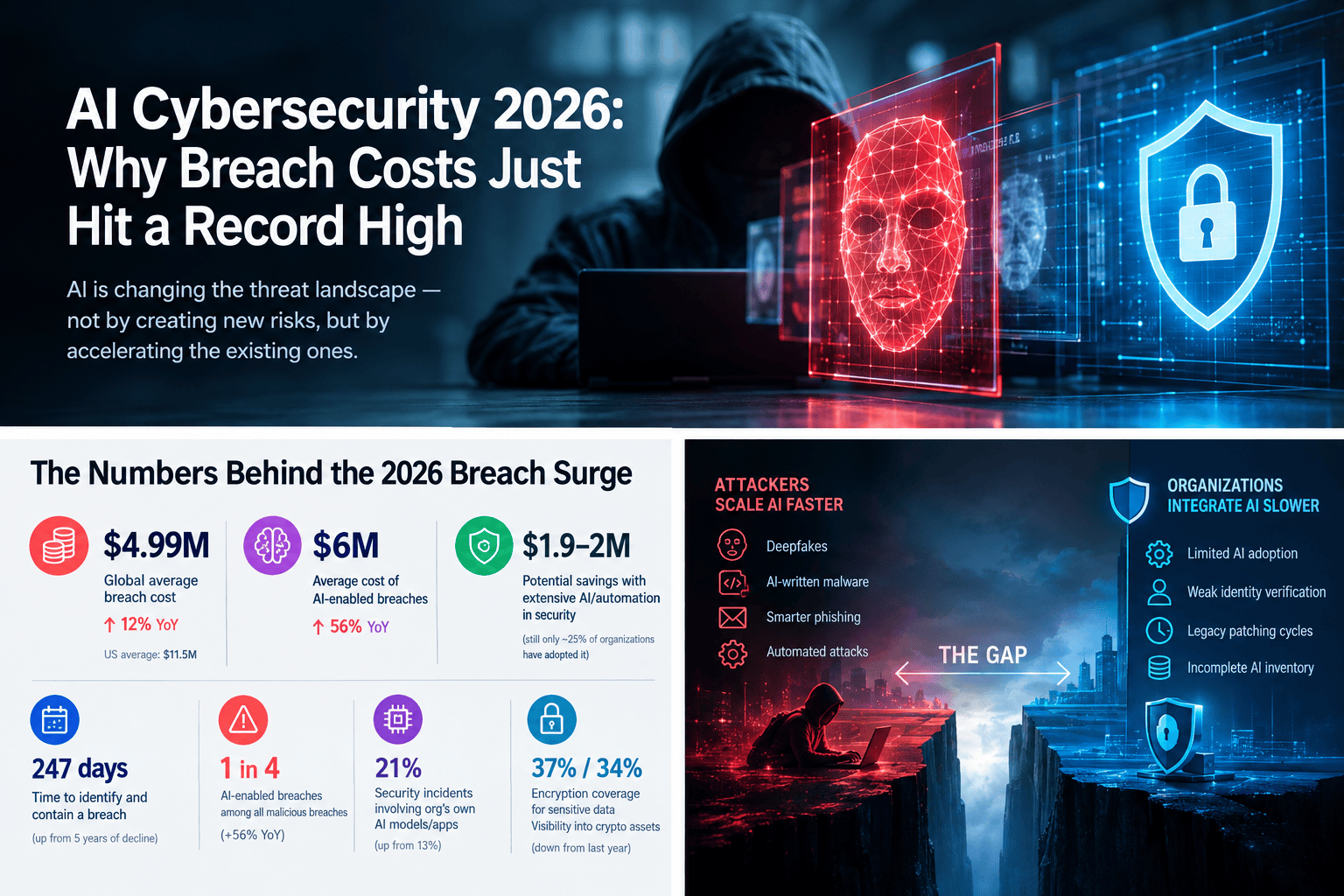
Confidence tier: Established, unless marked otherwise. Figures below trace to IBM’s Cost of a Data Breach Report 2026 (Ponemon Institute, 602 organizations breached March 2025–February 2026, released July 29, 2026), Verizon’s 2026 DBIR, Google’s Threat Intelligence Group, and named sources listed at the end.
A year ago this report would have opened with good news: breach costs had fallen for the first time in five years, and AI-assisted defense got a share of the credit. That draft is obsolete. IBM’s 2026 edition reverses it — the global average cost of a breach hit $4.99 million, a record and a 12% jump, and the time it takes to identify and contain a breach rose to 247 days after five consecutive years of getting shorter.
Nothing single caused that. What happened instead is a gap widening in plain sight: attackers scaled AI faster than most organizations integrated it into defense. IBM’s own data shows both halves of that sentence are true at once. Extensive AI/automation use in security still saves an organization roughly $1.9–2 million per breach. And AI-enabled attacks — mostly deepfake impersonation and AI-written malware — now make up one in four malicious breaches, up 56% in a single year, and cost $6 million on average when they land. Roughly a quarter of organizations still haven’t adopted AI/automation into security operations at all. That quarter is paying the difference.
The numbers that carry this article:
- Global average breach cost: $4.99M (record, +12% YoY). US average: $11.5M.
- AI-enabled breaches: 1 in 4 of all malicious breaches, up 56% YoY, averaging $6M each — about $1M above the overall average.
- Extensive AI/automation use in security cuts roughly $1.9–2M off average breach cost — yet about a quarter of organizations still haven’t adopted it.
- Security incidents involving an organization’s own AI models or applications: 21%, up from 13% a year earlier.
- Encryption coverage for sensitive data (at rest and in transit) fell to 37%; only 34% of organizations have visibility into their own cryptographic assets.
Three Places the Gap Is Actually Opening
Strip out the vendor language and three failures explain almost everything in the data above. Two of them are old failures moving faster. One is new.
Identity verification broke, and AI just walked through the hole
Deepfake fraud and AI-polished phishing look like different problems in most coverage. They’re the same problem wearing different clothes: both defeat the assumption that recognizing a face, a voice, or a well-written email is proof of who sent it.
The largest confirmed case is still the one from Hong Kong: in January 2024, a finance employee at engineering firm Arup authorized 15 wire transfers totaling roughly $25.6 million after joining a video call where every other participant — including the apparent CFO — was AI-generated in real time. No system was breached. The one control that was supposed to catch it, human recognition, was the control being attacked. That pattern hasn’t slowed down. In January 2026, a Swiss businessman transferred several million francs across a series of calls with someone he believed was a longtime business partner, later confirmed to be a voice clone built from public audio. Industry trackers citing FBI data put AI-assisted deepfake involvement in business email compromise at under 5% of incidents in 2023, rising to roughly 40% by early 2026 (Confidence: Probable — traced to one secondary source, not independently confirmed against the FBI report itself).
Phishing rode the same mechanism to a quieter but larger total impact: it remained the single leading initial access vector for the fourth straight year — 17% of all breaches, and the costliest vector tracked at $5.29 million average. What changed is which tell worked. Broken grammar used to flag a phishing email; generative AI erased that signal almost entirely. Detection has to run on identity and behavior now — domain age, authentication results, sending anomalies — infrastructure most small and mid-size organizations simply haven’t built.
Both problems share one fix, because they share one failure: verification has to happen out-of-band, on a channel the attacker didn’t control. A callback to a number already on file, not one given during the suspicious call. No exception for “the CEO says it’s urgent” — that phrase is the attack, not a reason to skip the check.
Malware that rewrites its own signature stopped being a lab demo
In November 2025, Google’s Threat Intelligence Group disclosed two malware families that query a large language model during execution rather than running fixed code. PROMPTFLUX prompts Google’s Gemini API to regenerate and re-obfuscate its own VBScript roughly every hour. PROMPTSTEAL — also documented by Ukraine’s CERT-UA as LAMEHUG — queries an open-source model hosted on Hugging Face to generate its commands on demand, and is attributed to the Russian state-linked group APT28. Google called it the first confirmed instance of an LLM queried inside a live attack rather than a test environment.
As of early 2026, that distinction still holds in opposite directions: PROMPTSTEAL is documented as active in ongoing espionage operations, while PROMPTFLUX remains assessed as experimental, without a confirmed means of compromising a device on its own. That gap between the two matters more than either strain individually. It shows the technique works in production for the strain an actor invested in operationalizing, and sits dormant for the one that’s still a proof of concept — which means the next mature version of this pattern is a matter of investment, not invention.
The defensive consequence is structural, not incremental. Signature-based detection assumes malware stays the same long enough to be hashed and matched. Code that regenerates itself on every run breaks that assumption by design, which pushes detection toward behavioral analysis — what the code does once it’s executing, not what it looks like on disk. That’s a real cost: behavioral detection is noisier and needs environment-specific tuning most teams don’t budget for.
The patch clock lost the race it was already losing
Verizon’s 2026 DBIR found something that would have been the year’s headline in a quieter year: exploitation of vulnerabilities overtook stolen credentials as the leading initial access vector into critical infrastructure. Remediation moved in the wrong direction to meet it — only 26% of vulnerabilities in CISA’s Known Exploited Vulnerabilities catalog were fully patched in 2025, down from 38% the prior year, and the median time to fully resolve one rose to 43 days from 32. Edge devices, VPNs, and firewalls specifically saw their share of vulnerability-driven breaches jump from 3% to 22% in a single year.
AI’s role here is unglamorous but decisive: automated tooling compresses the gap between a CVE’s publication and a working exploit from weeks to days. A 43-day median patch window was already too slow against a days-long weaponization clock before AI entered the picture. AI didn’t create this race. It just made the losing side lose faster.
The two boxes above aren’t opposite forecasts. They’re both true, right now, inside the same $4.99 million average. The organizations pulling that average up are disproportionately the ones still standing in the gap between them.
The Posture Gap: Why Your Own Stack Is Now the Third Attacker
Everything above describes something being done to organizations. This part is about what’s happening inside them, and IBM’s data suggests it’s growing faster than the external threat.
Security incidents tied to an organization’s own AI models or applications rose to 21% of breached organizations, up from 13% a year prior. That’s not attackers getting more creative about targeting you — that’s the AI footprint inside most organizations expanding faster than anyone’s inventory of it. The 2025 report found 97% of organizations breached in an AI-related incident lacked proper AI access controls at the time; the 2026 coverage reviewed for this piece didn’t restate that exact figure, but the surrounding numbers point the same direction. Encryption coverage for sensitive data — at rest and in transit combined — actually fell this year, to 37%. Visibility into cryptographic assets sits at 34%. An AI system nobody has inventoried is a system nobody is encrypting, patching, or watching. The access-control failure and the encryption failure aren’t two problems. They’re one failure showing up on two different line items.
The specific exposure types worth knowing by name, because none of them trip a conventional control:
- Data poisoning — manipulated training data that degrades or biases output, usually invisible until it’s already in production.
- Model extraction — systematically querying an API to reconstruct a proprietary model and the patterns baked into its training data.
- Adversarial inputs — samples that look ordinary to a person but force a misclassification, especially dangerous in fraud detection and medical imaging.
- Membership inference — probing a model to determine whether a specific person’s data was used to train it, which is a privacy violation on its own.
- Supply chain compromise — a poisoned pre-trained model or third-party AI API propagating risk into everything built on top of it.
A web application firewall doesn’t read training data. Endpoint detection doesn’t watch for model drift. That mismatch is exactly why shadow AI carries the specific premium it does in the data: one AI tool nobody approved, handling customer data, sits in a blind spot the rest of the security stack was never designed to see.
The Fix, In the Order the Evidence Supports
Not every control deserves equal budget, and “buy AI-powered everything” is how this year’s savings evaporate into next year’s shelfware. Here’s the sequence, ranked by what the data above actually shows failing first, with a timeframe attached to each so it’s a plan and not just a list.
| Priority | Control | Evidence it’s first | Start by |
|---|---|---|---|
| 1 | Out-of-band verification for payments and credential changes | Arup ($25.6M) and the January 2026 Swiss case both involved zero technical compromise | Day 15 |
| 2 | AI asset inventory across the organization | 21% had an incident tied to their own AI, up from 13% — you can’t secure what you haven’t named | Day 1 |
| 3 | 14-day patch SLA against CISA’s KEV catalog, edge devices first | Only 26% of KEV entries fully remediated in 2025; edge-device exploitation share rose from 3% to 22% | Day 15 |
| 4 | AI-assisted triage on telemetry you already have | Extensive users save $1.9–2M and cut containment time; the gap is adoption, not capability | Day 46 |
| 5 | Behavioral detection layered over signature tools | Self-rewriting malware defeats a signature by design, every time it runs | Day 46 |
Start the inventory on day one, because everything else depends on knowing what you’re protecting. Run the two procedural fixes — verification and patching — in parallel starting day 15; neither requires new tooling, both are close to free, and together they address the two attack patterns doing the most damage in the data above. Only after both are running does it make sense to point AI-assisted triage at your existing detection data, starting around day 46 — track one number weekly (mean time to acknowledge on your top three alert categories), and if 60 days in there’s no measurable movement, the problem is almost always data quality feeding the model rather than the model itself. Fix ingestion before adding another tool on top of it.
If there’s no team to staff row 4, skip it. Buy managed detection with AI-assisted triage built in, and put the budget you saved into rows 1 through 3 instead. Those three controls stop the costliest attack categories in this report and cost close to nothing to implement.
Where This Still Breaks
Three failure modes are worth naming plainly, because they’re the ones that quietly undo a program that looked solid on rollout day.
Wider detection nets catch more noise, and noise left untended becomes its own outage. Independent testing of AI-assisted detection tools has repeatedly shown them flagging far more suspicious activity than traditional tools in side-by-side comparison — and a meaningful share of those flags are false positives. Without a deliberate analyst feedback loop built into the rollout, that extra signal turns into alert fatigue within a few months, and alert fatigue is how a real intrusion gets missed inside a pile of noise your own tooling generated.
Deepfake detection is a losing bet if it’s the only control. Detection models are built after synthesis models exist, which means they’re structurally always a step behind whatever generated the fake in front of you. Out-of-band verification doesn’t care how convincing the deepfake is — it sidesteps the question entirely. Treat detection software as a tripwire that might catch something, never as the control the rest of the plan depends on.
AI copilots are a new door, not just a new tool. Any assistant reading external content — inbound email, a web page, an uploaded document — can be instructed by that content, not just by the person using it. Least-privilege permissions and human confirmation on anything that can actually act (send, pay, delete) aren’t optional hardening here; they’re the only thing standing between a prompt-injection attempt and a real transaction.
The Honest Counterargument
There’s a credible reading of this same data where AI is mostly an accelerant rather than a new category of threat — and it comes from the people who wrote the primary report. Verizon’s SVP for global solutions, Daniel Lawson, made roughly this point about the 2026 DBIR: threat velocity is rising because of AI, but the foundational practices of security and risk management remain the most effective defense against it, AI-driven or not.
The numbers underneath this article support that more than they undercut it. Phishing still wins because identity verification is still weak — not because the emails got better written. Vulnerability exploitation wins because a 43-day patch cycle can’t outrun a days-long weaponization window, and that math didn’t require generative AI to be true. Even the AI-specific failures in this year’s report are governance failures in new clothes: an organization running the first three rows of the sequence above is already harder to breach than most AI-equipped peers who skipped them.
What actually moved in 2026 is clock speed, not the win conditions. Verification, patching, and inventory still decide who ends up on the wrong side of that $4.99 million average. AI just punishes whoever was already slow at those three things — faster than it used to.
Do This Before You Close the Tab
Not this quarter. This week. Send whoever owns security or IT at your organization three questions: Which AI tools currently touch our customer data? What’s our real SLA on CISA KEV entries? Who can verify a wire transfer without using the channel the request arrived on? Any answer that’s “I’m not sure” is next year’s line item in a report exactly like this one.
Sources
- IBM, Cost of a Data Breach Report 2026 (Ponemon Institute, 602 organizations, March 2025–Feb 2026, released July 29, 2026): https://www.ibm.com/reports/data-breach
- IBM Newsroom, “One in Four Malicious Breaches are AI-Enabled” (July 29, 2026): https://newsroom.ibm.com/2026-07-29-ibm-study-one-in-four-malicious-breaches-are-ai-enabled,-costing-companies-6-million-on-average
- Verizon, 2026 Data Breach Investigations Report (via Industrial Cyber coverage) — initial access vectors, KEV remediation: https://industrialcyber.co/reports/verizon-dbir-finds-vulnerability-exploitation-overtakes-stolen-credentials-as-top-breach-entry-point-for-critical-infrastructure/
- Google Threat Intelligence Group, via The Hacker News — PROMPTFLUX, PROMPTSTEAL disclosure (Nov 5, 2025): https://thehackernews.com/2025/11/google-uncovers-promptflux-malware-that.html
- techyengineer.com — PromptSteal live-operations status as of March 2026, cross-checked against GTIG’s original disclosure: https://www.techyengineer.com/promptsteal-in-detail/
- BeyondScale, “Deepfake CEO Fraud: Voice Cloning Defense Playbook 2026” — January 2026 Swiss voice-clone case, FBI BEC deepfake share (secondary source, single citation, not independently verified): https://beyondscale.tech/blog/deepfake-ceo-fraud-voice-cloning-defense-2026
- Arup deepfake incident, aggregated Hong Kong police statements and CNN/SCMP reporting via the AI Incident Database: https://incidentdatabase.ai/cite/634/
Update Ledger
- 2026-09 structural revision (v2): This is not a data patch on top of the prior structure — the skeleton changed. The four parallel attack-pattern sections were reorganized into three, merging deepfake fraud and phishing under one “identity verification broke” frame instead of treating them as unrelated patterns, since both exploit the same underlying failure. The separate decision-matrix table and 90-day narrative plan (which repeated the same justification language twice) were merged into one sequenced table with start-days attached directly to each row. The defense-economics table and the AI-stack-risk section were merged into one “Posture Gap” section, since both describe organizational readiness rather than attacker technique. Failure modes were cut from five shallow entries to three with more depth each.
- Rebuilt the SVG diagram from scratch rather than reusing the prior attacker/defender-loop design. The new version is a direct cost comparison ($6.0M attack premium vs. $1.9–2M defense savings) with the adoption gap and AI-stack risk called out explicitly, matching ainvasion.com’s indigo/teal/copper palette — flagging this as an assumed destination site since it wasn’t specified; swap the palette if this runs on a different property.
- Actively cut recurring short-declarative-turn sentence constructions (“X. It isn’t. Y is why.”) that were flagged as a detectable AI pattern in the prior version; replaced with longer, more varied sentence structures throughout, particularly in the failure-modes and counterargument sections.
- Carried forward from the previous revision: the full 2026 IBM data refresh, the January 2026 Swiss deepfake case, the current PROMPTFLUX/PROMPTSTEAL operational status, and the confidence-tier flags on figures not re-confirmed in 2026 coverage.