
By [Tom Morgan] — AI Policy & Infrastructure Desk · Published September 2026
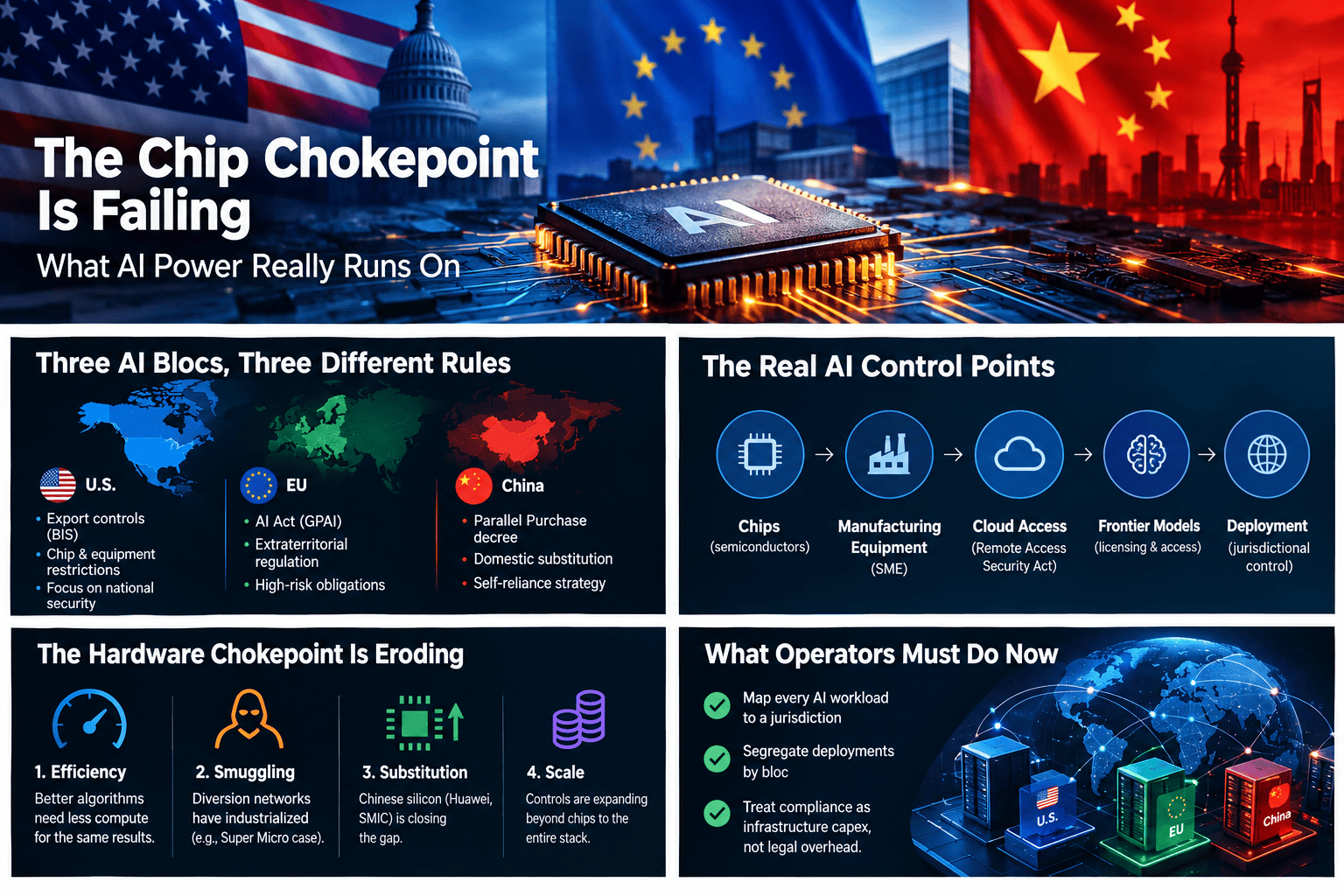
Direct answer: AI geopolitics in 2026 no longer runs on a single hardware chokepoint. US export controls, EU regulatory extraterritoriality, and China’s forced-substitution policy have split global AI into three partially disconnected stacks — and the control point is shifting from chips themselves to compute access, frontier-model licensing, and jurisdictional control over deployment.
URL slug: ai-geopolitics-chip-chokepoint-2026 · Meta description: “Export controls, the EU AI Act, and China’s Parallel Purchase decree have split AI into three blocs. What actually controls AI power in 2026 — and what operators must do now.”
Quick definitions, for readers who don’t live in export-control law: BIS is the US Bureau of Industry and Security, the Commerce Department arm that issues export licenses. SME here means semiconductor manufacturing equipment (the machines that make chips), not “small and medium enterprise.” GPAI is “general-purpose AI” — the EU’s regulatory category for foundation models like GPT, Gemini, and Claude. FLOPs are floating-point operations, the standard unit for measuring how much computation went into training a model.
TL;DR
- The hardware-chokepoint theory of AI control is degrading: chip smuggling at industrial scale, rapid algorithmic efficiency gains, and domestic substitution are eroding its premise (Chatham House).
- The compute ledger is lopsided but not quite as extreme as some coverage claims: independent analyses converge on roughly 74–75% of advanced AI computing capacity in the US and 14–15% in China, with the rest of the world splitting the remainder (Carnegie Endowment; UN Independent International Scientific Panel on AI, preliminary report, July 2026).
- Controls are climbing the stack: chips → semiconductor manufacturing equipment → cloud access (Remote Access Security Act, passed the House January 2026) → frontier models (Anthropic directive, June 2026) (American Action Forum).
- The EU AI Act’s high-risk (Annex III) obligations were set for 2 August 2026 — but a provisional Digital Omnibus agreement reached 7 May 2026 proposes pushing Annex III to 2 December 2027 and Annex I to 2 August 2028, while adding two new Article 5 bans effective 2 December 2026. This has not been finalized as binding law as of publication — treat both dates as live possibilities, not a settled calendar.
- For operators: map every AI workload to a jurisdiction, segregate deployments by bloc, and treat compliance as infrastructure capex, not legal overhead.
The Indictment That Exposed the Doctrine
On 19 March 2026, federal prosecutors in the Southern District of New York unsealed an indictment charging three former Super Micro Computer executives with diverting approximately $2.5 billion in AI servers toward end users in China. The case is pending and the counts are allegations. But the operational detail matters more than the verdict: a diversion channel of that size allegedly ran for years inside one of America’s most scrutinized hardware supply chains — while export controls were supposedly tightening. It is not an isolated case, either: a separate March 2026 indictment charged two US citizens and a Chinese national with using a Thailand-based front company to funnel export-controlled chips to China, and it followed a December 2025 enforcement action that had already disrupted a network responsible for at least $160 million in diverted AI chip exports (Alvarez & Marsal).
That case captures, in a single exhibit, why the hardware-chokepoint doctrine is failing.
The doctrine was simple and once defensible: frontier AI capability is bottlenecked by advanced semiconductors, so restricting adversaries’ access to chips restricts their AI progress. For roughly three years it structured Washington’s entire approach — first blocking AI accelerators, then the lithography and deposition equipment needed to make them, in coordination with the Netherlands and Japan.
Each leg of that logic has since been cut. First, efficiency: algorithmic improvements keep lowering the training compute required for a fixed capability level, so any control threshold written in FLOPs ages quickly. Second, smuggling: enforcement agencies lack the ability to track AI chips at scale once they leave authorized hands, and diversion networks have industrialized — the Super Micro case is the largest public example, not an anomaly. Third, substitution: Chinese domestic silicon — Huawei’s Ascend accelerators and SMIC’s expanding fab capacity — trails the frontier but is closing on a trajectory export rules cannot reverse; Beijing backed that push with an $8 billion national AI investment fund in 2025 and a much larger, roughly $295 billion infrastructure spending plan announced for 2026 (CSIS). Chatham House’s verdict is blunter: the policy “is based on a hardware-centric approach to AI capabilities that the technology has since outgrown.”
The Control Stack Now Has Three Floors
The diagram shows the structural shift. Controls began on the bottom floor — physical silicon and the machines that print it — because that is where the Cold War analogy held. By 2026, US law had climbed two floors. The Remote Access Security Act, passed by the House on 12 January 2026, extends export-control authority to cloud and remote compute access, closing the loophole that let barred actors rent American compute instead of buying it.
In June 2026, that logic reached the model layer for the first time. On 12 June 2026, the US government issued an export control directive citing national-security authorities and ordered Anthropic to suspend all access to its newly released Fable 5 and Mythos 5 models for any foreign national, anywhere — including Anthropic’s own foreign-national employees. Anthropic complied within hours, disabling both models globally rather than attempting to filter by nationality across its cloud platforms, and said in its own statement that the government’s understanding centered on a “jailbreak” of Fable 5’s safety guardrails, a technique that could partially unlock the underlying Mythos model’s more advanced (and more tightly controlled) cyber capabilities (Anthropic; Fortune). Anthropic characterized the shutdown as likely a misunderstanding and pushed to restore access; the government lifted the directive on 30 June 2026, with Mythos 5 access to vetted US organizations restored on 26 June following individual approval, and both models fully back on the Claude platform from 1 July.
Enforcement difficulty climbs with each floor. Chips move in shipping containers and can in principle be tracked; compute access is a network transaction; model weights are a file that can cross a border in seconds. A control regime that reaches the top floor must solve verification problems that barely exist on the bottom one. That is why the June directive matters less for what it blocked, and more for the precedent it set: capability, not substrate, now defines what gets controlled — and the mechanism used, the “deemed export” rule, treats sharing controlled technology with a foreign national anywhere, including inside the United States, as an export subject to federal jurisdiction.
Three Blocs, Three Weapons
| Bloc | Core instrument | Mechanism | Extraterritorial reach |
|---|---|---|---|
| United States | Export licensing (BIS) plus a congressional check (AI OVERWATCH Act, passed committee 42–2, Jan 2026) | Case-by-case approvals for advanced chips; coverage now spans chips, manufacturing equipment, cloud access, and models | High — any product with US-origin technology, enforced through the foreign direct product rule |
| European Union | AI Act market-access regulation | Models trained above 10²⁵ FLOPs carry “systemic risk” obligations (GPAI rules have applied since Aug 2025); high-risk Annex III rules were due 2 Aug 2026, now provisionally proposed to move to 2 Dec 2027 | Medium-high — “placing on the market” pulls foreign providers into EU jurisdiction regardless of where the model was trained |
| China | Parallel Purchase policy plus domestic stack buildout | Reported requirement to deploy a domestic-equivalent chip alongside every advanced Western import; Huawei and SMIC scale under the resulting captive demand | Defensive — restructures internal demand and erodes the effect of controls over time rather than projecting reach outward |
Europe’s logic is the least intuitive and the most instructive. It cannot out-build the compute gap — see the numbers below — so it competes where raw compute share matters less than legal access. The AI Act attaches obligations to any model placed on the European market, wherever it was trained. Hosting compute on European soil then becomes leverage: jurisdictions that host the infrastructure frontier models depend on tend to get a say in the rules governing them. Sovereignty as bargaining position, not self-sufficiency.
China’s instrument is decree-driven demand restructuring. Reporting on the Parallel Purchase policy describes a requirement to pair every advanced Western chip import with a domestic deployment — converting import dependence into forced market share for Huawei and SMIC. Treat the decree’s precise legal terms as reported rather than independently confirmed in primary government text; the direction of the policy (aggressive domestic-substitution push) is well corroborated even where the exact mechanism isn’t.
How Lopsided Is the Compute Gap, Really?
SHARE OF ADVANCED AI COMPUTING CAPACITY, 2026 Estimates, not measured fact — ranges vary 2–4 points across sources United States ~75% China ~15% Rest of world ~10% Sources: Carnegie Endowment (2025 estimate, ~75% US / ~14% China) and the UN Independent International Scientific Panel on AI, preliminary report (mid-2026, ~75/15/10 split)
Two things are true at once. The US-China-everyone-else gap is real and large — a UN Independent International Scientific Panel on AI preliminary report put roughly 90% of the world’s leading AI supercomputing capacity in just those two countries combined, leaving the remaining 190-odd nations to split what’s left. And the precise numbers move a few points depending on the source and the month: the Carnegie Endowment’s 2025 estimate put the US at about three-quarters of the world’s advanced AI computing clusters and China at 14%, while separate compute-tracking work (Epoch AI-derived estimates) has put China’s share anywhere from about 12% to just over 14% depending on methodology and date. None of that changes the shape of the story — it’s a reason to treat any single-decimal-point figure on this topic as directionally right rather than precisely measured.
The gap is not just about who has the most chips today. China’s own chip production remains a small fraction of US output — Carnegie estimates it reached only 1–4% of US AI chip production in 2025 and projects 1–2% in 2026 — which is exactly why Beijing is pouring capital into the rest of the stack: fabrication capacity, open-weight model distribution, and packaged infrastructure deals with governments in Latin America, Southeast Asia, and the Middle East that bundle Huawei hardware with training, cooling, and maintenance.
The Eighteen Months That Locked In the Fracture
| Date | Event | Strategic meaning |
|---|---|---|
| May 2025 | AI Diffusion Rule rescinded | The fullest expression of chokepoint logic abandoned; case-by-case bilateral licensing replaces it |
| 12 Jan 2026 | House passes Remote Access Security Act | The cloud-access loophole closes |
| 13 Jan 2026 | BIS shifts to case-by-case approvals for advanced chips to China | A relaxation signal the Council on Foreign Relations publicly called strategically incoherent alongside simultaneous tightening elsewhere |
| 21 Jan 2026 | AI OVERWATCH Act passes committee 42–2 | Congress asserts a check on chip export licensing |
| 2 Apr 2026 | MATCH Act introduced | Targets manufacturing equipment flowing to Chinese fabs through subsidiaries and front companies |
| 9–12 Jun 2026 | Anthropic launches, then is ordered to suspend, Fable 5 / Mythos 5 | Controls jump to the model layer for the first time; suspension lifted by 1 July 2026 |
| 7 May 2026 | Digital Omnibus provisional agreement reached | Proposes moving Annex III high-risk obligations to 2 Dec 2027 and Annex I to 2 Aug 2028; not yet finalized as of publication |
| 2 Aug 2026 | Original EU AI Act high-risk deadline | Still the legally binding date unless and until the Digital Omnibus changes are formally adopted |
The sequence contains a warning that allies have already priced in. Washington’s policy swung between restriction, relaxation, and re-tightening within a single year — while the Netherlands, Taiwan, and Japan need consistency to plan industrial investment. Chatham House calls the result “the worst of both worlds”: short-term uncertainty for supply-chain partners, plus a shared blind spot in both administrations — treating advanced chips as a prize to be restricted or traded rather than planning for where AI capability is actually heading.
The EU Deadline Is Genuinely Contested Right Now
TWO POSSIBLE EU AI ACT CALENDARS Which one is binding depends on a vote that had not concluded as of publication
AS WRITTEN TODAY
2 Aug 2026
Annex III high-risk rules fully binding
IF DIGITAL OMNIBUS IS ADOPTED
2 Dec 2026
Two new Article 5 bans take effect
2 Dec 2027
Annex III high-risk rules (delayed)
2 Aug 2028
Annex I obligations (delayed)
This is the single most consequential open question for any operator building an EU compliance timeline right now, and most coverage treats it as settled when it isn’t. As things stand in EU law today, the Annex III high-risk obligations are binding from 2 August 2026. A provisional political agreement on the Digital Omnibus package, reached 7 May 2026, proposes pushing that deadline to 2 December 2027 and the separate Annex I obligations to 2 August 2028, while pulling two new Article 5 prohibited-practice bans forward to 2 December 2026. That agreement is provisional — it has not, as of this writing, cleared the full EU legislative process required to become binding law. Some industry trackers are already writing as though the delay is confirmed; others are explicitly warning clients to keep building toward August 2026 in case it isn’t. Both are defensible positions given a genuinely unresolved fact, and any piece of content telling you with confidence which date will hold is overstating what’s known. GPAI (foundation-model) obligations are a separate track and are not affected by this dispute — they have applied since August 2025 regardless of what happens to Annex III.
Second-Order Effects the Headlines Miss
- Compute is becoming diplomatic currency. H200 exports to China are permitted but carry a 25% tariff — access is priced and negotiated, not merely granted or denied. The bargaining-chip era of export control has begun.
- Sovereign capex is surging. Nineteen EuroHPC AI factories are operational, the EU has pledged to substantially expand data-center capacity over the next five to seven years, and Nvidia significantly increased its committed European AI infrastructure investment in late 2025 to position inside the sovereignty envelope. Separately, the International Energy Agency projects US data centers will consume more electricity than the country’s entire energy-intensive manufacturing sector by 2030 — a reminder that grid capacity, not just chip supply, is becoming its own chokepoint.
- Compliance is industrializing, and the numbers are still soft. Multiple independent compliance-cost analyses converge on a rough range of $8–15 million in initial investment for large enterprises bringing high-risk systems into conformity, and $12–25 million in first-year costs for GPAI (foundation-model) providers specifically. These are analyst estimates built on self-reported figures and modeled scenarios, not audited costs — treat the range, not the midpoint, as the useful signal.
- Vendor decoupling is becoming a real strategy, not a threat. Some model providers have chosen to withhold their most advanced multimodal releases from the EU market rather than carry compliance costs at the systemic-risk tier, accepting market exclusion over compliance. When a company with real legal budget walks away from a market instead of complying, the compliance barrier has stopped being a line item and become a market boundary.
Failure Modes — and Who Pays for Them
- The split signal. Public relaxation (case-by-case chip approvals, tariffed access) coexists with prosecutorial escalation (the Super Micro indictment, Operation Gatekeeper). The two halves of US policy point in opposite directions, and firms that read only the friendly half get caught on the other.
- Efficiency whack-a-mole. FLOP-based thresholds assume training compute per unit of capability stays roughly constant. Algorithmic efficiency breaks that assumption, forcing regulators to revise thresholds continuously or accept systematic drift toward obsolescence.
- The contested causal claim. Whether controls have actually slowed China’s frontier AI progress is genuinely unresolved. Washington’s stated aim was buying time; Chatham House argues the controls will “largely fail” even at that modest goal. Treat any precise estimate of “years bought” as advocacy, not measurement.
- Who is disadvantaged. Mid-size economies outside all three blocs face overlapping compliance exposure with none of the negotiating leverage. Early-stage EU startups carry fixed compliance costs that scale poorly below the frontier threshold — the AI Act’s burden is regressive by accident, even under the delayed timeline. And global-south adopters increasingly locked into Huawei-bundled infrastructure packages risk becoming permanent rule-takers, governed by regimes they had no role in writing.
Decision Matrix for Operators
| Your situation | Primary exposure | Required action | If that fails |
|---|---|---|---|
| Training frontier-scale models (>10²⁵ FLOPs) | EU systemic-risk classification; US license exposure on compute | Legal review of training jurisdiction; map models to AI Act classification before release, tracking both possible Annex III dates | Split training and deployment by region; sequence the EU launch last |
| Deploying third-party models to EU users | GPAI due-diligence duties (binding now); Annex III high-risk categories (date contested) | Vendor diligence on the provider’s classification; immutable audit logging of outputs | Sovereign-RAG pattern: EU-resident storage, local embedding, local inference |
| Operating AI infrastructure in China | Export-control violation risk; forced substitution under Parallel Purchase | Plan around Ascend-class hardware; fully segregate from the US-controlled stack | Exit or restructure — do not straddle both stacks |
| Multi-bloc enterprise | Triple licensing, audit, and compliance overlap | One-page jurisdiction–compute map of every model, chip, and cloud contract | Narrow to two blocs and price the lost market explicitly |
What to Watch Over the Next Two Quarters
Four signals will mark where this goes. Whether the Digital Omnibus package’s Annex III delay is formally adopted rather than merely provisional — until it is, plan around 2 August 2026 as the operative deadline. Whether MATCH Act and Chip Security Act provisions ride into the annual defense bill. Whether the June model-layer directive becomes a repeatable template applied to other labs — that is the single highest-leverage precedent in the entire stack. And whether the Ascend-to-frontier performance gap narrows faster than EU capacity growth can offset it.
Each of these moves the balance between the blocs in one direction, and each is more decision-relevant than any headline about “winning the AI race.”
If you run AI infrastructure today, the concrete next step is unglamorous: inventory every model, chip purchase, and cloud contract in your stack, tagged to the bloc whose law governs it, and to whichever EU deadline calendar you’re planning against. That single page is now the difference between priced jurisdictional exposure and hidden structural liability.
Editor’s note: This piece was updated to replace boutique-analyst compute and cost figures with tier-1 sourcing (Carnegie Endowment, UN Independent International Scientific Panel on AI), and to add the Digital Omnibus timeline dispute, which was not resolved at original publication and remains unresolved now. Author bio and credentials to be added per house byline policy before publish.