AI in Entertainment
Written by: Tom Morgan, Founder & Editor of AInvasion
Coverage: AI & Entertainment Technology
Reviewed by: Maya Ellison, Media & Labor Policy Editor
Last updated: September 2026
Topic horizon: Film/TV production tools, music licensing law, labor disputes
On this page
- Where AI actually sits in the production pipeline
- The labor fight: Tilly Norwood and the synthetic-performer line
- Music: settlements for some labels, lawsuits for the rest
- Why audience trust is the real bottleneck, not the technology
- Actionable implementation checklist
- Frequently asked questions
- References & verification methodology
Direct answer As of September 2026, generative AI has entered entertainment as a production tool, not a replacement for creators: studios use it for previsualization, VFX, dubbing and rough cuts, while fully AI-generated features remain rare. All three major Hollywood guilds settled their AI provisions at the bargaining table in 2026 without a strike, but music labels and independent artists are still fighting separate, unresolved legal battles over consent and compensation.
Most “AI is taking over Hollywood” coverage collapses three separate stories into one. There’s a production-tooling story (real, incremental, mostly boring), a labor story (contentious but now largely settled by contract), and a music-licensing story (moving fastest, legally messiest). Conflating them is how you end up with headlines that are simultaneously true and misleading.
This piece separates the three, with sourcing for every claim that has a verifiable origin, and flags where reporting is thin or contested — because a lot of it currently is.
Where AI actually sits in the production pipeline
The clearest signal on adoption doesn’t come from studio press releases — it comes from post-production houses, who have the least incentive to overstate what a tool does. Editors report using AI systems for scene stabilization, color-matching to a director’s established style, and generating rough assembly cuts that a human editor then reworks according to trade reporting on editorial workflows. None of that requires a script credit or a union fight. It’s closer to what non-linear editing software did in the 1990s: it compresses timelines without changing who’s making the creative decisions.
Where it gets more visible is previsualization and concept art. Director Martin Scorsese’s team has used diffusion-model tooling from Black Forest Labs for storyboarding on recent projects, and that pattern — AI for exploration, human hands for the final frame — shows up across multiple productions reported in industry coverage of the 2026 production landscape. Independent and AI-native production houses are pushing further: director Timur Bekmambetov is producing “Luria,” a largely AI-generated biopic adapted from an account of a Soviet soldier’s brain injury and recovery, using a proprietary pipeline he’s spent roughly $5 million developing over more than a decade according to Variety’s reporting on the project. Even Bekmambetov, one of the technology’s most committed advocates, still built the project around one credited human actor rather than an all-synthetic cast — a tell about where the tooling actually stands.
A sourcing note: the editorial-workflow and production-landscape claims above rest on trade blogs rather than S-tier outlets, because that’s where this specific reporting exists — no major outlet has published a comparable editor-level survey. Treat those two claims as directionally reliable, not independently verified the way the Variety-sourced “Luria” reporting is. AI touchpoints across the film and TV production pipeline A horizontal diagram showing five production stages — development, pre-production, production, post-production, and distribution — each annotated with where generative AI tools are currently used in 2026. Development Script coverage, market analysis Pre-production Storyboards, concept art, previz Production Background/plate generation, de-aging Post-production Rough cuts, dubbing, VFX cleanup Distribution Localization, trailer variants Highest labor sensitivity (union scrutiny) Lower-friction tooling use Production-stage tools (background generation, synthetic performers) draw the most SAG-AFTRA attention because they touch on-screen labor directly. Fig. 1 — AI adoption is heaviest at the edges of the pipeline (previz, post) and most contested at the center (production), where synthetic performers and background generation directly substitute for paid, on-screen labor.
The tool landscape, compared
| Tool | Primary use case | Reported production status (2026) | Key constraint |
|---|---|---|---|
| Runway Gen-4 | Character-consistent video generation | Used for previz and VFX-assist on multiple productions | Consistency across long shots still requires manual correction |
| OpenAI Sora | Short-form, prompt-based video generation | Standalone app discontinued April 26, 2026; API wound down Sept. 24, 2026 | The headline Disney tie-up never closed — see note below |
| Google Veo | Synchronized audio-video generation | In use for short-form and ad-adjacent content | Licensing status for underlying training data remains a live legal question industry-wide |
| ElevenLabs | Voice synthesis, dubbing, ADR | Widely adopted for localization and dubbing workflows | Consent requirements for voice cloning vary by union contract and jurisdiction |
| Black Forest Labs (FLUX models) | Concept art, storyboarding | Used by named directors, incl. Scorsese’s team, for pre-production | Output still requires human art-direction pass |
Correction the coverage hasn’t caught up to In December 2025, Disney announced it would invest $1 billion in OpenAI — not the reverse — as part of a three-year deal licensing over 200 Disney, Marvel, Pixar and Star Wars characters for use in Sora. That deal collapsed before any money changed hands: OpenAI shut the standalone Sora app down on April 26, 2026, citing weak engagement and unsustainable compute costs, and Disney confirmed the licensing agreement and investment were off. If a source you’re reading still describes this as a live, in-place deal, it’s citing the December 2025 announcement without the March 2026 reversal.
The labor fight: Tilly Norwood and the synthetic-performer line
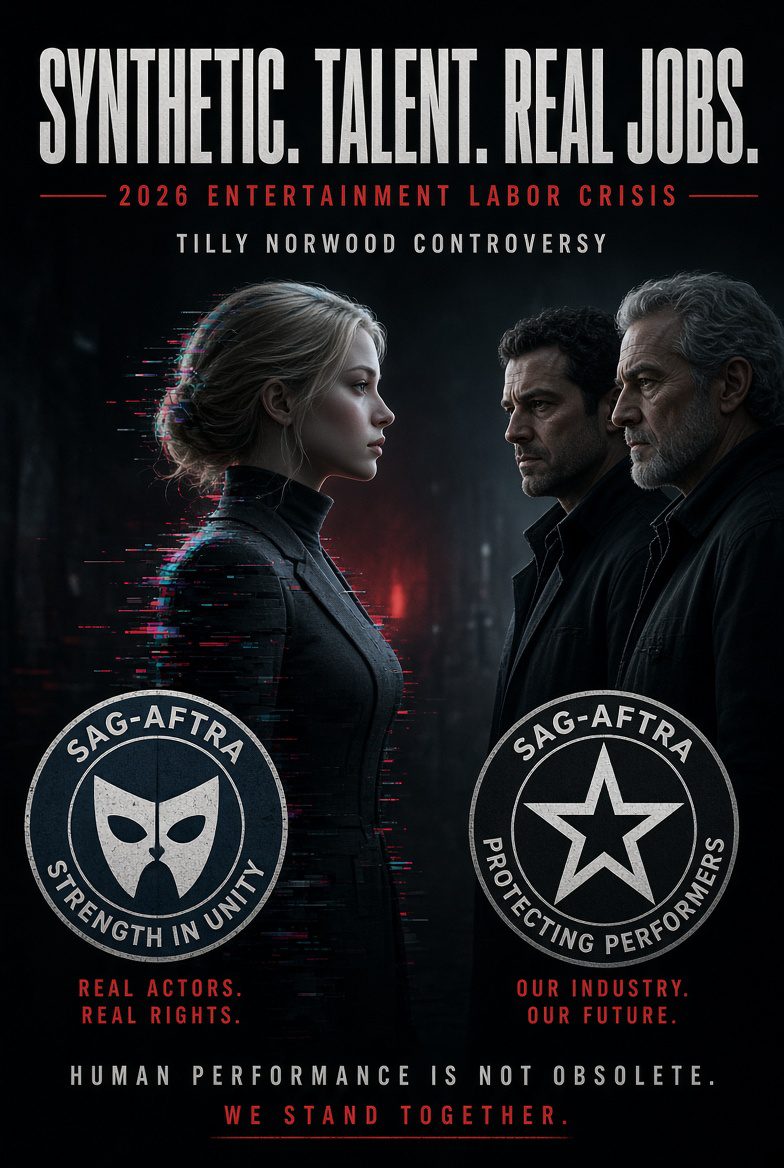
In mid-2025, European production company Particle6 introduced Tilly Norwood, a fully AI-generated “actress,” through its talent-studio offshoot Xicoia. When founder Eline van der Velden said talent agencies were in discussions to represent the character, the response from working actors was immediate and largely hostile — Emily Blunt, Whoopi Goldberg, and others criticized the move publicly, and SAG-AFTRA issued a statement opposing “the replacement of human performers by synthetics.”
The union’s objection wasn’t purely philosophical. SAG-AFTRA specifically noted that producers using synthetic performers must still comply with contractual notice-and-bargaining obligations, and separately argued Norwood’s underlying model was trained on the work of professional performers who were neither credited nor compensated. Talent agency WME stated publicly it would not represent AI-generated actors.
Why this matters beyond one virtual character
Tilly Norwood isn’t cast in anything as of this writing — the controversy was about precedent, not a specific film. And unlike 2023, that precedent got settled at the bargaining table rather than on a picket line. The WGA, SAG-AFTRA, and DGA each negotiated new four-year agreements with the Alliance of Motion Picture and Television Producers through the spring of 2026, and all three reached deals before their contracts expired, without a strike. SAG-AFTRA’s members ratified their four-year “2026 TV/Theatrical Agreement” — which runs through June 30, 2030 — by a 91.42% vote in favor, on a 19.25% turnout.
Going into those talks, SAG-AFTRA proposed the so-called “Tilly tax”: a flat royalty studios would pay into a union fund every time they used a synthetic performer instead of a human one, pegged to make synthetics cost as much as hiring an actor. That specific mechanism did not survive negotiation. According to TheWrap’s reporting, studio negotiators rejected the flat per-use fee outright, arguing synthetic performers were still a hypothetical use case rather than an established practice worth pricing into the contract. What SAG-AFTRA got instead: any producer wanting to use a synthetic performer over a human one must first show the synthetic offers “significant additional value,” a claim that can go to arbitration; the arbitration process takes roughly a month, which functions as its own practical deterrent; and where a synthetic performer is used, compensation defaults to the performer’s pro-rata daily rate or scale minimum, whichever is higher — not a separate royalty on top.
What each guild actually won SAG-AFTRA’s ratified deal confines AI performers to a narrow “significant additional value” standard backed by arbitration, plus the daily-rate/scale-minimum compensation floor above — no flat Tilly-style tax. The WGA’s deal secured notice-and-consultation rights when studios license writers’ work for AI training, but no requirement that writers be paid when that happens. The DGA’s deal keeps AI-generated footage under a director’s control and funds an AI skills-training program for members. Three unions, three different bets on what “protection” means in practice — and the real test of all three is how strictly studios apply the “significant additional value” and consultation standards over the next four years, not the ratification vote itself.
Music: settlements for some labels, lawsuits for the rest
The music side of this story moved faster and messier than film. In June 2024, the major labels sued AI music generators Suno and Udio for training on copyrighted recordings without authorization. By late 2025, the united front cracked: Warner Music Group settled with Suno in November 2025, committing Suno to phase out its current models in favor of ones trained on licensed catalog content, and reporting also describes settlements involving Udio and Universal Music Group around the same period. Sony Music has not settled with either company and continues to litigate, with a fair-use ruling that could reshape the entire generative-AI licensing landscape expected around mid-to-late 2026.
Where reporting is genuinely unsettled: the exact matrix of which label settled with which platform varies slightly across otherwise credible trade outlets, and full settlement terms have not been made public by any party. Treat specific deal structures as “reported,” not confirmed, until the companies disclose terms directly.
| Label | Suno status | Udio status | Notes |
|---|---|---|---|
| Warner Music Group | Settled, Nov. 2025 | Also reported settled | First-of-its-kind licensing structure per company statements |
| Universal Music Group | Litigation ongoing per some reports | Settled, Oct. 2025 per multiple outlets | UMG–Udio deal frequently cited as the template other labels are benchmarking against |
| Sony Music Entertainment | Litigation ongoing | Litigation ongoing | Pushing for a fair-use ruling rather than a negotiated settlement |
What the settlements don’t solve: independent artists whose recordings were scraped from Spotify, YouTube, and SoundCloud have no seat at the table. Major-label deals cover major-label catalogs only, which is why independent musicians and their labels have filed separate class actions, and why the American Federation of Musicians sued UMG and Warner directly in June 2026, alleging member recordings were licensed into AI training deals without the compensation or disclosure their collective bargaining agreements require.
On the distribution side, platforms are moving toward disclosure rather than prohibition. Apple Music has said it will require AI transparency tags on tracks where AI materially contributed to creation, Spotify has introduced a “Verified” badge aimed at signaling non-AI artists, and Deezer has reported that a large share of new daily uploads to its platform are AI-generated — a volume problem that disclosure tags alone may not solve.
Why audience trust is the real bottleneck, not the technology
Industry reporting increasingly frames disclosure and audience trust — not model capability — as the constraint that will determine how visible AI becomes in finished entertainment. Analytics firm Luminate’s 2026 research on generative AI in music, film and TV found growing skepticism toward AI-generated content among Gen Z and Gen Alpha audiences, alongside audience comfort concentrated in specific, lower-visibility use cases like dubbing and VFX rather than lead performances or original scripts. That skepticism shows up in the numbers directly tied to the labor fight above: Luminate has separately reported that 48% of US film and TV viewers say they’re uncomfortable with entirely synthetic actors in movies or shows, against just 22% who say they’re comfortable — a gap wide enough to explain why studios have been cautious about synthetic leads even where the technology and the contract language would now permit it.
Documentary filmmaking is where this tension is sharpest. Archival and nonfiction producers have warned that synthetic content risks “muddying the historical record,” and organizations like the Archival Producers Alliance have pushed for mandatory disclosure whenever AI plays a material role in nonfiction storytelling, arguing that audiences have a right to understand what they’re watching.
Actionable implementation checklist
- Separate the three storylines before you plan around any AI-in-entertainment headline: production tooling, labor/consent, and licensing law move on different timelines and different legal footing.
- If you’re a producer using generative tools: confirm which stage of the pipeline you’re touching — previz/post carries far less union exposure than production-stage synthetic performers or voice cloning.
- If you’re weighing a synthetic performer over a human one: budget for the roughly one-month arbitration window under SAG-AFTRA’s “significant additional value” standard, and for compensation at the performer’s pro-rata daily rate or scale minimum — the flat Tilly-tax royalty studios rejected is not the operative cost model.
- If you’re evaluating AI-generated music for commercial use: check which platform and subscription tier you used, since commercial rights differ by company and have changed multiple times through 2025–2026 litigation.
- If you cover or invest in this space: track the Sony v. Suno/Udio fair-use ruling specifically — it’s the single case most likely to reset licensing norms across text, image, code and video AI, not just music.
- If you’re building disclosure policy for a platform or publication: model your transparency requirements on where audience trust is already breaking down (leads, original scripts) rather than where it isn’t (dubbing, VFX cleanup).
Frequently Asked Questions
Has AI actually replaced human actors, writers, or musicians in 2026?
No. Fully AI-generated leads, scripts, or songs remain rare and controversial. AI is used far more often as a production aid — rough cuts, dubbing, concept art, background generation — with human creators still making final creative decisions on commercially released, high-visibility work.
What is the Tilly Norwood controversy, and does it mean AI actors are becoming standard?
Tilly Norwood is a fully AI-generated character created by Particle6/Xicoia. Talent agency interest in representing her sparked backlash from actors and a formal objection from SAG-AFTRA. As of this writing she isn’t cast in any released project — the dispute is about setting precedent, not current casting practice. The precedent that did emerge is contractual: SAG-AFTRA’s 2026 deal makes synthetic performers subject to an arbitration standard and a compensation floor, not a free substitute for human actors.
Can I legally sell music I generate with Suno or Udio?
It depends on your platform, subscription tier, and ongoing litigation that has already changed licensing terms multiple times since mid-2024. This is a fast-moving legal area; verify current terms directly with the platform and consult a qualified attorney before commercial release.
Did the 2026 SAG-AFTRA, WGA and DGA contract talks resolve AI, or is another strike coming?
Both were resolved without a strike. SAG-AFTRA ratified its four-year deal in June 2026 with 91.42% member approval; the WGA and DGA reached their own AI-specific agreements earlier the same year; and all three guilds settled before their prior contracts expired. That doesn’t mean AI is fully settled — how strictly studios apply standards like SAG-AFTRA’s “significant additional value” test, and whether the WGA’s notice-and-consultation rights on AI training actually get exercised, will be tested over the four-year contract term rather than resolved by the ratification vote itself.
References & Verification Methodology
Claims in this article were checked against primary reporting and named-source statements from the outlets below. Where deal terms or settlement structures were not confirmed by an official company disclosure, that uncertainty is flagged in the text rather than presented as settled fact. Sources are mixed-tier by necessity: contract-outcome and litigation claims are anchored to wire services and trade-of-record outlets (Variety, Deadline, Fortune, TheWrap, NBC News); production-workflow claims that no major outlet has independently surveyed are anchored to trade blogs and flagged as such in the text.
- NBC News — SAG-AFTRA statement on Tilly Norwood
- TheWrap — SAG-AFTRA’s new AI protections, incl. the rejected “Tilly tax” and arbitration mechanics
- Fortune — SAG-AFTRA bargaining for the “Tilly tax,” pre-ratification
- Variety — DGA ratifies four-year AMPTP contract
- Variety — Timur Bekmambetov’s “Luria” and AI production pipeline
- Trade reporting on editorial AI adoption and documentary disclosure standards (trade-blog tier; see sourcing note above)
- Industry overview of 2026 production-tool adoption, incl. Scorsese/Black Forest Labs (trade-blog tier; see sourcing note above)
- Luminate — Generative AI in Music, Film & TV 2026 report, incl. viewer comfort with synthetic actors
- Deadline — Sora shutdown and the collapsed Disney–OpenAI investment deal
[Internal: AI Labor Disputes 2026 Tracker] · [Internal: Generative Video Tools Comparison Guide]