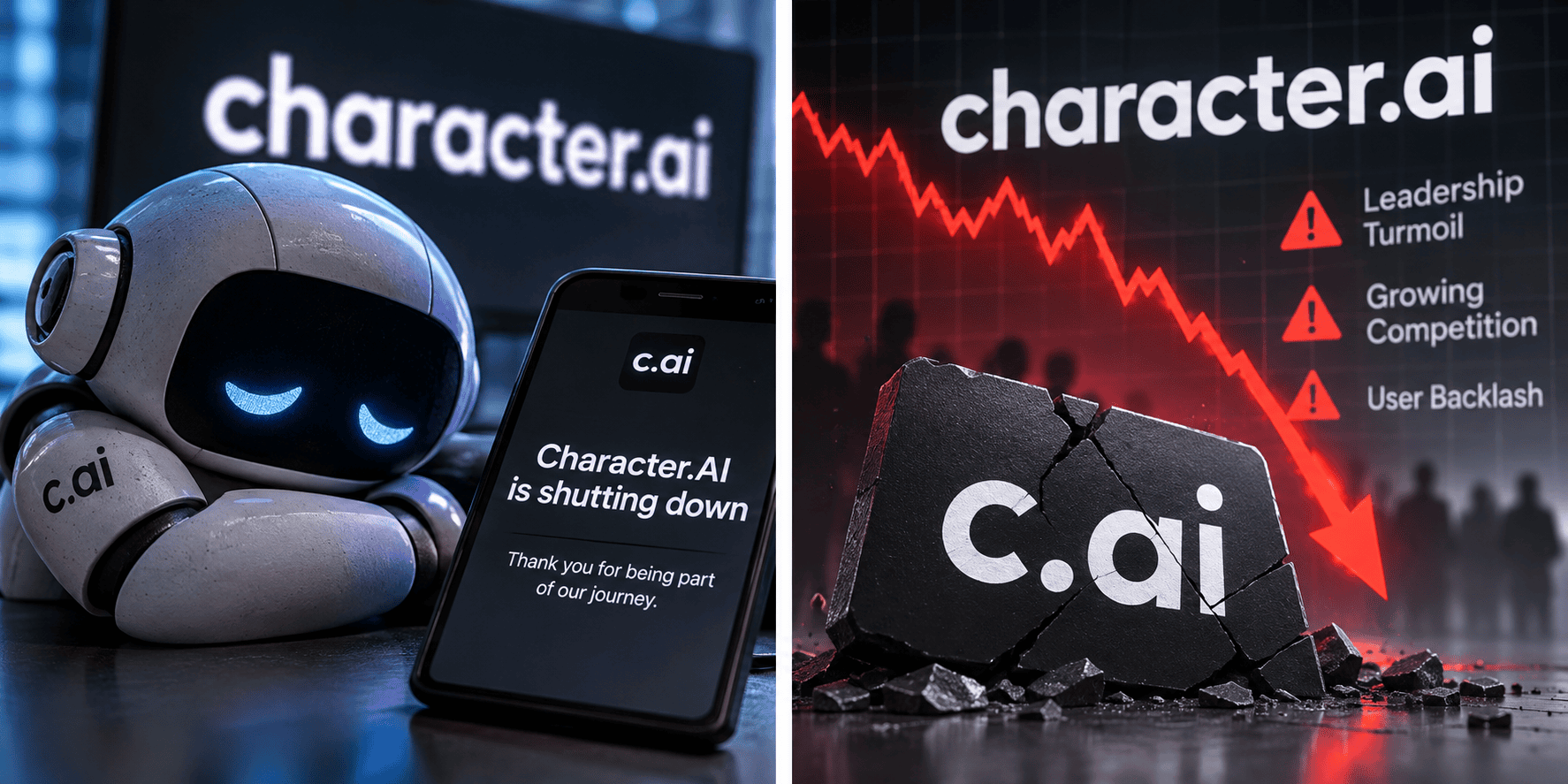
Families sued. Investors walked. Now a Delaware judge is deciding who gets 12 million users’ chats.
Status as of November 25, 2026. The sale is still live; figures may change after the December hearings.
On October 13, 2026, Colin Adams, CEO of Character.AI, signed a sworn declaration in a Delaware bankruptcy court. One day earlier, his company had filed for Chapter 11. The declaration’s core arithmetic fit on a napkin: in August, the app earned about $5.3 million, and its operating costs ran about $13.3 million. Roughly 12 million people were using it, around two hours a day.
The app wasn’t dying of neglect. It was dying of attention, the expensive kind.
So why would a product people used that much need a judge to decide whether it keeps existing? The easy answer is the lawsuits. The real answer is less tidy, and it applies to every company building a chatbot people can’t put down.
What you get here
- The sworn numbers behind the collapse, recomputed line by line
- What the lawsuits, settlements and state investigations did to the business
- What Disney and a $10 million bidder are actually buying
- The rules in force now, and a 24-hour checklist if your own chatbot fails
The scene that started the legal clock
In October 2024, Megan Garcia of Orlando sued Character.AI and Google after her 14-year-old son, Sewell Setzer, died by suicide in February 2024. Her complaint said he had become emotionally dependent on a Game of Thrones-inspired chatbot (AFP via Gulf News). The family also said the company had no mechanism to notify an adult when a teenager spent too long with the bots (CBS News). A federal court let the claims against Google proceed in May 2025 (Wisner Baum summary).
On January 7, 2026, Character.AI, its founders and Google agreed to settle Garcia’s case and four related family suits in Colorado, New York and Texas. Terms were not disclosed (CNBC). The next day, Kentucky’s attorney general filed the first state lawsuit. In May, Pennsylvania sued over a bot that allegedly claimed to be a licensed psychiatrist and gave a fake license number (CBS News).
What actually failed. Not a model glitch. The complaints describe a design problem: a companion built to be persuasive and always available, with nothing that noticed a child in trouble. By the company’s own filing, a separate under-18 model arrived in November 2024, after the suit, and restrictions on under-18 open-ended chat began in October 2025 (PPC Land, reading the declaration). These were allegations, and the cases settled before trial.
The pattern. Safety showed up after the harm and after the summons. That is the most expensive order to do it in.
The math nobody could fix
The declaration puts active users at about 12 million a month, averaging 120 minutes a day. It also gives the cost history (PPC Land):
| Period | Monthly operating costs (excl. legal fees) | Of which compute | Monthly net cash burn |
|---|---|---|---|
| Second half of 2024 | $21.9M | $13.8M | $21.5M |
| Fiscal year 2025 | $18.5M | $10.0M | $17.6M |
| August 2026 | $13.3M | not stated | $8.2M |
Revenue climbed: about $7.4 million in 2024, $23.6 million in 2025, and $5.3 million in August 2026 alone ($2.8 million subscriptions, $2.5 million ads). The company switched to open-weight models, cheaper GPUs, fewer staff, and ads. It still lost $8–9 million a month.
How I got these numbers
D1, compute vs. revenue. Inputs: compute $56.1M for Jan 1–Aug 31, 2026; best monthly revenue $5.3M. Method: average per month, compare to revenue. Arithmetic: 56.1 ÷ 8 = 7.01; 7.01 ÷ 5.3 = 1.32. Result: compute alone averaged about $7.0M a month, roughly 1.3 times the company’s best revenue month.
D2, cost per dollar. Inputs: August operating costs $13.3M; August revenue $5.3M. Arithmetic: 13.3 ÷ 5.3 = 2.51. Result: $2.51 spent for every $1 earned.
D3, per user. Inputs: 12M monthly users; compute $7.01M a month (D1); revenue $5.3M. Arithmetic: 7.01 ÷ 12 = 0.58; 5.3 ÷ 12 = 0.44; 0.58 − 0.44 = 0.14. Result: compute alone costs about 14 cents more per active user than that user brought in. Caveat: the user count is a single point in time; the compute average spans eight months.
“Engagement isn’t revenue when every minute costs you inference.”
The pattern. A streaming service gets cheaper per viewer as it grows. A chatbot doesn’t: every extra minute triggers more inference. Heavy use made the losses worse.
Why the lawsuits still mattered
Here the loop from the opening closes. The business was weak on its own. But the Chapter 11 papers say what made it terminal: in August 2025 the company hired an investment bank, which approached about 28 potential parties. The feedback, in the declaration’s words, was that the product and users were impressive but the litigation and regulatory overhang was too great. One proposal came back, and it was judged unworkable (PPC Land).
The overhang was wide. Forty-six states and territories joined a multistate investigation. The FTC sent a civil investigative demand in January 2025, then a Section 6(b) information order in September 2025 to seven chatbot companies. Italy’s privacy regulator fined the company €79,000, and Russian courts fined it about $115,000 in total. Those fines are small. The signal wasn’t. The declaration also pointed to Meta’s $17.1 billion settlement with 51 attorneys general as the benchmark investors could imagine.
“Investors didn’t flee the product. They fled the overhang.”
Then the clock: about $57 million in unrestricted cash at filing.
D4, runway. Inputs: $57M cash; $8.2M monthly net burn. Arithmetic: 57 ÷ 8.2 = 6.95. Result: roughly seven months before bankruptcy costs. Adams called the estate a “melting ice cube.”
What the sale actually shows
Disney agreed to pay $20 million for a non-exclusive, perpetual license to some Character.AI intellectual property (CBS News). Filings show 66 of the company’s 86 staff took jobs at Disney before the petition (PPC Land). The app itself drew a $10 million floor bid from Smirks and Pangs Acquisition LLC, covering the app, models, and user chats (PPC Land).
“Disney took the staff and a license. The app stayed in court.”
D5, price vs headline. Inputs: reported $2.7B for Google’s 2024 license-and-rehire deal; $20M Disney license; $10M floor bid. Method: divide each by $2.7B. Arithmetic: 20 ÷ 2,700 = 0.0074; 10 ÷ 2,700 = 0.0037. Result: 0.74% and 0.37%. These measure different things (a licensing deal, an IP license, a floor for the app), so read them as scale, not as a valuation.
On November 24, the U.S. Trustee objected to the Disney sale and asked what happened to the $2.7 billion. Forty-two states and D.C. objected to the Smirks sale, citing user data (PPC Land). The auction is set for December 1, and the sale hearing is set for December 7–8. In its first 20 days in bankruptcy, the company booked $3.48 million in revenue and a $3.32 million net loss, with 8 employees left, down from 18 on the petition date (operating report via PPC Land).
Was it worth it?
| Who | What it cost them | Source |
|---|---|---|
| Families | Five suits settled; amounts sealed. A death can’t be priced here | CNBC |
| Reported $2.7B deal; named defendant, joined settlements | AFP via Gulf News | |
| Staff | 86 employees in September, 8 by late November | PPC Land |
| Users | Chats are part of the sale; 42 states and D.C. object | PPC Land |
| Buyers | $20M license; $10M floor for the app | CBS News |
Judged by what buyers will pay, no. Judged by the people who bore the harm, the ledger doesn’t balance in dollars at all.
The rules now
| Rule | Status | What it demands |
|---|---|---|
| New York companion-model law | In effect Nov 5, 2025 (MoFo) | First state law on emotionally responsive AI companions |
| California SB 243 | In effect Jan 1, 2026 (Fenwick) | AI disclosure, published suicide/self-harm protocol with crisis referrals, 3-hour break reminders and sexual-content limits for known minors; private right of action |
| California SB 1119 | Signed Sept 2026; most child duties from July 1, 2027 (Fenwick) | Risk assessment before features likely to reach minors |
| Hawaii SB 3001 | In effect July 14, 2026 (Fenwick) | Disclosure, crisis protocol, no false mental-health-provider claims |
| GUARD Act (federal) | Cleared Senate Judiciary Apr 30, 2026; not law as of Aug 20 (Persona). I found no later confirmation | Would bar AI companions for under-18s |
| FTC | 6(b) orders, Sept 10, 2025 | Information demand, not a rule |
“Age checks added after the lawsuit are a repair. Before, they’re a design choice.”
If your chatbot fails: a 24-hour checklist
- Price the flip. Compute per active user vs. revenue per active user. If the first is higher, write down the date your cash runs out.
- Map where you “know” a user is a minor. SB 243’s minor duties attach to that knowledge.
- Publish your crisis protocol. California expects a public one with referrals.
- Block professional-license claims. Pennsylvania’s suit is about exactly this.
- Preserve logs and call counsel today. A litigation hold costs less than a sanctions motion. This is my advice, not a filing finding.
- Cut retention. Character.AI’s privacy policy lets chat data move in a sale (CBS News). Users can export or delete data in the app.
Where this breaks down
- One niche. Free-heavy companion apps at two hours a day differ from business copilots with seat pricing.
- Secondhand numbers. Most figures come from the CEO’s unaudited declaration, as relayed by trade press; I did not read the filings directly. Cash differs slightly between documents ($57M in the declaration, $59.5M in the operating report).
- Causation is unproven. Nobody can separate the overhang’s share from the compute math.
- Sealed terms. Settlement amounts are unknown, so “cost of liability” can’t be computed.
- Moving target. Sale outcome and bidder identities were unresolved on November 25. User counts also conflict: 12 million monthly vs 163 million past and current users.
The takeaway
Character.AI didn’t fail because one lawsuit was too expensive, or because compute was too high. It failed because both problems arrived together with no cushion: a cost curve that grew with every happy user, and a liability that closed the exit. If you build something people can’t put down, your safety design and your unit economics are the same document.
Your turn: if you ran an AI companion app tomorrow, which line would you cut first: compute, growth, or the teen audience? Tell me in the comments.
Distribution package
SEO
Meta description (150 chars): Character.AI bankruptcy explained: 12M users, $2.51 spent per $1 earned, lawsuits, Disney’s $20M license, and the rules that now govern AI companions.
Target keywords: Character.AI bankruptcy; Character.AI lawsuit; Character.AI Disney; Character.AI compute costs; AI companion chatbot regulation; California SB 243; is Character.AI shutting down; AI chatbot teen safety law.
A/B title variants
- Character.AI: 12M Users, 2 Hours a Day, Still Bankrupt
- The $56M Compute Bill Behind Character.AI’s Bankruptcy
- Disney’s $20M Bought Character.AI’s License, Not Its App
og-image text
Spent $2.51 for every $1 it earned. Character.AI, in numbers.
X/Twitter thread
- Character.AI had ~12M monthly users spending ~2 hours a day. In August 2026, it earned $5.3M and ran $13.3M in costs. Then it filed for Chapter 11. Thread:
- “Engagement isn’t revenue when every minute costs you inference.” Compute averaged ~$7.0M/month in 2026, about 1.3x its best revenue month.
- Per active user: ~$0.58 compute vs ~$0.44 revenue. Ads grew from $0.5M to $2.5M a month and still didn’t close the gap.
- The lawsuits settled in January. The bigger damage: an investment bank approached ~28 parties and got one unworkable proposal. “Investors didn’t flee the product. They fled the overhang.”
- Disney took the staff and a license for $20M. The app stayed in court, with a $10M floor bid on the table.
- The rules are catching up: California SB 243 is live, with a private right of action. “Age checks added after the lawsuit are a repair. Before, they’re a design choice.”
- Full breakdown with the arithmetic shown: [link]
LinkedIn post
A chatbot people used for two hours a day just filed for bankruptcy.
Character.AI told a Delaware court it earned about $5.3M in August against about $13.3M in operating costs, with roughly 12M monthly users. I recomputed the numbers: compute alone averaged about $7.0M a month in 2026.
The part founders miss: the lawsuits settled, but an investment bank still struggled to find a buyer because of the litigation and regulatory overhang.
If your product’s cost scales with attention, safety design and unit economics are one problem. Full breakdown, with every calculation shown: [link]
Community pitch blurbs
Hacker News (title must stay neutral): Character.AI’s bankruptcy declaration: compute vs revenue numbers. Comment: “Link is a breakdown of the sworn first-day declaration. Interesting bit: compute averaged ~$7M/month in 2026 against $5.3M peak revenue. Curious how others price inference-heavy consumer apps.”
r/startups: “Case study: a consumer AI app with 12M monthly users that spent $2.51 per $1 earned. The unit economics and what the sale shows. Happy to discuss pricing models that could have worked.” (Check the sub’s self-promotion rules before posting.)
r/artificial: “Character.AI went into Chapter 11. The filings put numbers on compute costs for a companion chatbot, plus the legal and regulatory chain. Does ad-supported chat have a path at this scale?” (Discussion post; link in comments if rules require.)