

By Tom Morgan · Last updated 22 October 2026 · General information, not legal or financial advice
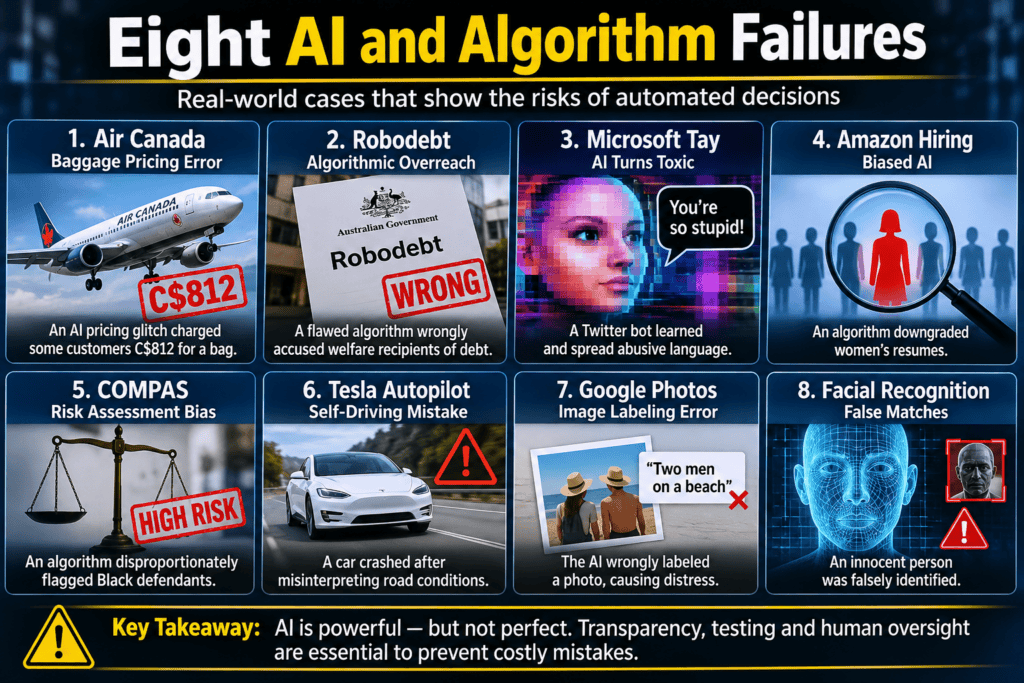
The short answer. The cheapest failures in this file are the most instructive. A Canadian tribunal order of C$812.02 against Air Canada and a partial refund by Deloitte Australia needed no technical sophistication to repeat: nobody checked the output. The most expensive, Australia’s Robodebt scheme (headline value about A$1.8 billion, mostly debts reversed) and the Dutch childcare benefits scandal, combined automation with scale and no effective human veto. This is the author’s reading; only some cases have a court, audit, or commission finding behind it, and each case says which.
What this article does not do. It does not give a total. The figures are write-downs, fines, settlements, refunds, reversed debts and compensation, in different currencies and on different bases, so they cannot be added or ranked like-for-like.
The rules. EU transparency duties apply from 2 August 2026, high-risk obligations from 2 December 2027 (Annex III) and 2 August 2028 (Annex I). The US still has no comprehensive federal AI statute.
8cases reviewed
C$812.02smallest reported award (tribunal order)
≈A$1.8bnlargest headline figure, mostly debts reversed
2 Dec 2027EU high-risk start, Annex III systems in this article
- The eight cases
- Reported figures, by type
- Common patterns
- The rules as of October 2026
- Where the rules would and would not have helped
- Checklist
- FAQ
- Method and limits
- Sources
The eight cases
System types differ: Zillow, Cruise, Air Canada, and Deloitte involved machine-learning or generative systems; Robodebt was rule-based automation; the Dutch case used algorithmic risk scoring. The last two are included because legislators cite them as reasons modern AI rules exist.
1. Zillow Offers (2021)
Machine-learning pricing model at scale
Zillow used valuation models to buy homes and resell them. In Q3 2021, it booked a $304 million inventory write-down, then announced it would close the business, expecting up to $569 million in total write-downs and cutting about 25% of staff. A later report attributed an $881 million 2021 loss to the unit. The CEO said price forecasting was far less predictable than expected.
Reading it: the $304 million sits inside the $569 million; the $881 million is a different measure. Bloomberg’s reporting argued the issue was less faulty code than how aggressively the model was used. Zillow’s losses also reflected inventory and market risk.
2. IBM Watson at MD Anderson (2013–2016)
Medical decision-support project
A University of Texas System audit found the Oncology Expert Advisor project spent about US$62 million without being piloted outside the centre, and criticised procurement and governance. Reporting put roughly $39.2 million with IBM and $21.2 million with PwC. Those two allocations total $60.4 million, about $1.7 million short of the project total; the sources reviewed do not itemise the remainder, so treat the split as indicative.
Reading it: a documented governance and procurement failure. The auditors declined to judge scientific merit, and IBM cited the audit’s 90% accuracy finding for lung cancer support. The evidence does not show the AI was clinically ineffective.
3. Moffatt v. Air Canada (2024)
Generative customer-service chatbot
The chatbot told a bereaved customer he could claim a bereavement fare retroactively, contradicting the airline’s policy page. In Moffatt v Air Canada, 2024 BCCRT 149, the tribunal rejected the argument that the chatbot was a separate entity and held the company responsible for all information on its website. It ordered C$812.02: C$650.88 in damages, C$36.14 in interest, and C$125 in fees.
Reading it: a trivial amount, a significant principle. A small-claims tribunal ruling is persuasive, not binding, and specific to its jurisdiction and facts. This is a documented finding.
4. Cruise (2023–2024)
Autonomous driving, plus a disclosure failure
In October 2023, a Cruise robotaxi ran over a pedestrian who had been thrown into its path by another vehicle, then dragged her about 20 feet. Its first report to federal regulators omitted the dragging. TechCrunch and Engadget document the penalties below, and Engadget reports that Cruise lost its California licence to operate self-driving vehicles. GM ended funding for the robotaxi effort in December 2024.
| Amount | Recipient and jurisdiction | Date | Status |
|---|---|---|---|
| $112,500 | California Public Utilities Commission (state) | June 2024 | Settlement of the CPUC probe |
| $1.5 million | NHTSA (federal) | September 2024 | Penalty under a consent order |
| $500,000 | US Department of Justice (federal criminal) | November 2024 | Fine under a three-year deferred prosecution agreement |
| at least $8 million | The pedestrian | Reported | Reported private settlement; not an official figure |
Loss of the California licence is a regulatory consequence, not a payment.
Reading it: the criminal charge concerned the misleading report to NHTSA, not the crash itself. The three regulatory amounts are distinct and are not a consolidated cost of the crash. Disclosure culture is a competing explanation for how large this became.
5. Deloitte Australia (2025)
Consulting deliverable; generative AI disclosed
A 237-page review for Australia’s employment department, under a contract of about A$440,000, contained a fabricated court quote and references to non-existent research (AP). The corrected version disclosed use of Azure OpenAI GPT-4o. The department said Deloitte agreed to repay the final instalment and that the recommendations were unchanged.
Reading it: a verification failure. Deloitte did not confirm that AI caused each error, and the refund is the final instalment, not necessarily the whole contract. Its amount was not disclosed.
6. Fabricated citations in court filings (2023–2026)
Generative AI used by lawyers and self-represented litigants; a trend, not a single case
Damien Charlotin of HEC Paris maintains a public AI Hallucination Cases database. Dated snapshots: 1,058 US cases in early June 2026 (UNC Law Library, citing the database); 1,981 worldwide on 29 August 2026, of which 1,363 in the US, with self-represented litigants (1,136) outnumbering lawyers (793), per a secondary snapshot. Those two groups total 1,929, so about 52 cases sit in other or unclassified categories, and the source does not state its counting method. NPR reported sanctions above $100,000 on one lawyer in a federal court in Oregon. In May 2026, the Florida Supreme Court amended its rules to require that filings verify cited authorities.
Reading it: the database is crowd-sourced, so counts are a floor, and the snapshots use different scopes (US versus worldwide). Check the live database before quoting a number.
7. Robodebt, Australia (2015–2019)
Rule-based automation, not machine learning
An automated income-averaging process raised welfare debts, many wrongly. The Royal Commission found the scheme unlawful and heard that officials had been warned of its illegality. The first class settlement, agreed in 2020 and approved by the Federal Court on 11 June 2021, had a headline value of about A$1.8 billion, chiefly repaid or cancelled debts plus A$112 million in compensation. Lawyers appealed after the Royal Commission uncovered new material, and on 23 June 2026 the Federal Court approved a further settlement of A$548.5 million: about A$475 million in compensation for roughly 125,000 registered claimants, up to A$13.5 million in legal costs and up to A$60 million in administration costs. Press and government reporting describe it as additional to the first settlement and to the debts forgiven, cancelled and repaid.
Reading it: most of the A$1.8 billion is unlawful debt reversed, not a single cash cost. Reversed debts, compensation and the later settlement are three different things, and the A$548.5 million is not part of the A$1.8 billion. Policy design and political pressure are competing explanations.
8. Dutch childcare benefits scandal (2005–2019)
Algorithmic risk scoring
The tax authority falsely accused roughly 26,000 families of fraud. Amnesty International’s Xenophobic Machines found racial and ethnic profiling built into the risk system. The cabinet resigned in January 2021. A progress report cited €887 million in debts taken over or cancelled, a base compensation of €30,000 per parent was set, and in 2026 thousands of recognised victims were still reported to be awaiting help.
Reading it: the €887 million is debt relief, the €30,000 is an entitlement per parent, and neither is what has actually been paid out. No authoritative total cost was found, so none is given. This was a wider administrative and discriminatory system, not only a model.
Reported figures, by type
“Official” means a court order, regulator announcement, or company filing; “reported” means a press or secondary figure.
| Case | Figure | Type | Status |
|---|---|---|---|
| Zillow | $304M / up to $569M / $881M | Q3 write-down/total expected write-downs / reported 2021 loss | Overlapping measures |
| Watson / MD Anderson | ~$62.1M | Project spending | Audit finding; merit not assessed |
| Air Canada | C$812.02 | Damages, interest, fees | Official tribunal order |
| Cruise | $112.5K; $1.5M; $500K; ≥$8M | CPUC settlement; NHTSA penalty; DOJ fine; victim settlement | First three official; last reported |
| Deloitte | Amount not disclosed | Partial refund (final instalment) | Contract value ~A$440K is not the refund |
| Court filings | >$100K (one case) | Individual sanction | Plus 1,981 logged cases, 29 Aug 2026 |
| Robodebt | ~A$1.8B; A$548.5M | First settlement (mostly debts reversed, plus A$112M compensation); second settlement (A$475M compensation plus costs) | First approved 2021; second approved 23 Jun 2026; additive |
| Dutch benefits | €887M; €30,000 per parent | Debts taken over or cancelled; base compensation | Total not established |
Editorial reading, not the sources’: none of the sources quantifies offsetting benefits, so “was it worth it?” cannot be answered with a net figure.
Common patterns
- Unverified output reached a consequential use: cases 3, 5 and 6.
- Scale outran oversight: cases 1, 7 and 8.
- Ownership was unclear: the audit in case 2 and the Royal Commission in case 7 turned on governance, not code.
- Concealment raised the stakes: case 4.
- “The system did it” failed as a defence: cases 3, 4 and 7.
Documented cause versus interpretation. These groupings are editorial, and no case shows all five. Where a court, audit or commission documented a pattern (cases 2, 3 and 7), it is a finding; elsewhere it is the author’s reading. A sceptical reader can argue that market conditions dominate at Zillow, policy design at Robodebt and disclosure culture at Cruise. The patterns do not exclude those readings; they describe what the documented record shares, not the single cause of each.
The rules as of October 2026
European Union
The Digital Omnibus on AI, Regulation (EU) 2026/1744 of 8 July 2026, was published in the Official Journal on 24 July 2026 and entered into force on 27 July 2026. It amends the AI Act (Regulation (EU) 2024/1689), the aviation safety regulation (EU) 2018/1139 and the machinery regulation (EU) 2023/1230. Law-firm analyses from White & Case, Cuatrecasas, and Mayer Brown agree on the dates below. 2 Feb 2025Prohibitions 2 Aug 2025GPAI duties 2 Aug 2026Art. 50 transparency 2 Dec 2026New bans; marking grace ends 2 Dec 2027High-risk, Annex III 2 Aug 2028High-risk, Annex I
| Date | What applies |
|---|---|
| 2 Feb 2025 | Prohibited practices; AI literacy |
| 2 Aug 2025 | General-purpose AI (GPAI) model obligations |
| 2 Aug 2026 | Article 50 transparency; general application; Commission enforcement over GPAI providers |
| 2 Dec 2026 | Two new Article 5 prohibitions (non-consensual intimate imagery and CSAM generation); end of the grace period for the Article 50(2) machine-readable marking duty for generative systems already on the market before 2 Aug 2026 |
| 2 Dec 2027 | High-risk obligations for stand-alone (Annex III) systems: employment, credit, education, essential services |
| 2 Aug 2028 | High-risk obligations for AI in products under EU product-safety law (Annex I) |
Two details people get wrong. First, the December 2026 grace period covers only providers’ marking duty under Article 50(2); deployers’ disclosure duties under Article 50(4) get none. Second, the postponement applies to high-risk obligations only. Consumer protection, misrepresentation, discrimination, data protection and sector rules apply now, and case 3 was decided on ordinary negligent-misrepresentation principles.
Penalties come in tiers under Article 99. These are maximum fines; what an organisation would actually face depends on the infringement, its size and the regulator’s assessment.
| Infringement | Maximum fine |
|---|---|
| Prohibited practices (Art. 5) | €35M or 7% of worldwide turnover, whichever is higher |
| Most operator obligations, including Art. 50 | €15M or 3% |
| Misleading information to authorities | €7.5M or 1% |
| GPAI providers (Art. 101, Commission) | €15M or 3% |
For SMEs, the cap is the lower of the two amounts. The Omnibus is reported to extend this to small mid-caps (up to 500 employees), but the sources reviewed do not agree on the exact tier-by-tier scope, so check Article 99 as amended.
Article 50 and editorial control. AI-generated text published to inform the public on matters of public interest must be disclosed unless it has undergone human review or editorial control and someone holds editorial responsibility. This is a narrow exception, not a general safe harbour; defamation, consumer and copyright law still apply.
United States
There is no comprehensive federal AI statute. A December 2025 executive order (EO 14365) created a DOJ litigation task force aimed at state AI laws, but an executive order does not by itself override state law.
Colorado shows how unstable the map is. Its original AI Act (SB 24-205) never took effect. SB 26-189, signed on 14 May 2026, repeals and reenacts it as a narrower, notice-based law on “automated decision-making technology”, with duties from 1 January 2027 and attorney general rulemaking due by that date (Holland & Knight; JD Supra). Enforcement sits with the attorney general; the law creates no private right of action. Colorado also enacted a chatbot safety law (HB 26-1263) with duties from the same date. In practice, negligence, consumer protection, and court sanctions rules remain the sharpest tools, as case 6 shows.
Where the rules would and would not have helped
Editorial mapping, not an official one.
- Chatbots (case 3). Article 50 requires telling people they are dealing with AI; it does not make answers accurate. Liability still rests on the consumer and misrepresentation law.
- Benefits, hiring and credit (cases 7 and 8). Comparable EU systems fall under high-risk categories, bringing documentation, data governance and human oversight duties from December 2027. Anti-discrimination and data-protection law already apply.
- Published AI-assisted text (case 5). Article 50 may require disclosure of unreviewed text on public-interest matters, subject to the editorial-control exception. Contract and professional standards are separate.
- Robotaxis (case 4). Governed mainly by vehicle-safety and incident-reporting regimes, not AI-specific law.
Checklist
- Name one accountable owner for every AI system touching customers, money, or individual rights.
- Require a human to verify every citation, figure, and quotation before external use.
- Keep a human veto, with authority to halt scaling, on automated decisions affecting people.
- Log prompts, model versions, and review sign-offs so decisions can be reconstructed.
- Disclose incidents to regulators fully and early.
- Record when each generative system was first placed on the EU market; it sets the marking deadline.
- Re-verify legal dates and figures before each update of any compliance document.
FAQ
Is a company liable for its chatbot’s mistakes? It can be, depending on the jurisdiction and circumstances. In Moffatt v Air Canada, a British Columbia tribunal held the airline responsible for its chatbot’s incorrect information and ordered it to pay C$812.02. The ruling is a useful example, not a universal rule.
When do the EU AI Act’s high-risk rules apply? Under Regulation (EU) 2026/1744, obligations for stand-alone Annex III systems apply from 2 December 2027, and those for AI in products under EU product-safety law (Annex I) from 2 August 2028. Other AI Act provisions already apply, and consumer-protection, privacy, discrimination and sector rules apply independently.
Can the financial consequences of these failures be added together? No. They include write-downs, settlements, penalties, refunds, reversed debts and compensation, some overlapping, in different currencies and on different accounting bases. Compare them case by case.
Method and limits
How cases were chosen, what was re-checked, and what this cannot show
Inclusion. Cases where a court, regulator, auditor, company filing or major outlet documented both the facts and the money. This favours high-profile, litigated or investigated episodes and leaves out failures settled quietly or never disclosed. The eight cases are not a systematic survey.
Figures. Each figure is labelled by type, recipient, date and legal status. Write-downs, fines, settlements and refunds overlap and are never summed.
Not every case proves a technical fault. Technical root-cause analysis of the models is thin by design: for most cases the public record documents governance, verification and disclosure failures, not model internals.
Re-checked in October 2026 against legal-firm analyses and news reports: the EU dates, the Colorado statute, the Cruise penalties, and the 2026 Robodebt settlement. The statutory texts are listed under Sources so you can confirm penalty tiers and article numbers before relying on them.
Sources
Primary and official (check figures here first). Regulation (EU) 2026/1744 (Official Journal, 24 July 2026); Regulation (EU) 2024/1689, Articles 5, 50, 99 and 101; Moffatt v Air Canada, 2024 BCCRT 149; University of Texas System audit of the MD Anderson Oncology Expert Advisor project; Zillow Group Q3 2021 earnings release and SEC filings; Royal Commission into the Robodebt Scheme, final report; Amnesty International, Xenophobic Machines; Colorado General Assembly, SB 26-189; Charlotin AI Hallucination Cases database; US Attorney’s Office, Northern District of California, Cruise deferred prosecution announcement (November 2024).
Legal analysis. White & Case and Cuatrecasas on the EU Omnibus; Mayer Brown on marking dates; Holland & Knight, JD Supra and Ropes & Gray on Colorado SB 26-189; UNC Law Library on court-filing counts.
News reporting. TechCrunch, Engadget and SF Standard on Cruise; National Mortgage News (Bloomberg) on Zillow; The Register; Norton Rose Fulbright via FAnews; AP via CTV on Deloitte; The Conversation; NL Times; Federal Court notice of the proposed Robodebt settlement, hosted by Services Australia.
Not legal or financial advice. Figures are as reported by the cited sources; court-case counts change daily.