
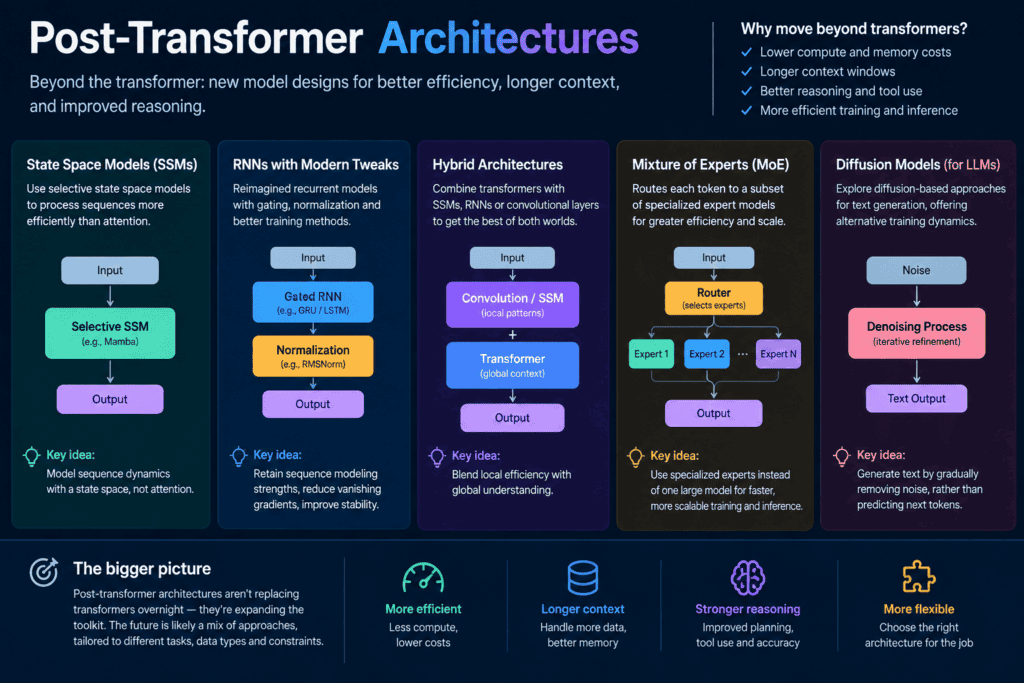
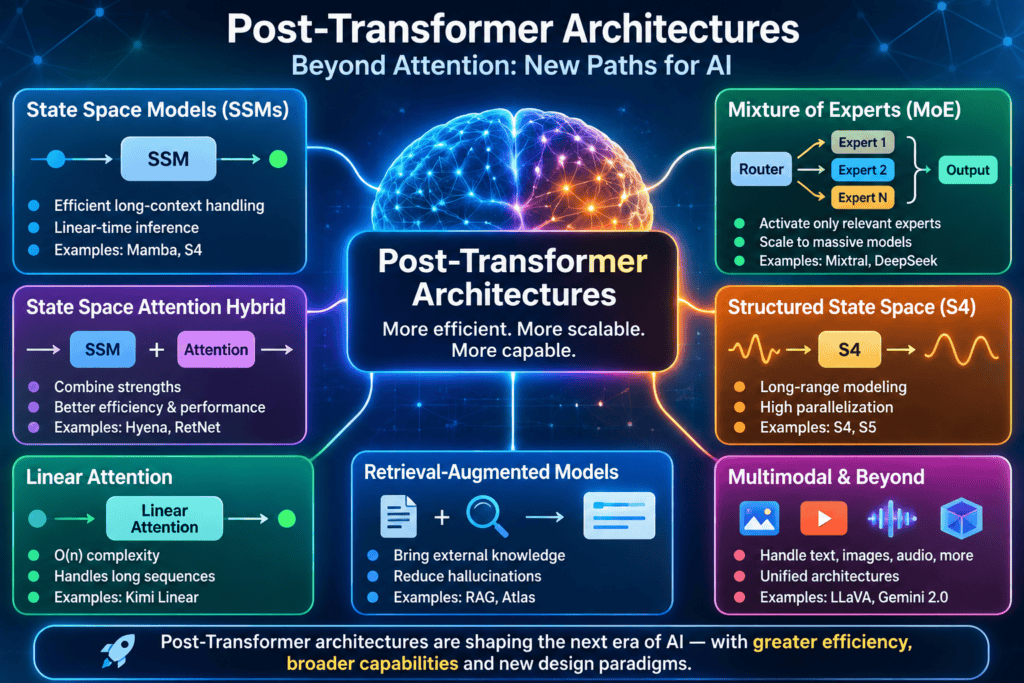
As of November 2026, no open-weight model with a published design has dropped attention. What changed is where attention runs: Kimi Linear, Qwen3-Next and Olmo Hybrid keep it in about one layer of four and use a fixed-size recurrent state elsewhere, while DeepSeek-V4 keeps it in every layer and compresses and sparsifies the cache.
On 30 October 2025, two documents appeared that appear to contradict each other. Moonshot AI posted the Kimi Linear paper, claiming a hybrid with a linear-attention core beats full attention under fair comparisons. The same day, MiniMax published an explanation of why its M2 model went back to full attention after its earlier M1 had bet on a linear-attention hybrid. Same quarter, same question, opposite production decisions, each with internal data.
That disagreement is the real story of “post-Transformer” architecture in 2026, and most coverage smooths it over. This piece takes a position: the question “what replaces attention?” is badly specified, and once it is split into two questions, the evidence gives a fairly clear answer.
“Attention” is two things bolted together
Standard attention bundles two separable components:
- A retrieval operation. Each new token computes a content-based match against earlier tokens (softmax over query-key scores) and pulls back what matches.
- A memory structure. To make that retrieval possible, the model stores a key and a value for every past token per layer. This is the KV cache, and it grows with every token.
Almost every “attention killer” attacks the second component and quietly weakens the first. The cost shows up in arithmetic. Take a grouped-query layer with 8 KV heads, head dimension 128, and bf16 storage, a configuration the DeepSeek-V4 report itself uses as a baseline. Each token costs 2 × 8 × 128 × 2 bytes = 4,096 bytes per layer. At one million tokens, that is about 4.1 GB, or roughly 3.8 GiB, per layer per sequence. A hypothetical 60-layer model at that configuration would need around 229 GiB of cache for a single 1M-token sequence, before weights or batching. (Calculation from stated inputs; layer count is illustrative.)
This is why the field moved. Quadratic compute gets the headlines, but at long context during decoding, the cache is what limits batch size and cost per request.
Figure: Where current designs sit on the two axes that “attention” bundles together. Positions are schematic and editorial, not measured.
Read the map as a statement about what production teams actually changed. Nobody has gone to the bottom-left corner and shipped a general-purpose assistant. The shipped designs hug the right side (attention retained) and differ in how they shrink the memory.
Route one: fixed-state recurrence, with attention demoted
The first route replaces most attention layers with a recurrent layer that compresses the entire past into a fixed-size state. State space models like Mamba belong to this family, as does linear attention. The current front-runner is the Gated DeltaNet family. Sebastian Raschka’s walkthrough describes Gated DeltaNet as having no n-by-n attention matrix, and notes that Qwen3-Next and Kimi Linear both use it in a 3:1 ratio: three linear layers per full-attention layer. Kimi Linear refines the layer into Kimi Delta Attention, which adds finer-grained gating over the state.
The 75% number is a ratio identity
Kimi’s headline claim is up to 75% less KV cache, plus up to 6× decoding throughput at 1M context, against a full-MLA baseline under an identical training recipe. The 75% needs no experiment to explain. If three of every four layers hold a constant-size state instead of a cache, only one in four layers accumulates a cache that grows with context. The memory saving follows from the layer ratio. The question worth asking is whether quality survives, and that is where the evidence splits.
The limit nobody can engineer around
A fixed state has a hard ceiling. Jelassi et al. proved that a model whose latent state has fixed size cannot copy a string containing more bits than that state holds, while a small two-layer transformer can copy strings of exponential length. Their experiments showed Pythia transformers beating similar-size Mamba models at copying and retrieval, even though Mamba reached lower language-modeling perplexity. The Kempner Institute’s summary of the work notes the authors’ argument that this is not a flaw in Mamba’s design but a property of any fixed-memory model.
Two scoping notes keep this honest. The result concerns exact copying, and many real tasks tolerate approximate recall. It also dates from early 2024 and tested older models. But the theorem applies to any fixed-size state, delta rule included. That explains why every production linear design keeps some attention layers: they are the verbatim-recall component, retained on purpose.
Route two: keep attention everywhere, shrink what it reads
DeepSeek chose the opposite path. Its V4 technical report describes a hybrid built from two attention variants. Compressed Sparse Attention (CSA) compresses the KV entries of every m tokens into one entry, then applies DeepSeek Sparse Attention (DSA), where each query attends to only k compressed entries. Heavily Compressed Attention (HCA) compresses far more aggressively. Per the report, V4-Flash needs 10% of V3.2’s single-token FLOPs and 7% of its KV cache at 1M context, and the cache lands at roughly 2% of the GQA8 bf16 baseline above. For V4-Pro, NVIDIA’s developer blog reports a 73% FLOPs reduction and 90% KV-cache reduction versus V3.2, and vLLM’s launch post puts the bf16 cache at 9.62 GiB per sequence at 1M tokens.
The mechanism behind DSA is a lightweight “lightning indexer” that scores past entries and retrieves a top-k set. An independent systems paper describes V3.2’s setting of k=2048, which turns the cost from O(L²) into O(kL). Other published models, including GLM-5.1, are described as using DSA as well, so this is a broader adoption than a single lab’s choice.
The trade-off is structural. Sparse selection is a learned approximation: if the indexer fails to surface the token that matters, the attention layer cannot recover it. Compression runs along the sequence dimension, so individual tokens get blended. Where the exact string matters, a compressed cache is a lossy cache, just a far larger one than a recurrent state. In other words, route two spends its complexity budget on keeping retrieval alive.
What the evidence actually supports, ranked
The sources differ in strength, and the order matters more than their enthusiasm.
| Rank | Source | What it shows | Why the rank |
|---|---|---|---|
| 1 | Olmo Hybrid (Ai2, 7B, 6T tokens) | Matches Olmo 3 on MMLU with 49% fewer tokens; 35% fewer on a Common Crawl loss slice | Controlled, open weights, matched pipeline; but one scale, one baseline |
| 2 | DeepSeek-V4 report | Large cost reductions at 1M context | Primary, but efficiency figures are against the lab’s own prior model |
| 3 | Kimi Linear paper | Beats full MLA with identical recipe at 48B total / 3B active | First-party comparison; a single scale |
| 4 | MiniMax M2 post | Efficient variants, including delta-rule and Mamba-2 per a replies thread, underperformed full attention in its setting | Informed, but qualitative: I found no public ablation tables |
Olmo Hybrid deserves a careful reading, because it is the clearest evidence in the set. Ai2’s description is that the hybrid replaces the sliding-window attention layers of Olmo 3 with Gated DeltaNet. So the baseline already limited most of its attention layers to local windows. The experiment shows that a delta-rule layer beats a sliding-window layer as the cheap mixer. It does not show that you can remove global attention layers, or that the hybrid beats a model with global attention in every layer. That is my reading of Ai2’s own architecture description, not a claim the authors make. It also matters that Ai2’s report concedes slight losses on two held-out evaluations, LBPP and DM Math.
Where the sources genuinely collide
MiniMax’s argument was that benchmarks failed to separate efficient from full attention, and that gaps appeared on multi-hop reasoning and long chains of logic. A QbitAI write-up adds that Songlin Yang, a named author on the Kimi Linear report, argued MiniMax’s tests understated linear attention. I could not verify that exchange against a primary source, so treat it as relayed. The more useful reading is that MiniMax and Kimi are not measuring the same thing. One is asking “does this match full attention on the standard suite?” and the other is asking “does it hold up when the task needs exact recall over a long, branching trajectory?”
MiniMax also reported operational costs: linear architectures were memory-bound even in training, more sensitive to numerical precision, and harder to cache. A July 2026 secondary account says MiniMax’s M3, launched June 2026, uses a new sparse-attention design rather than a return to linear attention. I have not confirmed this against MiniMax’s own material, so it is a signal, not a settled fact.
The judgment
Replacement of attention by a fixed-state layer is not happening in general-purpose models. The copy bound is a statement about memory, not engineering. Every production linear-hybrid design retains attention layers, and the one lab that tested abandoning efficient variants went the other way.
What is happening is demotion and compression. Attention is becoming a retrieval organ (present in a minority of layers) or an approximated one (sparse and compressed in every layer). The two routes are not converging on one answer. The correct description is a split by operating constraint:
- If your bottleneck is memory per concurrent request at long context, both routes help, and the 3:1 hybrids give the simplest guaranteed saving.
- If your bottleneck is verbatim recall under long multi-step trajectories, route two is the safer bet, because attention stays in every layer and the failure is a missed retrieval rather than a missing capability.
The non-obvious point
Efficiency papers quote savings in bytes (KV cache) and FLOPs. The risk that decides adoption is a different quantity: retrieval failure rate under task structure. A 75% cache cut that fails silently on a rare exact-recall step costs more in an agent loop than it saves. That is why standard benchmarks flatter hybrids, and why MiniMax and Kimi can both report accurately. Efficient designs should be judged by their worst-case recall step, not their average benchmark score. No published comparison I found reports it that way.
A decision matrix (editorial analysis, not measurement)
| Workload | Lean toward | Why | What to test first |
|---|---|---|---|
| High-throughput chat, moderate context | 3:1 hybrid | Cache savings raise concurrency | Quality parity on your own prompt set |
| Long-document Q&A, summarization | Hybrid or compressed attention | Recall needs are broad, not exact | Multi-needle retrieval at your real length |
| Code editing, tool-using agents | Full or sparse attention in every layer | Exact strings recur across steps | Copy-and-edit accuracy across a long trajectory |
| Very short prompts (a few thousand tokens) | Whatever is simplest to serve | Linear layers only win past a crossover length | Profile cost at your median length |
| Edge / on-device, tight memory | Hybrid | Fixed state fits a small budget | Degradation as the context grows |
Questions this leaves open, and what would settle them
Do hybrid gains hold at frontier scale on agentic work? Not established. The cleanest controlled study is 7B parameters, and Kimi’s is 48B total with 3B active. Resolving it needs a matched-recipe ablation at a much larger active-parameter count, scored on long-horizon tool-use tasks with run-to-run variance reported. MiniMax argued that evaluation quality, rather than architecture, is the binding constraint, and I find that persuasive.
Does 3:1 stay right beyond 1M tokens? Unknown. A recent paper on extending Gated DeltaNet contexts notes that major technical reports say little about how linear attention reaches such lengths (arXiv 2609.14320). The data that would resolve it is a ratio sweep at fixed total compute across several context lengths.
What about research-stage alternatives? Diffusion language models, test-time-memory networks, and xLSTM variants fall outside this analysis. In this research pass, I did not find a controlled, large-scale comparison for them, so they are out of scope here, not dismissed. Mamba-3 (reported as an ICLR 2026 paper) is in the same category: I saw it only in secondary coverage.
What to do with this
- Test recall on your data, not on public benchmarks. Build a probe from your real prompts: insert an exact string, an identifier, or a value early, then require the model to reproduce or edit it after tens of thousands of tokens. Run it three or more times per model, because recall failures are intermittent.
- Find your crossover. MiniMax’s own account says linear attention has a length beyond which it beats full attention on compute and memory. Profile cost per request at your median and 95th-percentile context. If most requests sit below the crossover, the architecture choice will not change your bill much.
- Check infrastructure before quality. MiniMax flagged immature serving support for linear and sparse designs, state-storage numerical-precision sensitivity, and caching complications. Confirm your serving stack handles the state format and prefix reuse before benchmarking.
- Treat prefix reuse as a design requirement for agent workloads. Agents resend large shared prefixes. A growing KV cache can be stored and reloaded per prefix, and the V4 summary on its Hugging Face page lists on-disk shared-prefix storage as a design feature. Whether a recurrent state caches as cleanly is my inference from MiniMax’s caching complaint, and it is worth testing.
- If you must convert an existing transformer, treat it as an experiment. Several 2026 preprints propose upcycling pretrained models into hybrids, such as HyLo. These are single-paper results without independent replication.
The next useful thing you can do is the probe in step one. If your model keeps copying an exact string across a 100K-token session, the cheap architecture is probably safe for you. If it does not, you have found out before the invoice did.