
Updated September 2026 · 11 min read
TL;DR — what the data actually supports
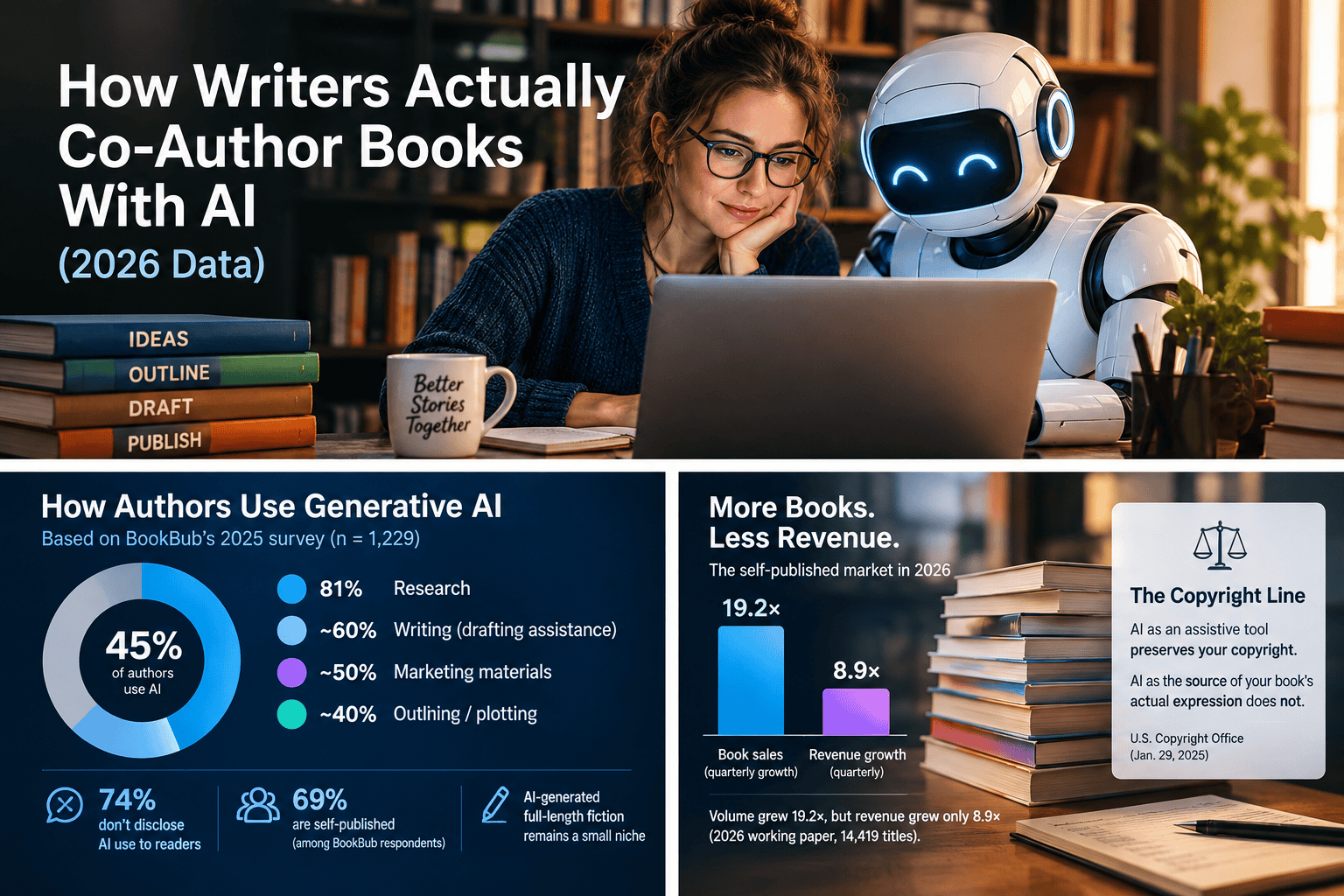
- 45% of surveyed authors report using generative AI somewhere in their process — but that figure describes an indie-skewed volunteer sample, not authors as a group. ✅ Established
- Within that group, research and marketing dominate (81% and 73%); a slim majority also touch drafting in some form. Fully AI-written fiction stays a minority practice even inside the AI-using cohort. ✅ Established
- A 2026 working paper found the self-published catalog’s quarterly sales-count grew 19.2× while revenue grew only 8.9× between 2023 and mid-2026 — a measured association, not a proven cause. 🟡 Probable
- Copyright law is settled on the principle (assistive AI keeps your copyright; AI-as-sole-author doesn’t) but the hardest edge case — how much prompting is too much — is still before a federal court. ✅ Established
A romance writer with seventeen titles recently did the math in public: her books bring in $500–$750 a month, and roughly $400 of that goes straight back out as Meta and Amazon ad spend — the toll for getting a reader’s thumb to stop on her cover before it stops on someone else’s. Her question, the one that actually matters, isn’t “is AI coming for authors.” It’s “how much of my shrinking margin is AI, and how much is just more people publishing.” For the first time, there’s enough measured data to start separating the two — if you’re willing to sit with the parts that don’t resolve cleanly.
The 45% number — and who it actually describes
In May 2025, book-discovery service BookBub surveyed more than 1,200 authors and found 45% currently use generative AI somewhere in their work, 48% don’t and don’t plan to, and the remaining 7% aren’t using it yet but might (BookBub, “How Authors Are Thinking About AI,” May 2025). That number went viral as “half of authors let a chatbot write their books.” It doesn’t say that — and it isn’t a clean read on “authors” as a category either.
The sample is 69% exclusively self-published, with romance and SFF/horror overrepresented — the segment of the market most exposed to AI tools already, responding to a voluntary survey that likely over-attracted AI-curious authors (ALLi’s coverage of the same data). Two details rarely get reported alongside the headline number:
- Among the 45% who use AI at all, only 30% use it occasionally — 60% describe their use as frequent. This isn’t a population dabbling; it’s a smaller group that has fully integrated the tools.
- 84% of non-users cite ethics, not skill or output quality, as their primary reason for opting out — only about a fifth say it’s because AI doesn’t do a good job.
Within the AI-using group, task breakdown looks like this:
| AI use case | Share of AI-using authors |
|---|---|
| Research | 81% |
| Marketing copy | 73% |
| Outlining / plotting | 72% |
| Editing | 70% |
| (separately) Writing in some form | Majority of this cohort |
| Disclose AI use to readers | 26% (74% do not) |
Source: BookBub, May 2025 (n=1,200+; not mutually exclusive categories).
Compare that with the Authors Guild, whose membership skews traditionally published:
| Survey | Sample | Headline figure | What “AI use” meant |
|---|---|---|---|
| Authors Guild, May 2023 | ~1,700 members, trad-pub-leaning | 23% use gen AI in writing | 47% grammar checks, 29% brainstorming, 26% marketing |
| Authors Guild, Dec. 2023 | ~2,400 members | 87% do not use gen AI | Of the remainder: 33% brainstorming, 26% marketing, 13% structuring drafts |
| BookBub, May 2025 | 1,200+ authors, 69% self-pub only | 45% use gen AI | 81% research; majority of AI-users also touch writing; 74% don’t disclose |
Both survey families are real data from real authors. Neither is a random sample of “all authors,” and eighteen months separated them during a period when the tools themselves changed fast. The honest synthesis: research and marketing delegation are now common and mostly uncontested. Drafting assistance is a real, majority practice inside the AI-using cohort — not inside the author population as a whole. “AI writes the book” remains a minority workflow even where AI is present at all.
Where the line actually sits, legally
The U.S. Copyright Office settled the principle in Copyright and Artificial Intelligence, Part 2: Copyrightability (January 29, 2025): assistive AI use — editing, organizing, refining your own expression — leaves your copyright fully intact. Prompts alone, however many rounds of them, don’t make you the author of what a model generates; only your own expressive input, when it’s perceptible in the final work, is protectable. ✅ Established
Two live cases test the edges of that rule, and they cut in different directions.
The clear edge is closed. In Thaler v. Perlmutter, computer scientist Stephen Thaler sought copyright for an image he said his AI system created autonomously — no prompting, no human editing. The D.C. Circuit affirmed that copyright requires a human author, and on March 2, 2026, the Supreme Court denied certiorari, leaving that ruling standing. Wholly AI-generated work, with no human authorial contribution at all, is settled: it isn’t copyrightable. That question is now closed unless Congress acts.
The hard edge is still open. Artist Jason Allen ran roughly 624 prompt-and-revision rounds through Midjourney for “Théâtre D’opéra Spatial,” was refused registration, and sued in Colorado federal court. In an August 2025 motion for summary judgment, Allen argues the Copyright Office applied the wrong legal standard by treating extensive, iterative prompting as automatically disqualifying — closer, he argues, to a photographer’s repeated takes than to a slot-machine pull. Briefing closed in January 2026, and legal trackers expected a ruling by Q2–Q3 2026 (Romano Law, July 2026; McBrayer’s case tracker). As of this writing, no ruling has been issued. This is the case that actually matters for working authors — it will define how much iterative, directed prompting counts as “your” authorship rather than the AI’s.
Amazon’s KDP layers its own rule on top: disclose AI-generated content (text, images, translations a tool produced); AI-assisted work (your text, AI as editor) needs no disclosure. The title-upload cap that started at three books a day in 2023 has been widely reported as replaced with a higher weekly limit by some publishing-industry trackers — but this article could not independently confirm a current figure against Amazon’s own live help pages, and Amazon has changed this rule with little notice before. Verify against KDP’s documentation directly before planning a launch schedule around any specific number. 🟡 Unconfirmed — verify before relying on it
The dilution problem — measured, not proven causal
A 2026 working paper from researchers at Stony Brook, Columbia Law School, the University of Michigan, and MIT ran full-text AI detection across 14,419 self-published genre-fiction titles on Amazon, matched to daily sales data from 2023 through June 2026 (Chakrabarty, Liu, Ginsburg & Dhillon, arXiv:2607.20349). Between 2023 and mid-2026, the number of books with observed quarterly sales grew 19.2×, while quarterly revenue grew only 8.9× — meaning revenue per selling book fell to roughly 46% of its earlier level. (That per-book ratio is this article’s own calculation from the paper’s reported multiples, not a figure the paper states directly.)
The more interesting finding isn’t about AI books underperforming — it’s about what they’re doing despite underperforming. Titles with more than 25% detected AI text make up about 20% of the sample but earn only 12.1% of sales and 11.3% of revenue, so per-title, AI-flagged books still under-earn their non-AI peers. What’s changing is share and rank: those books are taking a growing slice of total sales over time and occupying more of the scarce top-25 rank positions that used to go to fully human-written books. The effect concentrates in genres with heavier Kindle Unlimited participation, where the sales-share lead non-AI books hold shrinks by about 8.5 percentage points compared with less-KU-heavy genres — a subscription-economics detail that suggests the “read anything, pay once” model may be accelerating the crowding effect.
None of this requires AI books to be good. The paper’s own framing is positional, not qualitative: AI-flagged titles individually sell in small numbers but collectively occupy a growing share of the scarce visibility slots that used to go to human-authored books. That’s a plausible mechanism for why even unchanged, well-reviewed books are getting harder to find. It is still one preprint measuring an association, not an experiment proving AI content caused the decline.
Where this gets shakier than it sounds. The paper’s AI-detection layer almost certainly relies on classifiers in the same family as Pangram or GPTZero, and that category has a real accuracy problem baked in. Independent University of Chicago research found top commercial detectors achieve near-zero false positives on medium-to-long passages under lab conditions (Jabarian & Imas, 2025) — but real-world reporting on the same category of tool documents flagged human work and disputed calls sitting alongside its genuine gains in accuracy. Full-length novels are longer and structurally messier than the short passages most benchmarks test on. Treat the paper’s AI/non-AI split as directionally useful, not as ground truth on any individual book.
What could be wrong here
Three things would move this piece the most if new data arrived.
First, if BookBub or a comparable service surveyed a random cross-section of published authors rather than a self-selected, self-pub-heavy list, the 45% figure could move substantially in either direction — nobody has run that survey yet. Second, “uses AI for writing” is doing a lot of work across every source cited here; it covers everything from fixing a clunky sentence to generating full chapters, and most coverage doesn’t force authors to specify which. Third, the dilution paper’s causal story — AI volume crowding out visibility — is the most plausible read of the numbers, but “plausible” isn’t “proven,” and a single preprint, however well-constructed, shouldn’t be anyone’s whole model of the market.
Three things worth doing with this
- Run AI on your own draft, not instead of one. The Copyright Office protects expressive input you supply — your sentences, your notes, your structural choices — not output a model generated from prompts alone. Thaler just closed the door on the opposite extreme; don’t assume the Allen ruling, whenever it lands, will reopen it.
- Keep a dated record: prompts, draft versions, revision history. It’s your evidence if KDP flags a title, if a reader disputes authorship, or if an examiner questions how a work was made — and it’s the exact kind of documentation the Copyright Office’s own framework treats as relevant.
- Decide your disclosure stance on purpose. Amazon’s disclosure runs to Amazon, not to readers — there’s no public badge on the product page. With 74% of AI-using authors already not disclosing to readers, silence is the default. Make it a choice, not an accident.
FAQ
Does using AI for editing risk my copyright? No. The Copyright Office’s 2025 framework is explicit that assistive use — editing, organizing, refining your own expression — leaves your copyright intact.
Do I have to tell readers I used AI? No platform requires that. Amazon’s KDP disclosure goes to Amazon internally and isn’t shown on the product page; reader-facing disclosure is entirely your call.
Is the “three books a day” KDP limit still true? The original three-per-day cap was confirmed by Amazon in September 2023. Some publishing trackers report it has since been replaced with a higher weekly limit, but this wasn’t independently verified against Amazon’s own current documentation for this piece — check KDP’s live help pages before relying on any specific number.
Can AI-detection tools reliably prove a book was AI-written? Not with certainty. The best commercial detectors test very well on controlled, medium-length passages, but real-world false positives and adversarial evasion on full-length manuscripts are documented and unresolved.
Has a court ruled on AI and copyright ownership yet? Partly. The Supreme Court closed the easy question in March 2026 (Thaler v. Perlmutter): work with zero human authorial contribution isn’t copyrightable. The harder question — how much iterative human prompting is enough — was still awaiting a ruling in Allen v. Perlmutter as of September 2026.
Sources
- BookBub, “How Authors Are Thinking About AI”, May 2025
- Alliance of Independent Authors, coverage of the BookBub survey
- U.S. Copyright Office, Copyright and Artificial Intelligence, Part 2: Copyrightability, January 2025
- SCOTUSblog, Thaler v. Perlmutter case file
- Romano Law, coverage of Allen v. Perlmutter, July 2026
- Chakrabarty, Liu, Ginsburg & Dhillon, “Generative AI floods and dilutes the market for books,” arXiv:2607.20349, July 2026
- Jabarian & Imas, Becker Friedman Institute working paper on AI-text detection accuracy, 2025
How this was verified: BookBub’s May 2025 figures (1,200+ respondents, 69% exclusively self-published, the 81/73/72/70% task breakdown, the 30%/60% occasional-vs-frequent split, the 74% non-disclosure rate) were checked directly against BookBub’s own published survey report. The dilution-study numbers — 19.2× growth in selling titles against 8.9× growth in revenue, and the 20%/12.1%/11.3% AI-flagged sample/sales/revenue split — are drawn directly from the Chakrabarty, Liu, Ginsburg & Dhillon working paper; the 46% revenue-per-book figure is this article’s own division of the paper’s two multiples, not a number the paper states outright. Thaler v. Perlmutter‘s certiorari denial and Allen v. Perlmutter‘s pending status were confirmed against SCOTUSblog’s docket and law-firm case trackers current to mid-2026. Two figures were not independently re-verified for this update: the two Authors Guild survey results (23% and 87%), carried over from prior reporting, and Amazon’s current KDP weekly title cap, sourced to third-party trackers rather than Amazon’s own documentation — both are flagged in the text above rather than presented as confirmed.
The 45% headline was never the lie. The lie was treating one indie-skewed survey as a census of an entire profession.