Compliance Research Desk · Last verified September 11, 2026 · 13 min read
Editorial note on method: Every case, statute, and figure below is checked against a primary source or first-tier legal reporting — court dockets and law-firm client alerts for the litigation, the Council of the EU and the Official Journal for the Omnibus timeline, the Colorado Attorney General’s own filings for the rulemaking. This is editorial analysis, not legal advice; confirm any deadline below with counsel licensed in your jurisdiction. In the interest of the candor this piece argues for: an earlier draft had one EU transposition date wrong in a table cell and the national-sandbox deadline wrong in two places. Both are corrected below, and the correction is left visible rather than quietly fixed — because a compliance piece about verification discipline that ships an unverified date would be the whole argument in Section 4, proven against itself.
TL;DR
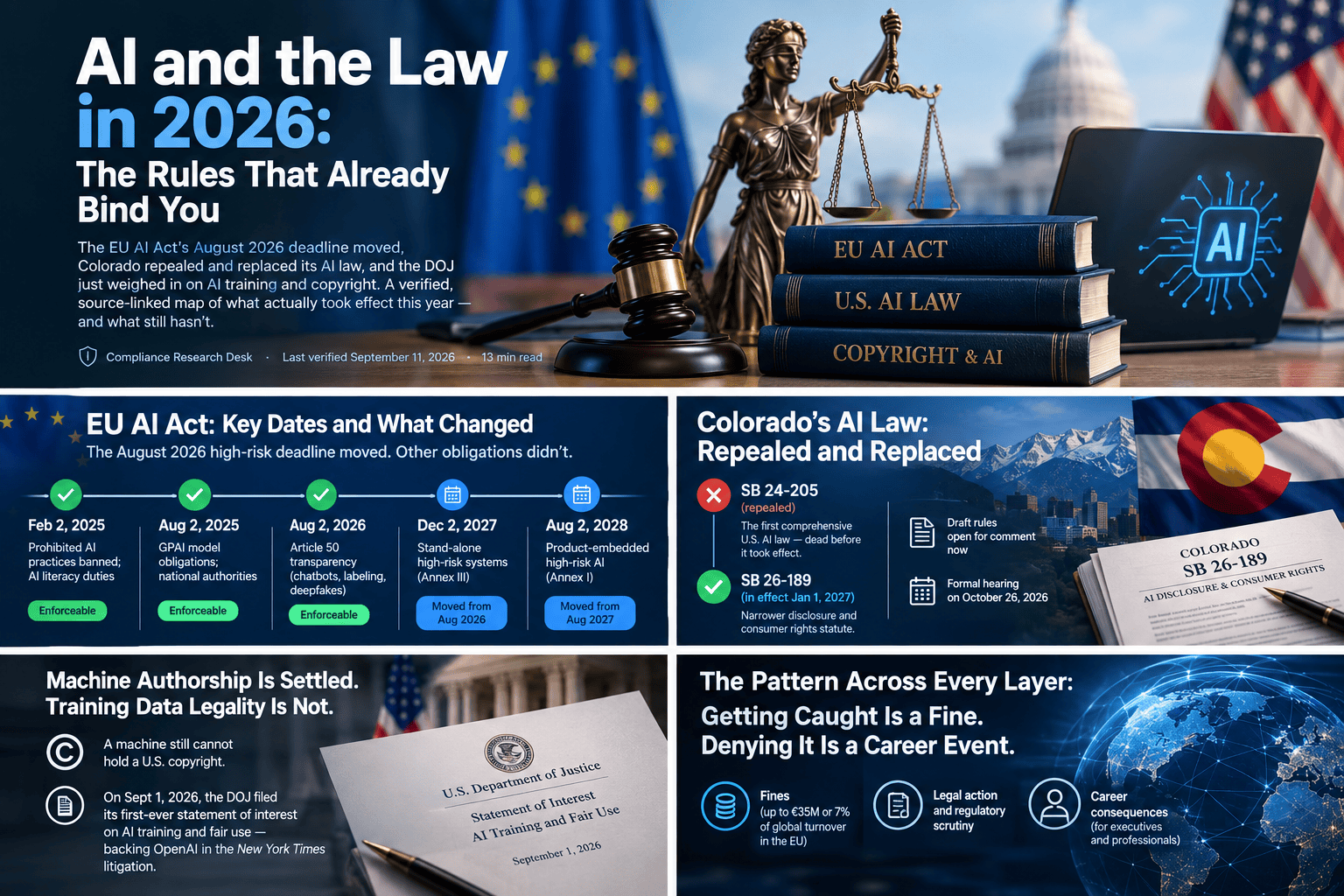
- The EU’s August 2, 2026 high-risk deadline is gone. The Digital Omnibus (in force since July 27, 2026) pushed stand-alone high-risk systems to December 2, 2027 and product-embedded high-risk AI to August 2, 2028. Prohibited-practices bans, GPAI obligations, and Article 50 transparency duties were not delayed and are enforceable now, with fines up to €35 million or 7% of global turnover unchanged.
- Colorado repealed the first comprehensive U.S. AI law before it ever took effect. SB 24-205 is dead. Its replacement, SB 26-189, is a narrower disclosure-and-consumer-rights statute effective January 1, 2027, with draft implementing rules open for comment now and a formal hearing on October 26, 2026.
- Machine authorship is settled; training-data legality is not. A machine still cannot hold a U.S. copyright. But on September 1, 2026, the Justice Department filed its first-ever statement of interest on AI training and fair use — backing OpenAI in the consolidated New York Times litigation. That’s an argument, not a ruling.
- AI-hallucinated citations have produced roughly 2,000 documented court decisions worldwide, up from about 200 eighteen months ago, with penalties now reaching six figures and, twice, a suspension from practicing law.
- The pattern across every layer: getting caught is a fine. Denying it is a career event.
1. The EU AI Act: what moved, what didn’t, and what still costs 7% of turnover
The single most common factual error in AI compliance content right now is “the EU AI Act high-risk deadline is August 2, 2026.” That was true until mid-2026. It no longer is — and the second most common error is assuming the whole Act moved with it. It didn’t.
Here’s the corrected timeline, after the Council of the EU’s final approval on June 29, 2026, and the Digital Omnibus’s entry into force on July 27, 2026:
| Date | Obligation | Status |
|---|---|---|
| Feb 2, 2025 | Prohibited AI practices banned; AI literacy duties | Enforceable |
| Aug 2, 2025 | GPAI model obligations; national authorities designated | Enforceable |
| Aug 2, 2026 | Article 50 transparency (chatbot disclosure, AI-content labeling, deepfake marking) | Enforceable — not delayed |
| Dec 2, 2026 | Grace period ends for AI-content watermarking on systems deployed before Aug 2026 | Narrow grace period |
| Dec 9, 2026 | Transposition deadline, revised Product Liability Directive (see §5) | Approaching |
| Aug 2, 2027 | Deadline for each member state to have a national AI regulatory sandbox operational | Moved from Aug 2026 |
| Dec 2, 2027 | Annex III stand-alone high-risk systems | Moved from Aug 2026 |
| Aug 2, 2028 | Annex I product-embedded high-risk AI (medical devices, machinery) | Moved from Aug 2027 |
The reprieve is narrower than the headlines suggest. Article 50 — telling users they’re interacting with an AI system, labeling synthetic content, disclosing emotion-recognition systems — stayed on its original date. Only the watermarking specification for already-deployed generative systems got a grace period, to December 2, 2026. And the sandbox deadline is its own line item: member states now have until August 2, 2027 — not December 2027, a mistake even specialist trackers have made — to stand up a national AI regulatory sandbox, which matters if a system stuck in classification limbo depends on one existing yet.
The penalty ceiling didn’t move at all. Prohibited practices still carry fines up to €35 million or 7% of global annual turnover — deliberately set above GDPR’s 4% maximum. Vendor estimates put large-enterprise AI Act compliance costs at $8–15 million, with third-party conformity assessment running $50,000-plus per system; treat that as an industry estimate, not an official figure, since no regulator has published one.
Why give ground now, after defending the original timeline for two years? The Omnibus reflects a trade: the EU chose market competitiveness over regulatory sequencing, replacing the Commission’s originally proposed conditional delay trigger with fixed dates. Teams that paused compliance work in mid-2026 assuming the delay covered everything are now rebuilding against a December 2027 date — while the Article 50 obligations they filed under “2027” actually applied from August 2026.
2. Colorado: how the first U.S. comprehensive AI law died, then grew a rulebook anyway
If the EU story is “deadlines moved,” the U.S. story is “the model itself collapsed — and a new one started drafting its own rules within months.”
Colorado’s SB 24-205, signed May 17, 2024, was the first comprehensive U.S. state AI law: a risk-based regime of impact assessments, risk-management programs, and a duty of reasonable care against algorithmic discrimination in “consequential decisions.” It never took effect.
- August 28, 2025 — effective date delayed from February 1, 2026 to June 30, 2026 after compromise negotiations collapsed.
- April 9, 2026 — xAI sued to block the law on constitutional grounds. On April 24, the DOJ intervened in support — the federal government’s first move against a state AI law, under a December 2025 executive order directing the Attorney General to challenge state AI regulation inconsistent with a “minimally burdensome” federal approach.
- April 27, 2026 — a federal magistrate judge stayed enforcement; the Colorado AG agreed not to enforce SB 24-205 or any replacement until 14 days after a ruling on xAI’s forthcoming preliminary-injunction motion.
- May 14, 2026 — Governor Polis signed SB 26-189 (Senate 34–1, House 57–6), repealing and replacing the law effective January 1, 2027.
What died with SB 24-205: the duty of reasonable care, mandatory impact assessments, risk-management programs, annual AG reporting. What arrived with SB 26-189 is worth understanding precisely, because other states are now copying it:
- Developer documentation as a statutory baseline. Developers of ADMT that “materially influences” a consequential decision must give deployers documentation covering intended uses, training-data categories, known limitations, and instructions for human review; notify deployers of material updates; retain records for three years. Most vendors aren’t providing this today — put it in contracts now, not at renewal.
- Deployer transparency. Clear pre-use notice, plus a plain-language post-adverse-outcome disclosure within 30 days.
- Consumer rights. Correction of inaccurate personal data used in the decision, plus meaningful human review “to the extent commercially reasonable” — two separate entitlements, each needing its own operational process.
- Enforcement architecture. AG-only, under the Consumer Protection Act, with a 60-day cure period (sunsetting January 1, 2030) and no private right of action. One clause deserves more attention than it gets: any contract term indemnifying a party against liability for its own discriminatory use of ADMT is void as against public policy.
Rulemaking is no longer theoretical. On August 11, 2026, the Colorado Department of Law filed the joint ADMT and Chatbot Safety draft rules, covering how “materially influences,” post-adverse-outcome disclosures, and “meaningful human review” will be defined. Comments submitted by September 4 feed a revised draft expected by September 23; the formal hearing is October 26, 2026 at the Ralph L. Carr Judicial Center in Denver. The AG has said he doesn’t intend to enforce until rulemaking concludes — and the January 1, 2027 effective date still sits downstream of both that rulemaking and the stay in xAI’s litigation.
The same rulemaking package implements a second statute: the Chatbot Safety Act (HB 26-1263, signed May 29, 2026), which layers duties onto operators of public conversational AI — persistent AI-disclosure repeated at least every three hours for minors, commercially reasonable age estimation, blocks on sexually explicit content and simulated emotional dependence for minors, suicide and self-harm response protocols, a ban on presenting chatbot output as equivalent to licensed professional services, and annual reporting to the AG. A business that both uses AI in consequential decisions and runs a public chatbot has both duty sets landing on the same date — a reason to build one governance program, not two.
Multi-state employers lose the most in this patchwork. Illinois requires AI-disclosure to employees from January 1, 2026; California agencies have layered automated-decision rules onto existing civil-rights and privacy frameworks; Colorado’s rewrite is disclosure-based and still being defined by rule. Four states, four architectures, no preemption in sight.
3. Copyright: authorship is settled; training data just got its most consequential new data point
On March 18, 2025, the D.C. Circuit decided the one AI-copyright question with a clean answer: a machine cannot be an author. In Thaler v. Perlmutter, 130 F.4th 1039 (D.C. Cir. 2025), the court held that the Copyright Act’s provisions on ownership, duration, and joint authorship all presuppose a human being. The Supreme Court denied certiorari on March 2, 2026 (No. 25-449), leaving the ruling in place.
That ruling is narrower than it sounds. Thaler listed his “Creativity Machine” as the sole author and disclaimed any human creative input, so the courts never addressed how much human involvement is enough. The Copyright Office’s January 2025 report staked an early position — prompts alone are unprotectable ideas, insufficient for registration — and the live test of where the line sits is Allen v. Perlmutter, No. 1:24-cv-2665 (D. Colo.), where an artist entered more than 600 iterative Midjourney prompts and refined the output in Photoshop, and still faced registration denial.
The practical consequences most teams miss:
- Pure AI output is uncopyrightable in the U.S. If a product generates content customers expect to own — code, images, marketing copy — the default is no copyright protection, which pushes the value into trade secret and contract law instead.
- Disclosure duties attach at registration. The Copyright Office requires applicants to disclose AI-generated material; failing to do so risks invalidating the registration.
- Training-data litigation just moved. The New York Times Co. v. Microsoft & OpenAI (filed December 2023) has been consolidated with related publisher and author claims before Judge Sidney Stein in the Southern District of New York as In re: OpenAI, Inc. Copyright Infringement Litigation. On September 1, 2026, the Justice Department filed a statement of interest backing OpenAI’s position that training on the Times‘ journalism is fair use — the first time the federal government has taken a formal position on that exact question. A statement of interest binds no one — Judge Stein isn’t obliged to give it weight, though practitioners expect courts to take it seriously — and no appellate court has ruled on the core question. More than 100 AI-copyright cases are currently pending against AI companies, per the running tally kept by Santa Clara Law professor Edward Lee.
Don’t let a vendor slide deck convert “the government argues training is fair use” into “training is legal.” Arguments aren’t verdicts. The Copyright Office’s 2025 report drew a narrower line — training can be fair use in some circumstances while market-substitutive outputs may not be — and the DOJ’s filing pulls federal policy toward the industry’s reading without resolving anything.
4. The hallucination sanctions economy: from a $5,000 cautionary tale to bar discipline
The legal profession’s most reproducible AI failure mode is embarrassingly simple: a language model generates a citation that looks like a citation — reporter, page number, plausible quote — because it’s a next-token predictor trained on millions of real citations, not a retrieval engine. It doesn’t search a database. It produces strings statistically shaped like case law.
In June 2023, that mechanism produced Mata v. Avianca: six invented cases, a $5,000 Rule 11 sanction, and — more damaging — a public opinion and mandatory notification letters. The sanction wasn’t for using ChatGPT; it was for standing behind citations the lawyers had never read, even after opposing counsel flagged them.
Three years later, the scale looks nothing like “isolated incident.” Researcher Damien Charlotin’s public database — which only counts cases where a court explicitly found, or clearly implied, reliance on hallucinated material — has logged roughly 2,000 decisions worldwide as of early September 2026, climbing by roughly five to eight new entries a day. Because the database only records what courts caught and wrote up, treat the number as a floor, not a ceiling.
| Checkpoint | Cases |
|---|---|
| Mid-2025 | ~200 |
| January 2026 | 719 |
| Early April 2026 | 1,227 (811 in the U.S.) |
| May 2026 | ~1,490 |
| June 9, 2026 | 1,598 |
| Early September 2026 | ~2,000 (extrapolated) |
Sanctions have escalated on their own curve, from four figures to six:
- Whiting v. City of Athens (6th Cir., March 13, 2026): more than two dozen fake citations and record misrepresentations across three consolidated appeals; $15,000 per attorney, joint-and-several liability for the city’s full appellate fees, double costs, and a disciplinary referral. The panel’s rule is now the standard: no filing should contain a citation the signing lawyer hasn’t personally read and verified — regardless of where it came from.
- Couvrette v. Wisnovsky (D. Ore.): the current single-matter record — roughly $109,700 in combined sanctions and fees, arising from 15 fabricated citations and 8 fake quotations across three briefs in a family winery dispute. The case was dismissed with prejudice.
- Withers v. City of Aberdeen (N.D. Miss., June 8, 2026): the case that breaks the “careless solo” narrative — filings from both sides contained fabricated citations, the judge canceled the trial, revoked two pro hac vice admissions, and suspended the two lead attorneys from the district for two years.
- Nebraska (April 16, 2026): the interim suspension of Omaha attorney Greg Lake after 57 of 63 citations in one appellate brief proved defective — roughly 20 outright hallucinations — and after Lake initially denied using AI when a justice asked him directly at oral argument. Two days before the suspension order, he filed an affidavit admitting the AI use and calling his earlier denial a “grave error of judgment.” A court-appointed referee will recommend a final sanction, which is not yet decided and could land shorter or longer than the interim suspension.
The regulatory backbone is ABA Formal Opinion 512 (July 29, 2024): lawyers using generative AI retain their duties of competence, candor, and confidentiality, and verification cannot be delegated to the tool. Read the 2026 cases against that framework and a pattern emerges worth internalizing: the hallucination itself still gets you fined; the denial gets you suspended. Lake’s suspension turned on the candor rule, not the competence rule. Correct fast and own it, and a first-time mistake stays in the sanctions lane; deny it, and it becomes a discipline matter that can follow a lawyer into every jurisdiction where they’re admitted.
Here’s the rule that survives every jurisdiction: every AI-assisted legal output stays a draft until it’s verified against a primary source. Retrieval-augmented tools with database-backed citations reduce this failure mode but don’t eliminate it — Stanford RegLab testing found purpose-built legal AI tools still hallucinate citations 17–33% of the time, versus 58–88% for general-purpose models. Lower, not zero. Any vendor pitching a legal-AI tool on a hallucination rate under 5% right now is either measuring on easy questions or hasn’t been tested against a hostile bar yet.
5. Liability: the presumption is quietly moving against you
Two structural shifts matter more than any single statute.
The EU killed its AI-specific liability bill and doubled down on the general one. Brussels floated a bespoke AI Liability Directive alongside the AI Act back in September 2022, then formally withdrew it in 2025 after member states couldn’t agree on a text. That leaves the revised Product Liability Directive (2024/2853) as the only EU-level liability instrument built for AI. Adopted in late 2024 and requiring transposition by December 9, 2026, it brings software and AI systems within product liability, extends standing to corrupted data and cybersecurity failures, and creates a presumption of defectiveness where a product fails to comply with safety requirements, or where the claimant faces excessive difficulty proving defect or causation. The claimant’s burden of proof drops precisely where AI opacity used to be the vendor’s best defense — claimants don’t get the withdrawn AILD’s bespoke disclosure tools, they get the PLD’s general presumptions instead, which is real litigation leverage, just not the one everyone expected two years ago.
Then there’s the explanation-rights stack: GDPR Article 22 restricts solely automated decisions with legal or significant effect; the EU AI Act layers a right to meaningful explanation (Art. 86) for high-risk-system decisions, plus a fundamental-rights impact assessment duty for deployers in certain contexts. These apply concurrently — violating both doesn’t double the fine, but it doubles the enforcement surface, since data protection authorities and market surveillance authorities are different agencies with different agendas.
Here’s a tradeoff worth pushing back on: over-indexing on novel-statute litigation risk misprices actual exposure. The most common real-world AI legal loss in 2024–2026 wasn’t a new AI statute or a product-liability verdict — it was ordinary contract, employment, and consumer-protection law applied to an AI system that made a provably bad decision at scale. A biased résumé-screening tool produces a Title VII pattern long before anyone invokes an AI-specific statute. Colorado’s voided-indemnity clause shows the same thing from the other direction — legislatures are second-guessing ordinary contract risk allocation specifically because AI is involved.
6. The compliance stack that survives all three layers
One disambiguation before the framework: the three enforcement layers above — EU, U.S. states, litigation — are what reaches an organization from outside. What follows is a different use of “layer”: the four-part program built in response. Worth not conflating the two.
Layer 1 — Inventory & classification (foundational; do this first, but not only)
Register every system, map to AI Act risk tiers. Enforceable now: Art. 5, Art. 50. Future: Annex III, December 2027.
Layer 2 — Data & documentation governance
Training-data quality, technical documentation, logging. GDPR Art. 22 screening, fundamental-rights impact assessment.
Layer 3 — Human oversight & explainability
Oversight by design, override capability, Art. 86 explanation right. The cheapest fix on this entire page, with zero lead time: verify every AI-assisted citation (ABA Op. 512).
Layer 4 — Incident, liability & litigation readiness
Serious-incident reporting, post-market monitoring, defect documentation. Output-ownership strategy: contract and trade secret where copyright is unavailable.
The ordering is deliberate but easy to misread. Layer 1 sits at the base because everything above depends on it — nothing can be classified that hasn’t been inventoried. But “lowest in the stack” isn’t the same instruction as “do this last”: Layer 3’s citation-verification fix is the cheapest item on this entire page and has zero lead time, so it shouldn’t wait for the layers below it to finish. Programs that sequenced “high-risk compliance first” spent 2025 building for an August 2026 date that moved; programs that sequenced “inventory and verification first” were already compliant with what actually took effect.
Two failure modes to design around. First, the inventory layer rots: shadow AI — employees pasting client data into consumer chatbots — rarely shows up in a registry built from procurement records alone, which systematically undercounts exposure from the systems most likely to trigger an Art. 50 violation or a confidentiality breach. Pair procurement data with network-level discovery and a written, enforced acceptable-use policy, and audit quarterly rather than annually. Second, the contract layer is newer and less obvious: Colorado’s anti-indemnification provision means a vendor contract signed in 2024 may allocate AI risk in a way a statute now voids. Contracts are part of the compliance stack in 2026, not paper that sits beside it.
7. The 90-day version
If starting from a blank page or a stale roadmap, work roughly in this order:
- Re-baseline the EU timeline against the Digital Omnibus: Annex III to December 2, 2027; Annex I to August 2, 2028; national sandboxes to August 2, 2027; Article 50 already in force. Any deck still citing August 2026 for high-risk systems is outdated.
- Close the Article 50 gap this quarter. Chatbot disclosure, synthetic-content labeling, and deepfake marking apply now, and the watermarking grace period for deployed systems expires December 2, 2026. This is the cheapest enforceable obligation on the board.
- Stand up the legal-output verification protocol before buying anything. It needs a policy and a checklist, not a platform. Write a one-line verification attestation into matter files — in a disciplinary proceeding, that timestamped log is among the strongest mitigation a lawyer can produce.
- Treat U.S. state tracking as a quarterly obligation, not a project. Colorado’s revised draft circulates by September 23 and the formal hearing is October 26, 2026. California and Illinois are moving on independent tracks. Assign one owner.
- Re-paper output ownership and vendor contracts. Where AI generates content a business expects to protect, rely on contract and trade-secret controls; assume U.S. copyright is unavailable for purely machine-generated output. Audit AI vendor agreements for the indemnity provisions Colorado now voids, before renewal closes the window.
- Design for the candor rule, not just the competence rule. The 2026 pattern is unambiguous: correction and disclosure stay in the sanctions lane; denial escalates to the license. An incident protocol should say so explicitly.
If the primary approach stalls, an AI regulatory sandbox is a legitimate path for a system stuck between classification ambiguity and compliance cost — but the Omnibus pushed the member-state sandbox deadline to August 2, 2027, so in most member states this isn’t a lever that can be pulled yet. A sandbox entry is a pilot, not a rollout; design the exit conditions before entering.
Frequently asked questions
Is the EU AI Act’s high-risk deadline still August 2, 2026?
No. The Digital Omnibus — in force since July 27, 2026 — pushed stand-alone high-risk systems (Annex III) to December 2, 2027, and product-embedded high-risk AI (Annex I) to August 2, 2028. Article 50 transparency duties, GPAI obligations, and the prohibited-practices ban were unaffected and remain enforceable now.
Did Colorado repeal its AI law?
Yes. SB 24-205, the original Colorado AI Act, was repealed and replaced by SB 26-189 (signed May 14, 2026) before its delayed effective date ever arrived. The replacement is built around ADMT disclosures and consumer rights rather than mandatory risk management, takes effect January 1, 2027, and is enforced exclusively by the Attorney General with a 60-day cure period and no private right of action.
Can you copyright something an AI generated?
Not on its own. Thaler v. Perlmutter (cert. denied March 2026) confirms U.S. copyright requires a human author. Content with substantial human creative control — editing, selection, arrangement — may still qualify for the human-authored elements; exactly where that line sits is what Allen v. Perlmutter is now litigating.
Is it illegal to train AI on copyrighted material?
Unresolved. The U.S. Copyright Office’s 2025 report suggested some training could be fair use while market-substitutive outputs might not be; on September 1, 2026, the DOJ filed a statement of interest in the consolidated In re: OpenAI litigation arguing training itself is fair use — the federal government’s first formal position. No appellate court has ruled on the core question, and a statement of interest binds no one.
What happens if a lawyer cites an AI-hallucinated case in court?
Consequences now range from four-figure fines to $15,000-per-attorney appellate sanctions, a roughly $109,700 record penalty, two-year court suspensions, and interim bar suspension. Courts increasingly treat “the AI made it up” as aggravating, not mitigating — and the 2026 pattern is that the denial, not the hallucination, is what converts a fine into a license consequence. Verification is the lawyer’s non-delegable duty under ABA Formal Opinion 512.
“The hallucination gets you fined. The denial gets you suspended. Plan your incident response around the second sentence, not the first.”
Sources & methodology
This piece draws on primary legal texts — court dockets, EUR-Lex, the Council of the EU, the Colorado Attorney General’s rulemaking page, LegiScan’s vote record for SB 26-189 — and reporting from outlets and firms including Norton Rose Fulbright, Crowell & Moring, Davis Polk, Reed Smith, Nixon Peabody, Gibson Dunn, DLA Piper, Mayer Brown, SCOTUSblog, Bloomberg Law, and Bird & Bird. Where a figure comes from a single industry estimate rather than an official one — the $8–15M EU compliance-cost range, for instance — that’s flagged in the text rather than presented as settled fact.
Primary and near-primary sources: Council of the EU (Omnibus agreement) · European Commission (AI Omnibus entry into force) · EUR-Lex, Directive (EU) 2024/2853 · SCOTUSblog, Thaler v. Perlmutter docket · Colorado Attorney General, ADMT & Chatbot Safety rulemaking (coag.gov/ai) · Colorado General Assembly, SB26-189 vote record · Damien Charlotin, AI Hallucination Cases Database
Reporting relied on: Crowell & Moring and Finnegan on SB 26-189 passage · Davis Polk and Byte Back on the August 2026 Colorado draft rules · Mayer Brown on cert denied in Thaler · multi-outlet coverage of the September 1, 2026 DOJ statement of interest · Gibson Dunn on the Omnibus sandbox deadline · Bird & Bird on the withdrawn AI Liability Directive · Norton Rose Fulbright, Reminger, and Okin Adams on Whiting v. City of Athens · Bloomberg Law and the District of Oregon docket on Couvrette v. Wisnovsky · Bloomberg Law and FindLaw on Withers v. City of Aberdeen · WOWT and Nebraska Public Media on the Greg Lake suspension
Where this will go stale first: Colorado’s ADMT/Chatbot rules are still drafts — the September 23 revised draft and the October 26 hearing could change specifics before January 1, 2027, and xAI’s preliminary-injunction motion could move the date itself. Allen v. Perlmutter and In re: OpenAI both remain undecided; either ruling would move Sections 3 and 5. The Nebraska referee’s final recommendation hasn’t been issued. The Charlotin hallucination count updates daily at the source above — check it before quoting the ~2,000 figure as current.
Last verified September 11, 2026. No vendor named in this piece paid for placement or review.